Asia · Politics
Thailand Pivots Closer to China as US Diplomatic Engagement Wanes
Bangkok's response to the Cambodia border conflict signals a broader recalibration of regional alliances across Southeast Asia
KEY TAKEAWAYS
- ·Thailand has shifted closer to China following renewed Cambodia border fighting, with Beijing assuming the lead mediation role after a US-attended peace accord failed to prevent renewed violence.
- ·China accounts for 13 percent of Thai exports and maintains regular military-to-military coordination with Bangkok, creating dependencies that shape Thai foreign policy choices.
- ·The shift reflects broader Southeast Asian perceptions of inconsistent American engagement versus persistent Chinese involvement in regional security and infrastructure matters.
A Shift in Bangkok's Strategic Calculus
Thailand's diplomatic center of gravity is moving eastward. What began as subtle hedging between Washington and Beijing has evolved into a more pronounced tilt toward China, driven by what Thai officials perceive as inconsistent American engagement in Southeast Asian affairs.
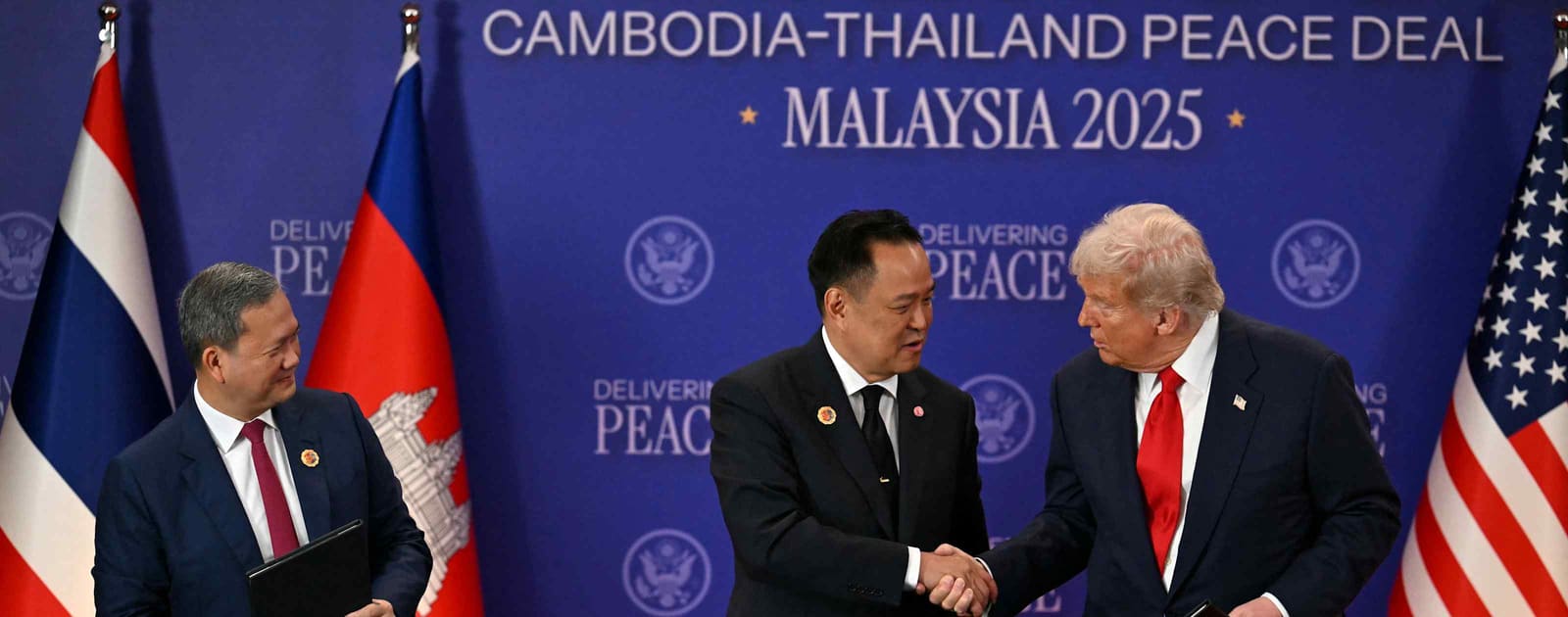
The shift became visible during the recent Cambodia border dispute. When fighting erupted months after a peace accord ceremony attended by Prime Minister Anutin Charnvirakul, Thai officials turned not to traditional security partners but to Beijing for mediation. China quickly assumed the lead role in de-escalating tensions, a position Washington once occupied by default.
The October 2025 peace ceremony in Malaysia, which brought together Anutin, US President Donald Trump, and Cambodian Prime Minister Hun Manet, was supposed to cement American involvement in regional stability. Instead, the renewed violence exposed the limits of episodic diplomatic appearances. Thai policymakers drew their own conclusions about reliability.
Beijing's Expanding Regional Footprint
China has methodically built the infrastructure for influence across mainland Southeast Asia. While American diplomatic presence has become sporadic, Chinese engagement operates on multiple tracks simultaneously: infrastructure financing through the Belt and Road Initiative, military-to-military exchanges, and crucially, a willingness to involve itself in territorial disputes that Washington prefers to avoid.
Thailand's military establishment, which holds significant sway over foreign policy regardless of civilian government composition, has noted this contrast. Chinese defense officials maintain regular contact with their Thai counterparts, discussing everything from joint exercises to equipment procurement. The relationship has deepened beyond transactional arms sales into strategic coordination.
Economic ties reinforce the diplomatic shift. China remains Thailand's largest trading partner, accounting for roughly 13 percent of Thai exports. Chinese tourists, once the backbone of Thailand's tourism recovery, represent a constituency Bangkok cannot afford to alienate. Investment flows from Chinese state-owned enterprises into Thai infrastructure projects create dependencies that shape policy choices.
The ASEAN Regional Forum Context
The annual ASEAN Regional Forum, which convenes 27 countries and territories each July, has become a barometer for these shifting alignments. The forum represents Asia's most established venue for multilateral security dialogue, yet its effectiveness depends on consistent great-power engagement.
Recent forums have revealed a pattern: American participation has become less predictable, while Chinese foreign ministry officials arrive with concrete proposals and follow-through mechanisms. Southeast Asian diplomats notice which powers show up prepared and which treat the forum as a photo opportunity.
Thailand's evolving position reflects a broader recalibration across ASEAN member states. Vietnam, Singapore, and Indonesia each navigate US-China competition differently, but all share a common calculation about reliability. When security crises emerge, the power that responds first and most substantively gains influence.
Implications for Regional Architecture
The Thai case matters because Bangkok has historically balanced between major powers with considerable skill. Thailand avoided colonization in the 19th century through careful diplomacy, maintained independence during the Cold War despite hosting US military bases, and emerged from the 1997 Asian financial crisis by diversifying partnerships.
If a country with Thailand's diplomatic tradition concludes that its interests lie closer to Beijing, it signals something fundamental about regional perceptions of American commitment. The shift is not ideological; Thai elites harbor no particular affection for Chinese governance models. It is pragmatic, driven by assessments of who will be present when decisions matter.
Other Southeast Asian capitals are watching. Malaysia's recent defense agreements, the Philippines' delicate recalibration despite territorial disputes in the South China Sea, and Myanmar's deepening isolation all occur within this context of perceived American disengagement and Chinese persistence.
What Comes Next
The trajectory is not irreversible, but reversing it requires more than summit declarations. Thai officials, speaking privately, emphasize that they prefer balanced relationships with both Washington and Beijing. However, balance requires both sides to show up.
The next test will likely come during the next round of infrastructure negotiations. Thailand needs significant investment in transport corridors, port facilities, and digital infrastructure. If Chinese financing arrives with clear terms while American alternatives remain vague, the pattern will continue.
For investors and businesses operating across Southeast Asia, these diplomatic shifts translate into regulatory environments increasingly shaped by Chinese standards and preferences. Supply chain decisions, technology partnerships, and market access strategies all must account for Bangkok's recalibrated foreign policy.
The Cambodia mediation may have been a single episode, but it crystallized a trend years in the making. Thailand's move toward China reflects not sudden conversion but accumulated disappointment with alternative options. In the calculus of Southeast Asian realpolitik, presence matters more than historical partnership.
RELATED STORIES

Thailand Urged to Tie EV Investment to Local Supply Chain Development
Priyanka V. Rao · 3 min

Five ASEAN Members Back Regional Oil Stockpile as Study Nears Completion
Tran Quoc Bao · 3 min

Mitsubishi Motors Brings Back Pajero SUV With Thailand Launch
Cheng Wei-Lun · 3 min
Thailand and New Zealand Set $8 Billion Trade Target Under New Partnership
Priyanka V. Rao · 3 min
Spot something wrong? Email editor@briefasia.com. We log every correction publicly.