Sustainability · Mobility
Thailand Deploys Emergency Funds to Replace Diesel Buses With EVs
Finance Ministry taps 200 billion baht energy transition tranche to accelerate public transport electrification across intercity routes, taxis, and vans
KEY TAKEAWAYS
- ·Thailand's Finance Ministry is using a 200 billion baht emergency borrowing tranche to subsidize the replacement of combustion-engine buses, taxis, and vans with electric vehicles, targeting high-passenger-volume segments.
- ·Operators must permanently retire and de-register existing gasoline vehicles, with all borrowed funds required to be deployed by September 2027 under a screening committee's oversight.
- ·The program runs parallel to the existing EV3.5 consumer subsidy of 50,000 baht per vehicle and includes support for B20 biodiesel to hedge against EV supply chain and infrastructure delays.
Emergency Decree Unlocks Capital for Transport Overhaul
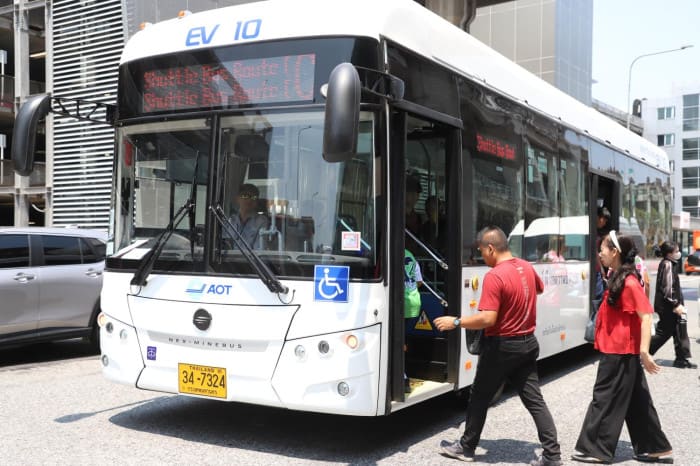
Thailand's Finance Ministry is channeling funds from a 400 billion baht emergency borrowing decree into subsidies that will replace internal combustion engine public service vehicles with battery-electric alternatives. The initiative prioritizes intercity buses, taxis, and public vans, segments that move the highest passenger volumes across the country's road network.
Finance Minister Ekniti Nitithanprapas confirmed the ministry will also back vehicles running on B20 biodiesel, a dual-track approach designed to cut fossil fuel dependency while supporting domestic palm oil farmers through higher crop prices. The energy diversification push follows disruptions to Thai supply chains caused by conflict in the Middle East, which prompted the government to authorize the emergency borrowing package.
The 400 billion baht facility is split evenly. The first 200 billion baht funds the "Thai Chuay Thai Plus" economic relief program. The second tranche underwrites the shift from fossil fuels to clean energy, and it is from this pool that the public transport electrification subsidies will flow.
Scrappage Requirement and Disbursement Timeline
Operators entering the program must permanently retire their existing gasoline-powered vehicles. De-registration from the Department of Land Transport's system will ensure retired units cannot return to service. The Finance Ministry is coordinating with the Transport Ministry to finalize procedural details.
Discussions with the Industry Ministry are ongoing to establish protocols for dismantling retired vehicles. Private companies with expertise in automotive recycling will handle the physical breakdown of scrapped units into parts.
Jindarat Viriyathavikul, director-general of the Public Debt Management Office, said 138 billion baht of the first 200 billion baht tranche has already been disbursed under the co-pay scheme. Another 30 billion baht is scheduled for borrowing within the next one to two months. If that allocation remains unspent, the government may redirect it to clean energy transition projects, provided they align with the decree's objectives.
A screening committee chaired by the finance permanent secretary evaluates project proposals submitted by government agencies. The committee applies strict criteria to ensure consistency with legal mandates and maximum public benefit, according to Jindarat. All borrowed funds must be deployed by September 2027, leaving agencies roughly 13 months to execute approved programs.
Existing EV Incentives Remain in Place
The proposed vehicle scrappage scheme for private cars has not yet moved forward. The EV3.5 support program, which offers a 50,000 baht subsidy per electric vehicle purchased, remains active and serves as the government's primary incentive for individual buyers.
By ring-fencing emergency borrowing for high-utilization public transport, the Finance Ministry is effectively layering a second tier of support on top of consumer incentives. Intercity buses and taxis log significantly higher annual mileage than private vehicles, amplifying both fuel savings and emissions reductions per unit replaced.
Regional Context and Fiscal Pressure
Thailand's move mirrors policy experiments across Southeast Asia, where governments are testing subsidy structures to accelerate fleet electrification without exhausting fiscal capacity. Indonesia has rolled out similar scrappage incentives for two-wheelers, while Malaysia is piloting EV bus deployments in Kuala Lumpur and Penang.
The September 2027 deadline imposes execution risk. Agencies must navigate procurement, operator onboarding, charging infrastructure build-out, and vehicle delivery within a compressed window. Any delays in finalizing protocols with the Transport and Industry ministries could push disbursements into the final quarters of the program, raising the likelihood of unspent allocations.
The inclusion of B20 biodiesel as an eligible fuel under the subsidy framework reflects the political economy of Thai agriculture. Palm oil farmers represent a significant rural constituency, and higher blending mandates create floor prices for domestic crops. Whether operators will opt for biodiesel retrofits over full electrification remains an open question, one that will likely hinge on relative subsidy levels and the availability of charging infrastructure along intercity routes.
Thailand's dual-fuel strategy offers a pragmatic hedge. If EV supply chains tighten or charging build-out lags, biodiesel provides a fallback that still reduces net fossil fuel imports. The trade-off is a longer tail of tailpipe emissions compared to battery-electric fleets, though B20 blends lower particulate matter and carbon intensity relative to pure diesel.
Implementation Challenges Ahead
The screening committee's evaluation process will determine which projects receive funding first. Agencies proposing intercity bus conversions must demonstrate not only vehicle acquisition plans but also depot charging capacity and maintenance ecosystems capable of supporting battery-electric fleets.
Private recycling firms tasked with dismantling retired vehicles will need to scale operations quickly to handle the expected influx. The government has not disclosed whether it will provide working capital or advance payments to these contractors, a detail that could influence the speed of scrappage processing.
The 30 billion baht buffer within the first tranche offers fiscal flexibility, but reallocation requires cabinet approval and alignment with the decree's stated objectives. If uptake of the co-pay scheme undershoots projections, the Finance Ministry will have additional capital to deploy toward public transport electrification, potentially accelerating the transition beyond initial targets.
Thailand's emergency borrowing architecture reflects a broader regional trend: using fiscal headroom created by crisis response mechanisms to fund structural transitions that might otherwise stall in normal budget cycles. The risk is that compressed timelines and multi-agency coordination demands lead to suboptimal execution, leaving funds on the table or vehicles on order but not yet on the road when the September 2027 clock runs out.
RELATED STORIES
Thai Industrialists Flag Water Stress as Data Center Boom Accelerates
Priyanka V. Rao · 2 min
Electric Vehicle Prices Fall Below Hybrids in Global Markets
Cheng Wei-Lun · 5 min

Indonesia Car Sales Jump 34% as Electric Vehicles Reshape Southeast Asia's Auto Market
Siti Nuraini · 3 min
Thailand Raises LPG Subsidy to Shield Households as Fuel Fund Deficit Widens
Priyanka V. Rao · 3 min
Spot something wrong? Email editor@briefasia.com. We log every correction publicly.