Asia · Trade
Thailand Cuts 2026 Auto Output Target as Mideast Conflict Disrupts Exports
Federation of Thai Industries lowers production forecast by 50,000 units after shipping disruptions through Strait of Hormuz hammer vehicle shipments to the region
KEY TAKEAWAYS
- ·Thailand's Federation of Thai Industries cut its 2026 vehicle production target to 1.45 million units, down 50,000 from the original 1.5 million forecast, due to export disruptions.
- ·Thai car exports to the Middle East have plummeted over 38 percent as conflict between Israel, the US, and Iran blocks shipping through the Strait of Hormuz.
- ·Domestic Thai car sales rose 17.3 percent in June, driven by a 140 percent surge in battery EV sales to 22,275 units despite a 33.7 percent drop in ICE vehicle sales.
Target Reduction Amid Shipping Chaos
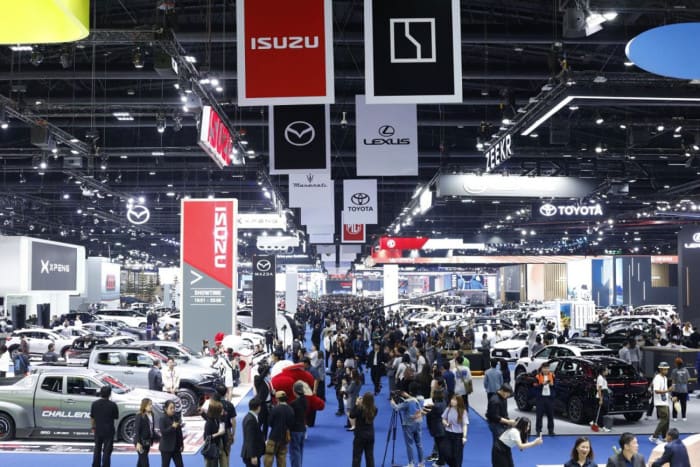
Thailand's automotive sector has pulled back its 2026 manufacturing forecast, citing deepening turmoil in the Middle East that has choked off vehicle shipments through critical trade routes. The Federation of Thai Industries now expects domestic plants to produce 1.45 million vehicles this year, down from an earlier projection of 1.5 million units.
The revision centers entirely on export volumes. The FTI's Automotive Industry Club lowered its overseas shipment target by 50,000 vehicles to 900,000 units, while holding its domestic sales forecast steady at 550,000. The adjustment follows a sharp deterioration in regional security after a brief diplomatic opening collapsed in June.
Surapong Paisitpatanapong, adviser and spokesman for the club, warned that further cuts may follow if hostilities persist. The conflict has severely disrupted passage through the Strait of Hormuz, a chokepoint for energy and goods flowing between Asia and Europe.
Middle East Demand Falls Off a Cliff
Thai car exports to the Middle East have dropped more than 38 percent, according to Surapong. The decline is not a question of demand evaporating but rather an inability to deliver vehicles safely and reliably. Buyers in the region still want the cars; logistics networks simply cannot function under current conditions.
Overall, Thailand shipped 421,144 vehicles overseas in the first half of 2026, down 8.32 percent from the same period a year earlier. The Middle East accounted for a disproportionate share of that decline, underscoring the region's importance to Thai manufacturers who have spent years building distribution and service networks there.
The conflict has also introduced unpredictability into supply chains. Even when shipments can move, transit times have stretched and insurance costs have climbed, eroding margins for exporters who operate on thin spreads in competitive markets.
Compounding Headwinds
The war is not the only force weighing on Thailand's automotive outlook. US tariff policies continue to create friction in key export markets, while Chinese electric vehicle makers are capturing share in regions where Thai producers once dominated with internal combustion engine models.
Regulatory pressures are also mounting. Several countries have tightened carbon dioxide emission standards for new ICE vehicles, making it harder for traditional automakers to compete without significant investment in cleaner powertrains or a pivot toward battery-electric platforms.
These structural shifts come at a time when Thailand's auto sector is navigating a delicate transition. The country has long served as a regional manufacturing hub for Japanese and European carmakers, but that position is under pressure as China scales up production capacity and Southeast Asian neighbors offer competitive incentives.
Domestic Market Holds Steady
At home, the picture looks brighter. Thai car sales rose 17.3 percent year-on-year in June to 58,724 units, buoyed by a surge in battery electric vehicle purchases. BEV sales in the passenger car segment jumped 140 percent to 22,275 units, more than offsetting a 33.7 percent drop in ICE car sales to 8,114 units.
The first-half data reflects the same pattern, with total domestic sales climbing despite a retreat in conventional vehicle demand. Government incentives for EV adoption, combined with falling battery costs and an expanding charging network, have accelerated the shift among Thai consumers.
For manufacturers, the domestic EV boom offers a partial hedge against export volatility. Local demand provides a more predictable revenue stream and allows producers to test new models and technologies in a market that is increasingly aligned with global trends.
Still, the domestic market alone cannot absorb the volume that Thailand's auto plants are designed to produce. The sector remains heavily export-dependent, and any prolonged disruption in key overseas markets will force producers to make difficult decisions about capacity utilization and workforce planning.
What Comes Next
The FTI's revised forecast assumes no further escalation in the Middle East. If fighting intensifies or spreads, the club has signaled it will cut targets again. That uncertainty makes it difficult for manufacturers to commit to capital expenditures or production schedules beyond the next few months.
Industry officials are watching diplomatic efforts closely, but the collapse of the June ceasefire has tempered expectations. Both sides have accused each other of violations, and there is little indication that a durable settlement is within reach.
For now, Thai automakers are recalibrating their strategies, shifting shipments to more stable markets where possible and accelerating their EV transitions to stay competitive. The Middle East remains an important destination, but the conflict has underscored the risks of over-reliance on any single region in an era of geopolitical volatility.
RELATED STORIES
Thailand Urged to Tie EV Investment to Local Supply Chain Development
Priyanka V. Rao · 3 min
Thailand and New Zealand Set $8 Billion Trade Target Under New Partnership
Priyanka V. Rao · 3 min

Delta Electronics Thailand Hits $100 Billion Market Cap Milestone
Priyanka V. Rao · 4 min

Mitsubishi Motors Brings Back Pajero SUV With Thailand Launch
Cheng Wei-Lun · 3 min
Spot something wrong? Email editor@briefasia.com. We log every correction publicly.