Asia · Trade
Thailand Abandons $30 Billion Land Bridge Project After Feasibility Concerns
Bangkok shelves ambitious dual-port corridor linking Andaman and Gulf coasts, pivoting instead to upgrade Ranong's existing infrastructure as regional logistics hub.
KEY TAKEAWAYS
- ·Thailand canceled its one-trillion-baht land bridge project on July 24 after government feasibility studies showed poor financial returns and environmental risks requiring 13,000 rai of seaward reclamation.
- ·Bangkok will instead modernize Ranong Port and connect it by rail to the national network, leveraging its proximity to both Bangkok and Myanmar as Thailand's Indian Ocean logistics gateway.
- ·The reversal follows public opposition and adds to a pattern of stalled Thai megaprojects including the Eastern Economic Corridor high-speed rail contracted in 2019 and Phang Nga's proposed Andaman airport.
Project Cancellation Announced
Thailand terminated its one-trillion-baht land bridge megaproject on July 24, with Deputy Prime Minister and Finance Minister Ekniti Nitithanprapas citing unfavorable feasibility study results. The ambitious proposal would have connected two deep-sea ports across the country's southern provinces with a dual-track railway and six-lane motorway, creating an alternative shipping route to the Strait of Malacca.
The cancellation marks a sharp reversal for a project that Thai administrations had promoted to international investors since 2023. Ekniti confirmed that no financial losses were incurred, as neither land acquisition nor construction had commenced. Yet the decision carries significant reputational implications for Prime Minister Anutin Charnvirakul's government, which had positioned the infrastructure corridor as critical to Thailand's trade ambitions amid regional geopolitical uncertainty.
Financial and Operational Hurdles
Government feasibility studies identified multiple obstacles that made the project economically unviable. The requirement to repeatedly load and unload cargo at both terminals introduced logistical complexity that would likely offset any time savings compared to existing Malacca shipping lanes. Projected financial returns fell short of thresholds needed to justify the scale of investment.
Environmental damage posed another critical barrier. The 90-kilometer transport corridor would have required seaward land reclamation totaling approximately 13,000 rai across two ecologically sensitive provinces: 7,000 rai in Ranong on the Andaman Coast and 6,000 rai in Chumphon facing the Gulf of Thailand. This reclamation footprint substantially exceeds the 5,257 rai used for Laem Chabang Port, Thailand's primary international deep-sea terminal in the Eastern Economic Corridor.
Pivot to Ranong Modernization
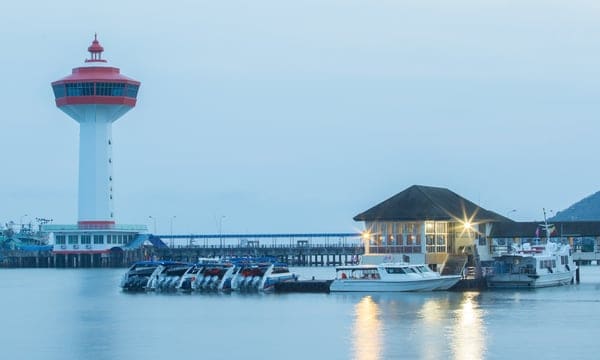
Bangkok will redirect infrastructure investment toward upgrading Ranong's existing port facilities. The scaled-down plan includes modernizing the current Ranong Port and establishing direct rail connectivity to the national train network already operational through Chumphon. This approach concentrates resources on a single Andaman gateway rather than building dual terminals from scratch.
Ranong holds several structural advantages as Thailand's logistics gateway to the Indian Ocean. The province maintains the shortest distance to Bangkok among all Andaman provinces and sits adjacent to Myanmar, enhancing cross-border trade potential. Ranong Port is also the only Andaman facility managed by the Port Authority of Thailand, which oversees key state-owned commercial ports including Laem Chabang.
Phuket, despite its prominence and existing deep-sea port near the Royal Thai Navy's Third Naval Area Command, faces physical constraints that limit expansion capacity. The island's tourism-focused economy further complicates large-scale industrial port development.
Public Opposition and Political Calculus
Thai public sentiment had turned sharply against the land bridge in recent months. Environmental concerns combined with anxiety over foreign capital inflows drove widespread opposition. The Anutin government's decision to cancel the project, despite its action-oriented image and months of high-profile promotion, may earn credit for responsiveness to public pressure.
However, the episode raises questions about Thailand's infrastructure planning credibility. The government had actively courted international investors for a project whose viability remained uncertain throughout its development. This pattern extends beyond the land bridge: the high-speed rail linking U-Tapao, Suvarnabhumi, and Don Mueang airports, contracted in 2019 as part of the Eastern Economic Corridor, has yet to materialize. Phang Nga's proposed Andaman airport and Phuket's light rail transit system remain on paper after years of discussion.
Regional Infrastructure Context
Thailand competes with neighboring countries for logistics supremacy in Southeast Asia. Singapore's dominance as a transshipment hub and Malaysia's control of port infrastructure along the Malacca Strait create pressure for Bangkok to develop alternative routes. Vietnam has rapidly expanded container handling capacity at ports like Cai Mep, while Myanmar's Kyaukpyu port development, backed by Chinese investment, positions the Bay of Bengal as an emerging trade corridor.
The land bridge concept sought to position Thailand as a central node connecting the Indian Ocean and South China Sea economies. Its cancellation leaves Bangkok reliant on incremental upgrades to existing infrastructure rather than transformative megaprojects. Whether the Ranong modernization can deliver sufficient capacity to meet Thailand's ambitions remains an open question.
The centuries-old proposal to dig a canal across the Kra Isthmus resurfaces periodically in Thai planning discussions. As a strategically less controversial alternative rooted in the same geographic logic, the land bridge concept may return if Ranong's development proves successful and political calculations shift. For now, Thailand has chosen pragmatism over ambition in its southern corridor strategy.
RELATED STORIES

Mitsubishi Motors Brings Back Pajero SUV With Thailand Launch
Cheng Wei-Lun · 3 min
Southeast Asian Factories Adopt Proximity Planning to Retain Workers and Investors
Lim Hui Ying · 3 min

Thailand's Telecom Regulator Faces Paralysis as Board Crisis Deepens
Priyanka V. Rao · 3 min

Five ASEAN Members Back Regional Oil Stockpile as Study Nears Completion
Tran Quoc Bao · 3 min
Spot something wrong? Email editor@briefasia.com. We log every correction publicly.