Technology · Products
Tesla's Shanghai Dependence Makes China Exit Implausible
The EV maker's manufacturing footprint, supplier ecosystem, and revenue exposure lock it into the mainland despite speculation over a sale
KEY TAKEAWAYS
- ·Elon Musk dismissed reports Tesla would divest its China business, calling the speculation absurdly fake news on social media.
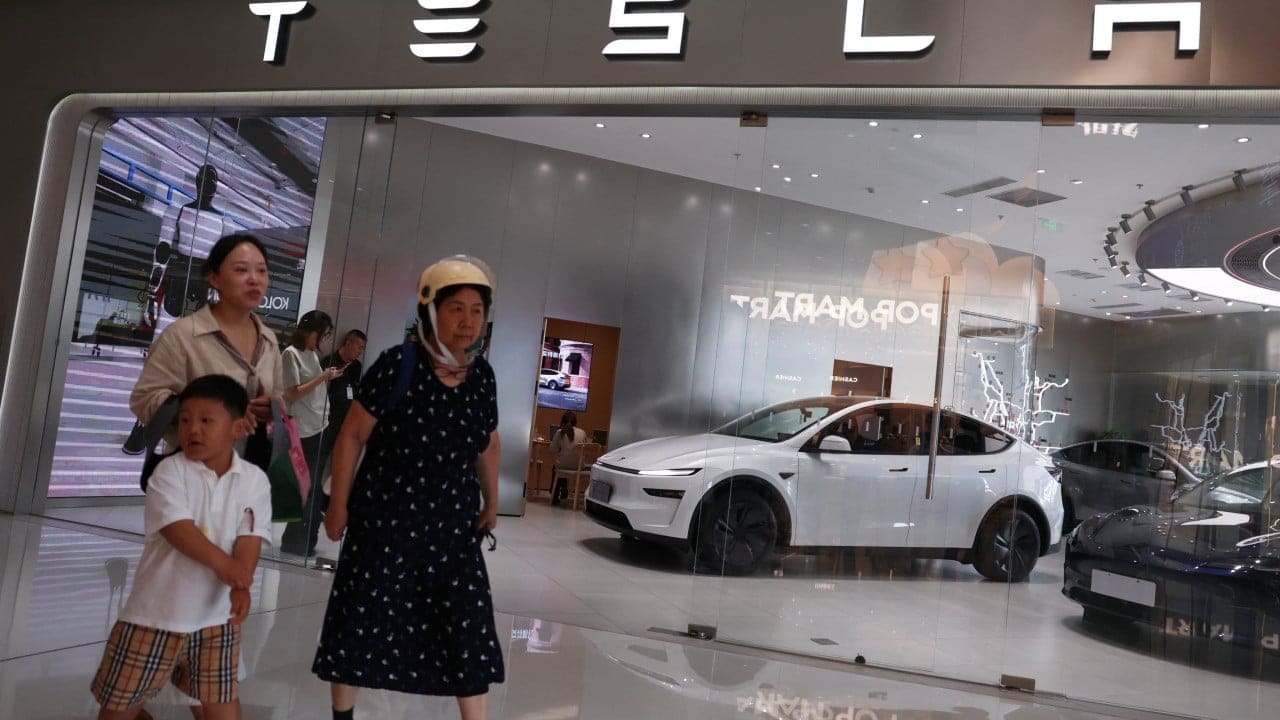
- ·Tesla's Shanghai Gigafactory produces over one million vehicles annually and accounts for more than half of the company's global deliveries.
- ·China contributes 20 to 25 percent of Tesla's total revenue and serves as a critical export hub for Asia-Pacific and European markets.
The Denial and the Underlying Reality
Elon Musk moved quickly to dismiss speculation that Tesla might divest its China operations. "This has never even come up in a discussion ever," the CEO wrote on X, calling the reports "absurdly fake news." Yet the rumor's persistence underscores a structural fact: Tesla's business model is anchored in Shanghai in ways that make separation extraordinarily difficult.
The company's Gigafactory in Shanghai is not a satellite plant. It is the single largest production node in Tesla's global network, accounting for more than half of the company's worldwide deliveries in recent quarters. The facility produces Model 3 and Model Y vehicles both for domestic sale and for export to markets across Europe and Asia-Pacific. Any attempt to relocate or replicate that capacity would require years of capital deployment and regulatory clearance, not to mention the risk of production gaps that competitors would exploit.
Manufacturing Scale and Speed
Tesla opened its Shanghai plant in late 2019, and within three years it had become the company's most productive site. The factory can produce over one million vehicles annually, a scale that dwarfs Tesla's older Fremont, California facility. According to company disclosures, Shanghai output has consistently exceeded North American production since 2021, a shift driven by both manufacturing efficiency and proximity to Asian supply chains.
The speed at which Tesla brought Shanghai online also illustrates the advantage of working within China's industrial ecosystem. Construction began in early 2019, and the first Model 3 rolled off the line by December of that year. In contrast, Tesla's Berlin and Texas plants faced extended permitting delays and slower ramp-up curves. The Shanghai facility benefits from a dense network of local suppliers for batteries, motors, and electronic components, many of which are integrated into Tesla's supply chain at a level that would be costly to replicate elsewhere.
Revenue Exposure and Market Position
China remains Tesla's second-largest market by revenue, trailing only the United States. In recent fiscal periods, the Greater China region has contributed between 20 and 25 percent of total company revenue, according to Tesla's quarterly filings. While domestic competition has intensified with the rise of BYD, Nio, and other local brands, Tesla retains strong brand recognition among Chinese buyers willing to pay a premium for foreign EVs.
The company has also used its Shanghai base to serve export markets, shipping vehicles to Japan, South Korea, Australia, and several European Union countries. This dual function makes the plant a linchpin not just for Chinese sales but for Tesla's broader Asia-Pacific and European strategies. Decoupling from Shanghai would force Tesla to either absorb higher logistics costs by shipping from North America or invest in alternative Asian manufacturing hubs, each carrying its own set of political and operational risks.
Supplier and Technology Ties
Tesla's supply chain in China extends well beyond final assembly. The company sources lithium-ion battery cells from Contemporary Amperex Technology Co. Limited (CATL), the world's largest battery manufacturer, and has entered into long-term agreements that lock in pricing and capacity. CATL's facilities are concentrated in Fujian and other mainland provinces, and shifting to alternative suppliers would require new qualification processes and potentially higher costs.
Other critical components, including power electronics and electric drive units, are also manufactured by Chinese partners or produced in-house at the Shanghai site. Tesla has invested in local R&D teams to adapt vehicle software and hardware for the Chinese market, creating institutional knowledge that would be difficult to transfer. The company's ability to iterate quickly on design and production owes much to the proximity of engineering teams to the factory floor, a setup that would be disrupted by geographic separation.
Policy and Geopolitical Constraints
Speculation about a China exit often overlooks the policy environment that has enabled Tesla's success. The company was the first foreign automaker permitted to establish a wholly owned subsidiary in China, a concession granted in 2018 as Beijing sought to attract advanced manufacturing. Tesla benefited from land subsidies, tax incentives, and streamlined approvals that would not be available to new entrants today.
At the same time, the company operates under regulatory scrutiny. Chinese authorities have imposed data localization requirements, mandating that certain vehicle data be stored on servers within the country. Tesla has complied by establishing local data centers, but this arrangement also embeds the company more deeply in China's regulatory framework. Any decision to exit would likely trigger questions about data transfer, intellectual property, and contractual obligations with local partners.
The Calculus of Staying
For Tesla, the question is not whether China poses risks but whether those risks are manageable relative to the benefits. The Shanghai factory delivers margins that support the company's global expansion. It provides a hedge against supply chain disruptions in other regions and offers a manufacturing platform that can scale with demand. Musk's swift denial of exit rumors reflects an awareness that even entertaining the possibility could unsettle investors, suppliers, and employees.
The broader tension for Tesla is one that many multinational firms face in China: deep integration brings efficiency and market access, but it also creates dependencies that are difficult to unwind. For now, the company's strategy appears to be doubling down on Shanghai while expanding capacity elsewhere, a bet that diversification can coexist with continued reliance on the mainland. Whether that balance holds will depend on factors beyond Tesla's control, including trade policy, technological competition, and the trajectory of U.S.-China relations.
RELATED STORIES
China Targets 84% Share of AR-HUD Production by 2031
Cheng Wei-Lun · 3 min
Li Auto Expands Battery Roster with CALB as Third Supplier
Siti Nuraini · 2 min
China's Battery Dominance Faces Quality Test as CALB Defect Spreads
Anand Sundaram · 3 min
China's Auto Chip Race Shifts to Volume as Horizon Robotics Crosses 15 Million Units
Jun-ho Seo · 3 min
Spot something wrong? Email editor@briefasia.com. We log every correction publicly.