Perspectives · Analysis
Technology's Quiet Bias: Who Gets Served and Who Gets Left Behind
Two KAIST professors are building tools for people innovation usually ignores, from assisted dressing to off-grid water purification
KEY TAKEAWAYS
- ·Two KAIST research teams have developed assistive dressing robots and solar-powered water filters for people typically ignored by commercial technology markets.
- ·The portable filtration unit processes 50 liters daily, costs under USD 150, and has reduced waterborne illness in field trials across Cambodia, Thailand, and the Philippines.
- ·These projects face funding obstacles because they serve fragmented, low-margin markets that do not fit venture capital models despite large absolute user populations.
- ·Both teams spent months observing users in real environments before building, a user-centered approach still rare in Asian technology research.
- ·Asia's technology sector has the talent and resources to serve both wealthy and underserved populations, but current incentives heavily favor monetizable problems.
The Invisible Majority
Walk into any consumer electronics showcase in Seoul, Shenzhen, or Silicon Valley, and you will encounter a predictable parade of incremental refinement. Cameras gain another megapixel. Refrigerators acquire voice assistants. Cars edge closer to driving themselves. These are not trivial achievements, but they share a common feature: they serve people who already have abundant access to technology, infrastructure, and purchasing power.
Meanwhile, millions across Asia face problems that are neither glamorous nor complex to articulate. A person with limited upper-body mobility cannot put on a jacket without help. A farming family beside a massive freshwater lake cannot drink from it safely. These are not edge cases. They represent a substantial portion of humanity that innovation routinely overlooks.
Two researchers at the Korea Advanced Institute of Science and Technology have spent years addressing this gap. Their work does not promise disruption or unicorn valuations. It offers something more fundamental: tools that restore dignity and extend capability to people the market has decided are not worth designing for.
Building for Bodies That Move Differently
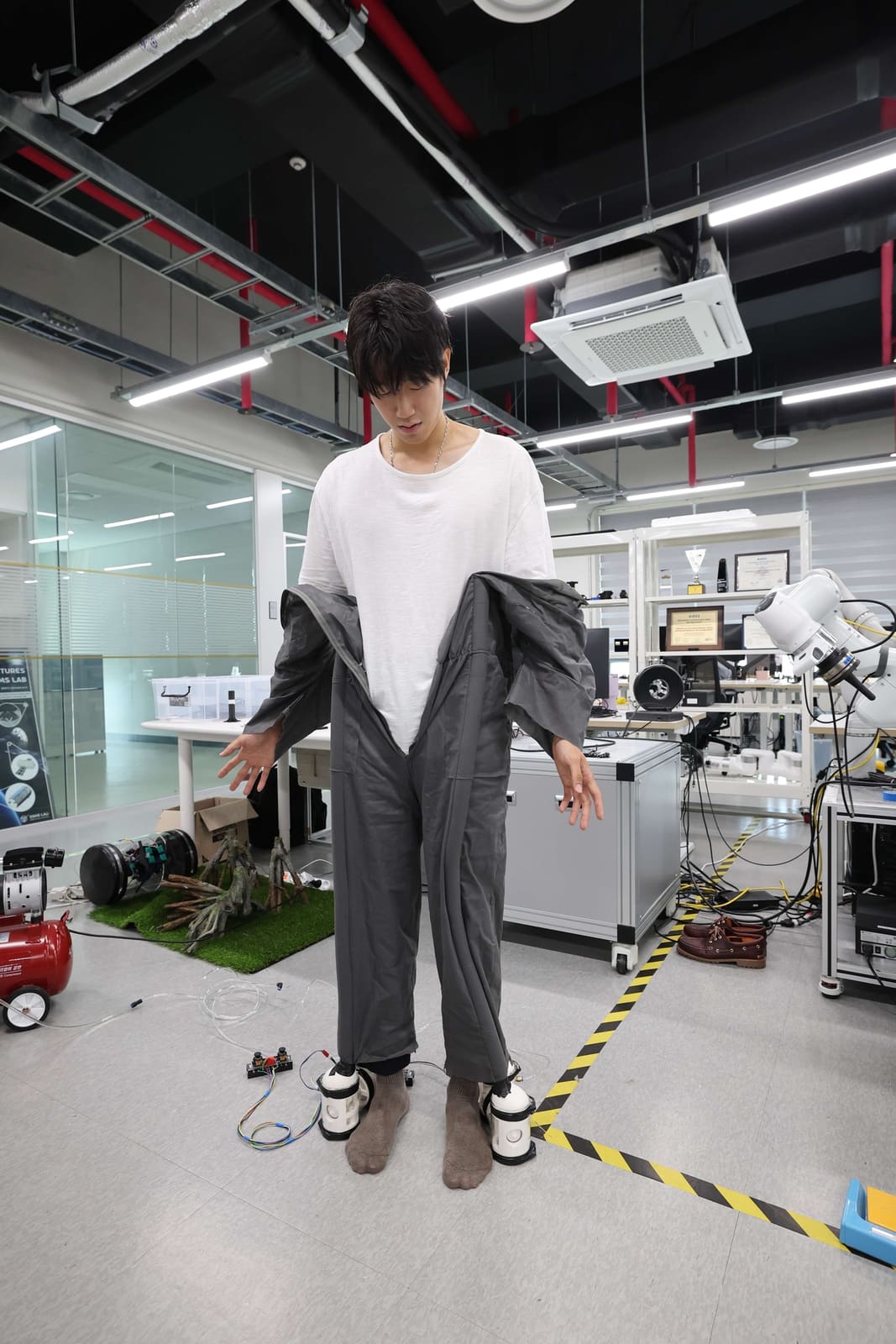
The first project concerns clothing. For individuals with cerebral palsy, stroke survivors, or those with severe arthritis, the simple act of dressing can be a daily ordeal. Conventional garments assume a baseline level of dexterity and range of motion. When those assumptions fail, people lose independence in one of the most basic daily tasks.
One KAIST team has developed an assistive dressing system that does not require redesigning every piece of clothing or retrofitting an entire wardrobe. The approach relies on a modular robotic arm that can be mounted on a wheelchair or bedside frame. The device uses pressure sensors and soft grippers to manipulate fabric without tearing or pinching skin. It is not fast, and it is not invisible. But it works.
The design philosophy is pragmatic. Rather than pursuing a fully autonomous system that might never leave the lab, the researchers built a tool that augments human effort. A caregiver or family member can guide the device through the initial positioning, and the robot handles the repetitive, physically demanding motions. This division of labor reduces caregiver strain while preserving the user's agency.
The technology has been tested in rehabilitation centers in Daejeon and Seoul. Early feedback indicates that users value the system less for its speed than for the reduction in physical contact required during dressing. For many people with disabilities, privacy is a scarce resource. A tool that allows someone to dress with minimal assistance from another person carries psychological weight that extends beyond the mechanics of putting on a shirt.
Water That Looks Clean But Is Not
The second project addresses a problem that affects an estimated 200 million people across South Asia and Southeast Asia: access to safe drinking water in regions where surface water is abundant but contaminated. Lakes, rivers, and reservoirs may appear clear, yet harbor pathogens, agricultural runoff, and industrial pollutants that cause chronic illness.
Centralized water treatment infrastructure is expensive to build and maintain. In rural or remote areas, it often does not arrive at all. The KAIST research group has developed a portable, solar-powered filtration unit designed for off-grid use. The system combines ceramic microfiltration with ultraviolet sterilization, powered entirely by a small photovoltaic panel.
The unit can process up to 50 liters of water per day, enough for a household of five. It requires no external electricity and minimal maintenance. The ceramic filters can be cleaned and reused for up to two years. The UV component runs on a low-voltage LED array that draws less power than a smartphone charger.
Field trials have been conducted in rural villages in Cambodia and northern Thailand, as well as in coastal communities in the Philippines. The results are straightforward: waterborne illness rates dropped measurably in households using the device. The cost per unit is under USD 150, a price point that remains out of reach for many families but is accessible to community organizations, NGOs, and local governments.
The Economics of Overlooked Problems
These projects share a common obstacle: they do not fit neatly into the venture capital model that dominates technology funding in Asia. The addressable market is large in absolute numbers but fragmented and low-margin. Users often cannot afford premium pricing. Distribution requires partnerships with governments, nonprofits, and community health organizations rather than sleek retail channels.
This is not a failure of innovation. It is a design feature of the current funding ecosystem. Capital flows toward problems that can be solved at scale with high unit economics. That leaves entire categories of human need underserved, not because the technology is hard, but because the business case is unattractive.
South Korea has a strong tradition of public research funding, and KAIST in particular has institutional support for projects that prioritize social impact over commercial returns. But even within academia, researchers face pressure to publish in high-impact journals, secure patents, and demonstrate pathways to commercialization. Work that serves marginalized populations often struggles to meet those criteria.
What Changes When You Start With Need
Both KAIST teams began their work by spending months with the people they hoped to serve. They observed daily routines, listened to frustrations, and tested prototypes in real environments rather than controlled labs. This is not a revolutionary methodology. It is user-centered design, a practice that has been standard in product development for decades. Yet it remains surprisingly rare in technology research, especially in Asia, where engineering excellence often prioritizes technical performance over human context.
The result is technology that works differently. The assistive dressing system is slower than a human caregiver but more patient. The water filter is less efficient than a municipal treatment plant but infinitely more accessible. These are not compromises. They are appropriate responses to the actual constraints and priorities of the people using them.
The broader lesson is not that all technology should serve social good or that profit is inherently problematic. It is that the current allocation of research talent, funding, and institutional attention is deeply skewed. The same engineering skill that goes into making a phone camera slightly better could also make a prosthetic limb affordable. The same sensor technology that powers smart home devices could monitor water quality in rural wells.
Who Decides What Gets Built
The Korea Herald article that prompted this reflection posed a question: Who does technology serve? The answer, for now, is clear. It serves people who already have money, infrastructure, and market power. It serves problems that are easy to monetize. It serves the comfortable.
There is no conspiracy here, only incentives. Engineers build what they are funded to build. Investors fund what they believe will return capital. Markets reward products that appeal to people with disposable income. The system works exactly as designed.
But design can change. KAIST's work demonstrates that it is possible to build useful, scalable technology for people the market ignores. It requires different funding structures, different measures of success, and a willingness to accept that impact and profit do not always align.
Asia is home to both extraordinary wealth and persistent poverty, cutting-edge infrastructure and vast off-grid populations. The region's technology sector has the talent and resources to address both realities. The question is not whether it can, but whether it will choose to. The answer will say more about priorities than capabilities.
RELATED STORIES
Samsung and SK Hynix Turn Down KEPCO's Multibillion-Dollar Prepayment Demand
Cheng Wei-Lun · 4 min

South Korea Records Highest September Export Start on Semiconductor Demand
Tran Quoc Bao · 3 min
Hyosung Heavy Gains Ground in US Power Grid Market With Early Manufacturing Push
Jun-ho Seo · 4 min
LG Pivots to AI-Defined Vehicle Platform as Korea Chases China's Self-Driving Lead
Jun-ho Seo · 3 min
Spot something wrong? Email editor@briefasia.com. We log every correction publicly.