Finance · Markets
Taiwan Stock Index Rebounds Above 40,000 After Two-Day Tech Selloff
Bargain hunters push TAIEX back over psychological threshold despite broader regional retreat from AI-fueled semiconductor bets
KEY TAKEAWAYS
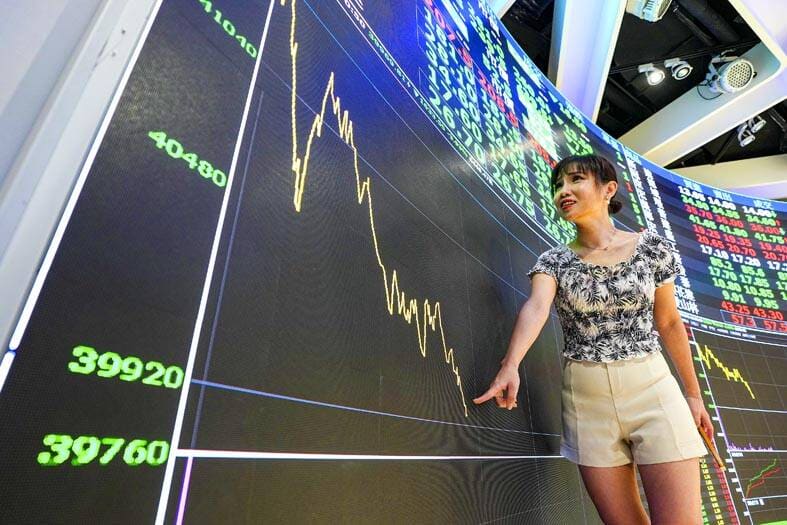
- ·Taiwan's TAIEX closed at 40,039.18 on Wednesday after falling 3.76 percent, the seventh-largest single-day point drop, with foreign investors selling NT$22.25 billion in net shares.
- ·South Korea's KOSPI dropped 6 percent after an intraday plunge exceeding 12 percent, extending a regional tech selloff driven by doubts over AI infrastructure returns.
- ·Trading volume on the Taiwan Stock Exchange surged to NT$1.084 trillion as investors watch for Federal Reserve policy signals and stabilization in Seoul's market.
Late Session Rally Halts Slide
Taiwan's benchmark stock index clawed back above 40,000 points by Wednesday's close after dipping below that level during morning trading, as late-session bargain hunters stepped in to arrest a two-day rout that erased more than 3,500 points from the market.
The TAIEX fell 1,564.18 points, or 3.76 percent, to close at 40,039.18, marking the seventh-largest single-session point drop in the index's history. The decline followed Tuesday's 2,030.83-point plunge, the third-steepest on record, according to Taiwan Stock Exchange data.
Trading volume surged to NT$1.084 trillion ($33.49 billion), up sharply from NT$809.48 billion in the previous session, reflecting heightened volatility as investors reassessed positions in semiconductor and technology shares.
Foreign Capital Exits Accelerate
Foreign institutional investors offloaded a net NT$22.25 billion in shares on the main board Wednesday, while proprietary traders reduced holdings by NT$18.6 billion. Investment trust firms provided modest support, adding NT$9.09 billion in net purchases.
The selling pressure centered on large-cap technology names including Taiwan Semiconductor Manufacturing Co. and MediaTek, as nervous investors unwound positions built during the artificial intelligence rally that had propelled the TAIEX to record highs earlier this year.
Moore Securities Investment Consulting analyst Adam Lin attributed the slide to a broader shift in sentiment around AI infrastructure spending. Investors are now questioning whether massive capital expenditures by technology companies will generate adequate returns, a concern that has rippled through tech-heavy markets across the region.
Regional Tech Retreat Intensifies
South Korea's KOSPI bore the brunt of Wednesday's selling, plummeting more than 12 percent intraday before closing down 6 percent. The index extended Tuesday's nearly 11 percent collapse, making it one of the sharpest two-day declines in the market's history.
Tokyo's Nikkei 225 dropped approximately 3 percent, while Chinese markets moved in the opposite direction. Hong Kong's Hang Seng Index gained 2 percent and the Shanghai Composite Index rose 0.4 percent, diverging from the semiconductor-driven weakness elsewhere in Asia.
IG International analyst Fabien Yip noted that markets are increasingly distinguishing between companies that maintain spending discipline and those stretching their balance sheets. Capital expenditure commitments at Alphabet, Microsoft, and Amazon running into hundreds of billions of dollars each have sparked concerns about return on investment timelines.
Fed Decision Looms Over Recovery
The timing of any sustained TAIEX rebound depends heavily on stabilization in South Korea's market, according to Lin. He emphasized that investors should monitor signals from the U.S. Federal Reserve following its policy meeting conclusion Wednesday.
Market participants are weighing whether central bank messaging will provide clarity on interest rate trajectories and economic outlooks that could either support or undermine technology valuations.
The two-day decline has wiped out a significant portion of gains accumulated during the AI-driven rally that characterized much of 2025 and early 2026. The selloff reflects a recalibration of expectations rather than deterioration in underlying corporate fundamentals, with forced deleveraging and algorithmic trading amplifying the move.
Taiwan's technology sector remains central to global semiconductor supply chains, with TSMC serving as the world's largest contract chipmaker and a primary beneficiary of AI chip demand. The company's stock performance typically sets the tone for the broader index given its outsized weighting.
Whether Wednesday's late recovery signals the beginning of stabilization or merely a pause in a deeper correction remains uncertain. Regional market correlation suggests that sustained recovery will require coordinated stabilization across Asia's major technology exchanges, particularly Seoul and Tokyo, before investor confidence fully returns to Taiwan's equity market.
RELATED STORIES
Taiwan Stock Exchange Moves Odd-Lot Trading Start Time Forward
Cheng Wei-Lun · 3 min
Integrated Systems Will Drive Next Wave of AI Growth, Says TSMC
Cheng Wei-Lun · 4 min
Tokyo Summit Pushes Trilateral Tech Alliance Among Taiwan, Japan, and US
Cheng Wei-Lun · 3 min
Taiwan GDP Growth Forecast Lifted to 11.6% on AI Chip Demand
Cheng Wei-Lun · 3 min
Spot something wrong? Email editor@briefasia.com. We log every correction publicly.