Asia · Trade
Sri Lanka Adopts US Forced-Labor Import Ban to Secure Lower Tariff Rate
Colombo's move to qualify for 10 percent tariff comes amid pressure to align with Washington's trade policy targeting China
KEY TAKEAWAYS
- ·Sri Lanka banned forced-labor imports in early July, securing a 10 percent US tariff rate instead of 12.5 percent on a quarter of its exports.
- ·The country's apparel sector exported 1.96 billion dollars to the United States in 2025, making market access critical to jobs and revenue.
- ·Colombo's alignment with Washington's trade framework risks diplomatic friction with China, a major trade partner, investor, and creditor.
A Choice Between Markets
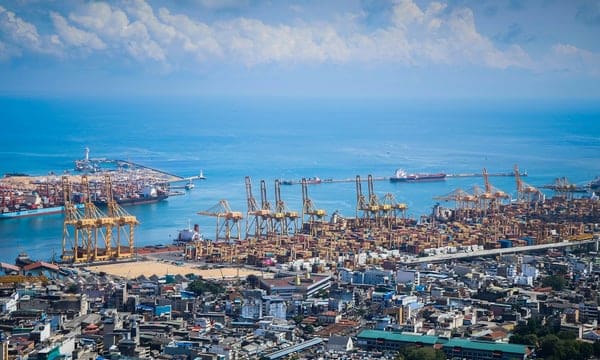
Sri Lanka moved swiftly in early July to ban imports of goods produced using forced labor, publishing a gazette that prohibits entry of any product made, mined, or produced, wholly or partially, through coerced work. The government will maintain a list of high-risk goods, companies, and countries based on International Labor Organization findings. Importers bringing in flagged items must provide proof that their goods were not made using forced labor, with enforcement assigned to the Director General of Customs.
The timing was not coincidental. In June, Washington announced that countries failing to prohibit forced-labor imports would face heavy tariffs. Sri Lanka exports roughly one-quarter of its goods to the American market and could not afford punitive duties. By adopting the ban, Colombo qualified for a 10 percent tariff rate rather than the higher 12.5 percent bracket applied to countries without formal forced-labor import prohibitions.
Sri Lanka joined 16 other economies, including Canada, India, Mexico, and the United Kingdom, in the lower tier. According to Washington, these countries have "made commitments to adopt, and effectively enforce, forced labor import prohibitions."
Industry Relief After Two Months of Uncertainty
The Joint Apparel Association Forum, representing Sri Lanka's garment sector, welcomed the outcome. The industry group noted that competitiveness hinges on narrow margins and that even a single percentage point in tariff differences can determine whether an order goes to Sri Lanka or a rival sourcing destination. The Exporters Association of Sri Lanka and Ravi Karunanayake, a former finance and foreign affairs minister, echoed that assessment.
Between early June, when Washington signaled possible tariffs, and late July, when rates were announced, Sri Lankan apparel businesses faced nearly two months of uncertainty. Industry sources reported serious concern over potential order cancellations and job losses during that window.
Karunanayake pointed out that there is no evidence Sri Lanka imports anything from destinations that use forced labor. Yet the country moved ahead with the ban to preserve access to its largest export market.
The Numbers Behind the Pressure
The United States consumed $1.96 billion of Sri Lankan apparel and textile exports in 2025, when the sector generated $4.9 billion in total revenue. The European Union took $1.6 billion and the United Kingdom $688 million. Together, these three markets absorb the bulk of Sri Lanka's top merchandise export category.
That dependency leaves Colombo with little room to maneuver when Washington uses tariffs as a foreign-policy lever. The administration has deployed tariffs globally to negotiate trade terms, and countries reliant on US market access find themselves adjusting domestic policy to meet American requirements.
The China Angle
The forced-labor framework targets China in particular. Washington has singled out cotton from Xinjiang, alleging that production relies on coerced minority labor. That presents a problem for Sri Lanka's apparel sector, which sources many inputs from China.
China installed 54 percent of the 542,000 industrial robots deployed worldwide in 2024, according to industry data. A 2023 Food and Agriculture Organization report noted that mechanization in Chinese crop production and harvesting exceeded 70 percent as early as 2019. In Xinjiang, official data shows that more than 90 percent of cotton was machine-picked in recent years, up from 5 percent in 1990. Overall mechanization in cotton farming in the region surpassed 97 percent in 2025.
Sri Lanka's apparel sector continues to import Chinese inputs. By enforcing a ban premised on forced-labor allegations, Colombo signals alignment with a narrative that Beijing contests, even as data points to widespread automation in Chinese agriculture.
Diplomatic Tightrope
For Sri Lanka, the calculus extends beyond tariffs. China is a major trade partner, investor, and creditor. Colombo has relied on Beijing for infrastructure financing and balance-of-payments support, particularly during its recent debt crisis.
Acting on Washington's demands carries a diplomatic cost. While the gazette does not name China explicitly, the framework it establishes is designed to restrict goods from sources Washington deems problematic. Beijing is watching whether Colombo lends credibility to contested allegations by adopting policies that assume their validity.
Sri Lanka has little evidence of forced-labor imports entering its supply chain, yet it issued the ban to avoid a 2.5 percentage point tariff penalty. That decision reflects the asymmetry in its relationships with two large powers. Washington can impose immediate economic pain through tariffs. Beijing's response, if any, will unfold over a longer horizon, in the form of investment decisions, credit terms, or diplomatic temperature.
Colombo secured the lower tariff bracket and preserved short-term access to the US market. The question now is whether that choice has a price that will come due elsewhere.
RELATED STORIES
Ralph Lauren Surpasses Revenue Expectations on Asian and North American Demand
Priyanka V. Rao · 2 min
China Imposes Anti-Dumping Measures on Japanese Semiconductor Chemical Imports
Jun-ho Seo · 3 min
China's Electric Truck Exports Surge as Fuel Costs Rise Across Asia
Cheng Wei-Lun · 3 min
India's Chinese Import Bill Climbs Despite Self-Reliance Push
Priyanka V. Rao · 3 min
Spot something wrong? Email editor@briefasia.com. We log every correction publicly.