Technology · Products
China's Electric Truck Exports Surge as Fuel Costs Rise Across Asia
Regional diesel price spikes following the Iran conflict have accelerated Chinese heavy-duty electric vehicle shipments, with South and Southeast Asia driving demand.
KEY TAKEAWAYS
- ·China exported 16,823 heavy electric trucks in the four months after late February, more than double the prior-year period, with half going to South and Southeast Asia where diesel prices rose 48% to 57%.
- ·Sany, the world's largest electric heavy truck maker, reports payback periods for buyers in the region have shortened from 28 months to 18 months due to fuel cost increases.
- ·China's domestic electric truck fleet will displace 141 million barrels of oil equivalent this year, while first-half exports will replace fuel at an annualized rate of 1.6 million barrels.
Regional Fuel Crisis Accelerates Electrification
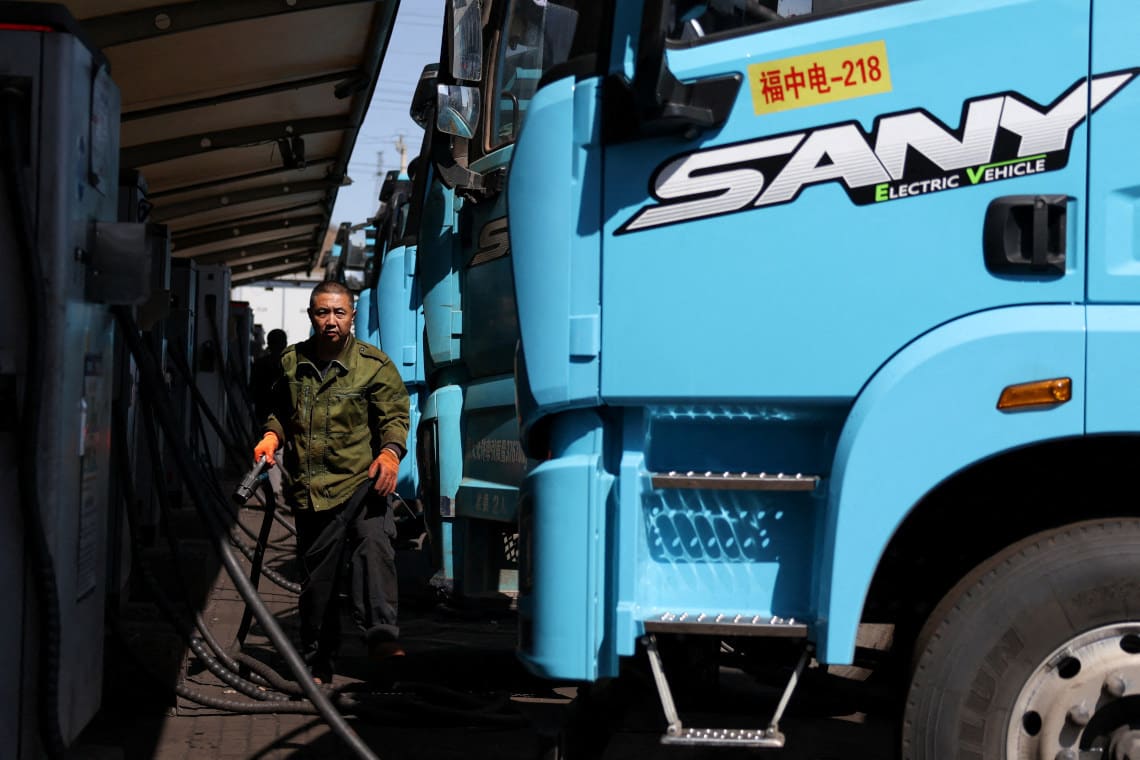
China shipped 16,823 heavy electric trucks to overseas buyers in the four months following the late-February onset of conflict in the Middle East, more than double the volume from the same period last year. Half of those vehicles landed in South and Southeast Asia, where diesel prices have climbed sharply since the Strait of Hormuz closure disrupted oil flows.
Sri Lanka has seen diesel costs jump 48% since late February, while the Philippines recorded a 57% increase, according to GlobalPetrolPrices.com. By comparison, diesel in China rose 15% over the same window. The price divergence has created an opening for Chinese manufacturers, who now dominate global production of battery-powered commercial vehicles.
Shipments to South Asia increased more than fivefold during the period, while Southeast Asian deliveries nearly tripled. The volumes remain modest compared to China's passenger car and two-wheeler exports, and regional truck fleets still number in the millions. Yet the growth trajectory mirrors China's domestic market, where electric trucks climbed from near zero in 2021 to 30% of all truck sales last year.
Payback Periods Shrink
Sany, the world's largest manufacturer of electric heavy trucks, previously concentrated on European markets but is now redirecting resources toward Southeast Asia and developing lower-cost models. The company shipped its largest single order in June, 880 heavy trucks to an undisclosed buyer.
"Before oil prices rose, buyers in these countries might have needed 28 months to recoup their investment in an electric heavy truck," said Zhaoting Yue, Sany's vice president of international marketing. "Now, it takes only 18 months."
The shortened payback window addresses one of the main barriers to adoption. In Australia, an electric truck costs approximately A$500,000, roughly twice the price of a diesel equivalent. However, fuel savings cut operating expenses by as much as 70% compared to diesel-powered vehicles, even before the recent price surge.
Sany expects the conflict to sustain rapid export growth for at least another year, particularly across Asia, Africa, and Latin America, according to Yue. The company is also selling integrated systems that generate, store, and deliver power to customers, addressing infrastructure gaps that have slowed electrification in markets with limited charging networks.
Displacement Effect
China sold 140,000 electric trucks domestically in the first half of this year. The existing fleet will displace the equivalent of 141 million barrels of oil in 2026, representing more than 3% of China's total consumption and matching the country's entire import volume from Kuwait, according to the Centre for Research on Energy and Clean Air.
China's diesel consumption began declining last year, a shift partly attributable to the rapid penetration of electric commercial vehicles. By contrast, first-half exports of Chinese electric trucks will replace fuel at an annualized rate of 1.6 million barrels, the Helsinki-based research center estimates.
The displacement figures underscore the scale difference between domestic adoption and export activity, though the gap may narrow if regional buyers follow China's adoption curve. South and Southeast Asia rely heavily on Middle Eastern oil, making them particularly vulnerable to supply disruptions and price volatility.
Infrastructure and Market Dynamics
Higher upfront costs and charging infrastructure remain the primary obstacles to wider adoption outside China. In the United States and Europe, electric delivery vans have gained traction, but larger trucks have lagged. Tesla announced plans for its electric Semi nearly a decade ago but has since dropped its goal of reaching volume production this year.
The expansion of Chinese electric passenger vehicles in many Asian markets is expected to support truck adoption by accelerating charging network buildout. Daniel Bleakley, co-founder of Australian electric trucking firm New Energy Transport, noted that even before the recent fuel price surge, electric trucks offered significant operating cost advantages.
"High fuel prices are going to focus minds and get businesses to move fast," said Lauri Myllyvirta, co-founder of CREA. The current environment may compress the typical adoption cycle, particularly in markets where diesel price increases have been most severe and where logistics operators face immediate cost pressures.
Chinese manufacturers are positioned to capture demand as regional buyers reassess fleet economics. Whether export growth continues at the current pace will depend on sustained fuel price differentials, infrastructure development, and the willingness of operators to absorb higher capital costs in exchange for lower operating expenses.
RELATED STORIES

India's Electronics Push Faces Water Scarcity and Visa Friction
Priyanka V. Rao · 3 min

DeepSeek Raises API Prices by Up to 1,100 Percent for V4 Models
Cheng Wei-Lun · 2 min

Taiwan Think Tank Warns of China's National Push in Physical AI and Robotics
Cheng Wei-Lun · 3 min

Tencent Joins $400 Million Round in Stockholm's Lovable at $13.3 Billion
Cheng Wei-Lun · 4 min
Spot something wrong? Email editor@briefasia.com. We log every correction publicly.