Finance · Markets
South Korean Retail Investors Retreat After Record KOSPI Losses
Seoul's mom-and-pop traders absorbed 22% monthly losses and four circuit-breaker halts, the worst volatility since 2008, raising questions about leveraged ETF rollout timing
KEY TAKEAWAYS
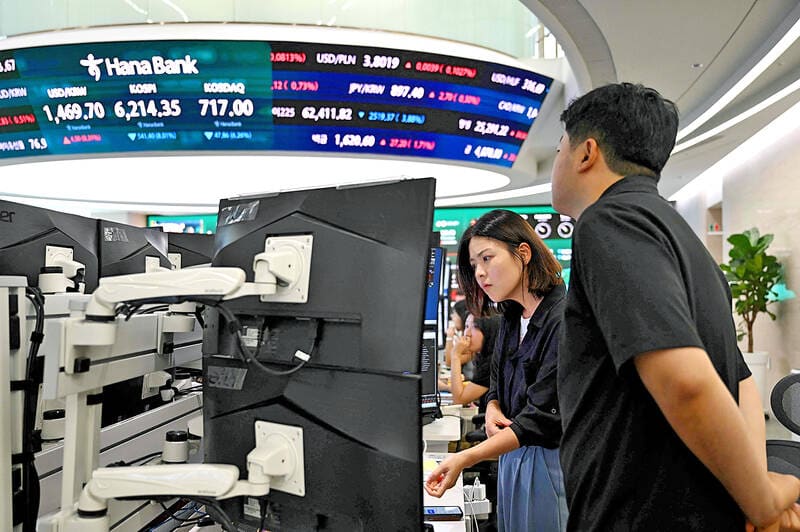
- ·The KOSPI fell 22 percent in July, its steepest monthly loss since the global financial crisis, triggering four circuit-breaker halts and record retail selling despite an 18 percent Friday rebound.
- ·Retail investors poured 78 trillion won into KOSPI shares over May and June, encouraged by reform promises and new single-stock leveraged ETFs, only to face rapid deleveraging and amplified losses.
- ·Authorities halted new leveraged ETF listings mid-month and pledged further curbs, but investors and analysts say the response came too late to prevent a confidence crisis among mom-and-pop traders.
Retail Exodus After Worst Month Since Crisis
South Korea's retail investors sold a record volume of KOSPI shares on Friday even as the index rebounded 18 percent in a single session, capping a month that tested the risk appetite of one of Asia's most aggressive trading communities. The benchmark closed July with a 22 percent loss, the steepest monthly decline since the global financial crisis, leaving the US$3.9 trillion market reeling from four circuit-breaker suspensions in a single month.
Kim Han-kyung, a Seoul resident in her 30s who began trading Korean equities for the first time in May, said she has resolved never to invest in the domestic market again. "That was the era of the KOSPI mania," Kim said. "I got completely swept up in the frenzy. Now, I'm honestly scared."
The reversal comes after mom-and-pop traders poured approximately 78 trillion won (US$54.1 billion) into KOSPI shares over May and June, drawn by President Lee Jae Myung's stock-market reform push and the May debut of single-stock leveraged exchange-traded funds. Those products, designed to offer amplified returns, have since become a focal point of investor anger.
Leveraged Products Under Fire
The single-stock leveraged ETFs were introduced in May to broaden investment options for retail participants and reduce capital flowing into similar products listed abroad. Instead, the instruments have been blamed for magnifying swings in an already volatile market.
Lee Jung-min, a 40-year-old trader who borrowed 50 million won against his apartment to fund stock purchases, said the government "put fuel into the fire with those leveraged ETFs. I think it's wrong how they turned the stock market into a casino."
Trading halts, once rare in South Korean equity markets, occurred four times in July alone, a record for circuit-breaker suspensions. The frequency of these stoppages underscores the intensity of selling pressure and the speed at which positions unwound.
Lale Akoner, global market analyst at eToro Group in London, described the episode as "a textbook example of what happens when a crowded trade meets leverage." She warned that deleveraging is unlikely to resolve quickly, and investors should anticipate further sharp moves in technology and semiconductor stocks over the coming months.
Policy Response and Criticism
South Korean authorities moved to contain the damage midway through July by temporarily halting new listings of single-stock leveraged ETFs. Last week, regulators pledged additional measures to stabilize the market and restrict retail access to such products.
Many investors and market participants argue the intervention came too late. Kim Dong-woo, a 33-year-old who has traded stocks for more than seven years, said volatility levels indicate "the market is not functioning normally."
Francis Tan, chief strategist for Asia at Indosuez Wealth Management in Singapore, noted that the current environment presents a significant challenge for the government, which had championed the reform agenda only months earlier.
Broader Regional Context
The KOSPI's turbulence reflects a wider pattern of strain across Asian equity markets in July. Taiwan's TAIEX suffered its third-largest point decline on record, falling 2,030.83 points, or 4.65 percent, in a single session as investors retreated from technology shares amid concerns over the sustainability of the artificial intelligence boom.
Semiconductor stocks bore the brunt of the selling pressure, with forced deleveraging and automated trading amplifying the moves. The episode illustrated how quickly sentiment can shift when leveraged positions become crowded and liquidity thins.
Despite the sharp correction, Akoner cautioned against interpreting the volatility as a fundamental collapse in the investment case for AI-related companies. She suggested the moves are primarily technical in nature, driven by position adjustments rather than a reassessment of long-term growth prospects.
What Comes Next
The scale of retail participation in May and June, combined with the availability of leveraged products, created conditions for a rapid unwind once momentum reversed. The 78 trillion won that flowed into KOSPI shares over two months represented a significant concentration of capital in a market already sensitive to shifts in global risk appetite.
Regulatory tightening around leveraged ETFs may reduce the risk of similar episodes in the near term, but the damage to retail confidence is already evident. The record selling on Friday, despite the 18 percent intraday rebound, suggests many participants are prioritizing capital preservation over attempts to time a recovery.
South Korea's equity market has long attracted a retail base willing to embrace volatility in pursuit of outsize returns. July's 22 percent decline and the accompanying circuit-breaker halts represent a stress test of that relationship, one that has left even seasoned traders questioning the sustainability of recent policy initiatives.
RELATED STORIES
Seoul Stocks Drop on Mideast Tensions and Oil Price Surge
Tran Quoc Bao · 3 min

Samsung Electronics Drops 8% as Market Questions Buyback Strategy
Cheng Wei-Lun · 2 min
Samsung Biologics Plans $2.2 Billion Rights Offering to Fund Peptide Acquisition
Jun-ho Seo · 3 min
Seoul Markets Tumble as Tech Selloff Ripples Across Asia
Cheng Wei-Lun · 3 min
Spot something wrong? Email editor@briefasia.com. We log every correction publicly.