Finance · Markets
South Korean Volatility Cools After Forced Liquidations Clear Margin Debt
Outstanding margin loans dropped to 27.4 trillion won by early August, while new rules slashed trading volumes in leveraged chip-stock ETFs
KEY TAKEAWAYS
- ·South Korean equity volatility fell to a two-month low after forced liquidations reduced outstanding margin loans to 27.4 trillion won by early August, the lowest level in 2026.
- ·New rules requiring higher cash deposits for leveraged ETFs took effect July 31, leading to sharp drops in trading volumes and assets for funds tracking Samsung Electronics and SK Hynix.
- ·Foreign investors withdrew over 100 billion dollars from South Korean equities in 2026, leaving the Kospi at a record-low 5.1 times forward earnings, but institutional managers remain cautious despite cheap valuations.
Deleveraging Wave Reduces Market Stress
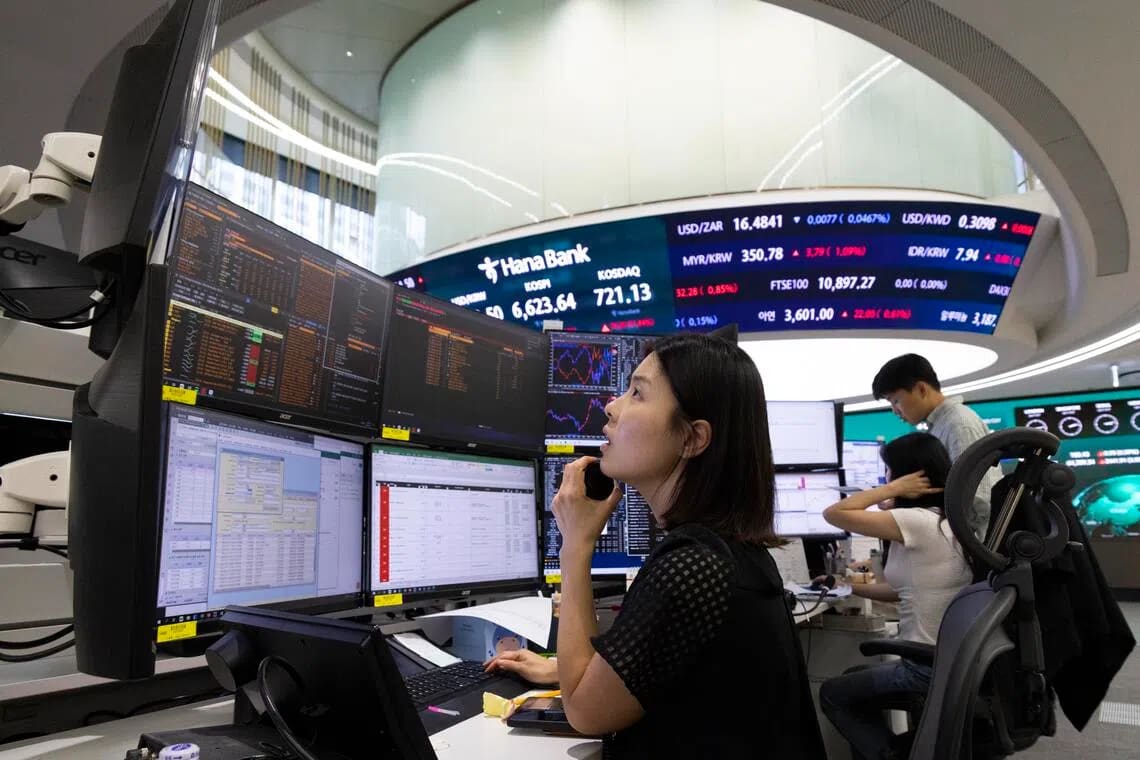
The most severe phase of South Korea's equity market turbulence appears to have passed after a wave of forced liquidations cleared out highly leveraged positions and new regulatory restrictions sharply reduced activity in risky products.
A volatility index tracking South Korean equities fell to a two-month low last week, down from a record 96.9 in June, according to exchange data. The decline followed mandatory liquidations that cut outstanding margin debt to 27.4 trillion won by August 4, the lowest level recorded in 2026. Morgan Stanley estimates the deleveraging process is now more than halfway complete.
The shift marks a turning point after months of wild swings that saw the Kospi Index drop nearly 40 percent from its June peak. Exchange circuit breakers, triggered when the market falls 8 percent, activated a record four times in July. On nearly half of July's trading days, the Kospi moved by at least 5 percent in either direction. The largest single-day swing came on July 31, when the index jumped 18 percent, a record.
Regulators Tighten Leverage Rules
South Korean authorities responded to the turmoil with a series of measures targeting leveraged products. New rules requiring higher cash deposits for single-stock leveraged ETFs took effect on July 31, leading to an immediate drop in trading volumes and assets for funds tracking Samsung Electronics and SK Hynix.
The combination of falling prices and tighter regulations drove retail investors out of the market in large numbers. Forced liquidations hit 1 trillion won worth of retail accounts in June, followed by 993 billion won in July, the two highest monthly totals this year, according to the Korea Financial Investment Association.
Outstanding margin loans, which retail investors use to finance stock purchases on credit, declined steadily through the summer. The reduction suggests that much of the leverage-driven excess that amplified the market's extraordinary volatility has now been flushed out.
Foreign Investors Hold Back Despite Cheap Valuations
Global fund managers have slowed their retreat from South Korean equities but have not reversed course. After pulling out a record 30 billion dollars in June, overseas investors withdrew another 6.2 billion dollars in July and 4.3 billion dollars in the first week of August, exchange data shows.
The selloff has left the Kospi trading at 5.1 times its 12-month forward earnings, a record low. Emerging-market funds remain underweight on South Korea, with total foreign outflows for 2026 exceeding 100 billion dollars.
Yet institutional investors are not rushing back. Isaac Thong, senior investment director at Aberdeen in Singapore, said his firm is becoming more positive but remains cautious. Volatility, while down from its peak, stays elevated relative to historical norms.
Yiping Liao, a fund manager at Templeton Global Investments in Singapore, acknowledged that Samsung and SK Hynix look inexpensive given their strong earnings outlook. However, extreme price swings are making managers hesitant to add positions aggressively. Instead, money is returning in small increments rather than large blocks.
Diverging Views on Recovery Timeline
Some market participants see significant upside. Goldman Sachs this week maintained its 12-month Kospi target of 12,000, implying roughly 90 percent gains from early August levels. Timothy Moe, the bank's chief Asia Pacific equity strategist, argued that once volatility normalizes, strong underlying fundamentals will reassert themselves.
Others prefer to wait longer. Sean Taylor, chief investment officer at Matthews International Capital Management, said his firm views fundamentals as sound but believes the market got overheated. He expects to remain on the sidelines for at least another month.
Maxence Visseau, chief investment officer at Arkevium Capital in Dubai, said a few calm trading days will not be enough to restore confidence. Foreign portfolio managers need sustained evidence that the market's price-discovery mechanism is functioning normally again before committing capital.
Retail-to-Institutional Shift Underway
The forced liquidations and regulatory changes appear to be shifting the market's composition. Visseau described the current moment as the beginning of a handoff from domestic retail investors to foreign institutions, a transition that could take months to complete.
The question now is whether the deleveraging process has removed enough speculative froth to allow fundamentals to drive prices, or whether further volatility will keep institutional capital on the sidelines. With earnings growth intact but risk appetite still fragile, South Korea's market sits at an inflection point.
RELATED STORIES
Seoul Market Climbs on Tech Rally After US Jobs Data
Cheng Wei-Lun · 3 min
South Korean Retail Investors Pivot to US Leveraged ETFs After Domestic Crackdown
Cheng Wei-Lun · 3 min
South Korea's Pension Giant Faces Questions Over Market Timing
Jun-ho Seo · 3 min

KT&G Posts Fourth Consecutive Quarter of Double-Digit Profit Growth
Cheng Wei-Lun · 3 min
Spot something wrong? Email editor@briefasia.com. We log every correction publicly.