Finance · Markets
South Korea's KOSPI Sheds a Third of Its Value as Chipmakers Face Chinese Competition
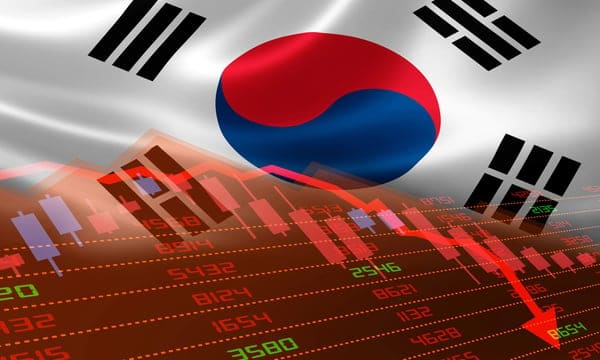
The benchmark index plunged from 9,385 to 5,663 in six weeks, exposing Seoul's reliance on Samsung and SK Hynix amid rising trade tensions and domestic chip advances in China.
KEY TAKEAWAYS
- ·South Korea's KOSPI index fell over 35 percent from a June 19 peak of 9,385 to 5,663 by July 29, driven by sharp declines in Samsung and SK Hynix shares.
- ·Semiconductors accounted for 43.8 percent of South Korea's exports in June 2026, with the sector representing nearly half of the KOSPI benchmark's weighting.
- ·Chinese advances in lithography equipment and U.S. export control uncertainty threaten South Korean chipmakers, who produce 30 to 40 percent of output in China.
A Dramatic Reversal
The Korea Composite Stock Price Index has entered a sharp correction, falling more than 35 percent since reaching an intraday peak of 9,385.59 on June 19. By July 29, the benchmark closed at 5,663.24, erasing months of gains driven by artificial intelligence infrastructure demand. The index had climbed 270 percent from the start of 2025 through its June high before investor sentiment reversed.
The speed and scale of the decline have drawn attention across Asian markets. Samsung Electronics and SK Hynix, which together represent nearly half of KOSPI's weighting, saw shares drop 13.4 percent and 14 percent respectively in a single session after reports emerged that Chinese firms were developing domestic deep ultraviolet lithography equipment. The news raised concerns that South Korean memory chipmakers could lose ground in the global market to domestic Chinese competitors.
The Semiconductor Concentration Risk
South Korea's economy has become increasingly concentrated in chipmaking. In 2024, semiconductors accounted for more than 10 percent of the country's manufacturing output, surpassing steelmaking and oil refining to become the largest industrial sector. By June 2026, semiconductor exports reached $44.8 billion, up 199.5 percent year-on-year, and represented 43.8 percent of total exports.
This concentration has amplified market volatility. When Samsung and SK Hynix face headwinds, the entire index moves. The two companies carry price-to-earnings ratios between 18x and 24x, elevated multiples that leave less room to absorb negative news. A shift in competitive dynamics or regulatory environment can trigger outsized reactions.
China's Dual Role
Beijing's influence on South Korean chipmakers operates through two channels: as both competitor and production base. China announced plans to spend $295 billion on a nationwide AI buildout, with a mandate that at least 80 percent of technology come from domestic suppliers such as Huawei Technologies. The strategy aims to reduce reliance on foreign manufacturers and strengthen local capabilities.
At the same time, South Korean firms depend on their Chinese operations. SK Hynix produces approximately 30 to 40 percent of its DRAM and NAND flash memory in China, while Samsung manufactures around one-third of its NAND chips there. Both companies operate under annual licenses from U.S. authorities after their end-user access validations were revoked in September 2025. The short-term nature of these licenses adds uncertainty to production planning and capital allocation.
Plants in China require equipment, components, and software governed by U.S. export controls. Any tightening of restrictions or delays in license renewals directly affect output. The regulatory environment between Washington and Beijing has become a material factor in South Korean corporate earnings.
Ripple Effects Across Asia
The sell-off has not remained confined to Seoul. Japanese flash memory chipmaker Kioxia Holdings fell 18 percent, and Taiwanese chip designer MediaTek declined 9 percent as concerns about Chinese competition spread through the region. The moves illustrate how interconnected Asian technology markets have become, with investor sentiment in one market quickly affecting others.
Taiwan and Japan face similar exposure. Their chipmakers also operate in a geopolitical environment shaped by U.S.-China relations and compete in overlapping market segments. High valuations across the sector mean that any perceived shift in competitive positioning can trigger rapid repricing.
Path to Stabilization
Recovery for KOSPI will likely depend on two factors: clarity in the U.S.-China trade relationship and diversification of production footprints. Some U.S. technology companies, including Nvidia, SpaceX, and Microsoft, have pushed back against tighter restrictions on Chinese AI adoption domestically. If this effort gains traction, it could ease some of the regulatory pressure affecting South Korean operations in China.
Longer-term resilience will require South Korean firms to reduce concentration risk. Expanding manufacturing capacity outside China and developing new export markets would lower vulnerability to single-country regulatory changes. The current correction has made the cost of dependency visible in market capitalization terms.
For now, the benchmark index remains down sharply from its June peak, and investor caution persists. The volatility serves as a reminder that rapid growth driven by a single sector carries structural risks, especially when that sector operates at the intersection of geopolitical competition and technological change.
RELATED STORIES
Samsung Electronics Drops 8% as Market Questions Buyback Strategy
Cheng Wei-Lun · 2 min
Seoul Stocks Drop on Mideast Tensions and Oil Price Surge
Tran Quoc Bao · 3 min

LG Pivots to AI-Defined Vehicle Platform as Korea Chases China's Self-Driving Lead
Jun-ho Seo · 3 min
Seoul Markets Tumble as Tech Selloff Ripples Across Asia
Cheng Wei-Lun · 3 min
Spot something wrong? Email editor@briefasia.com. We log every correction publicly.