Technology · Dev
South Korea's Danuri Orbiter Photographs SpaceX Rocket Impact on Moon's Far Side
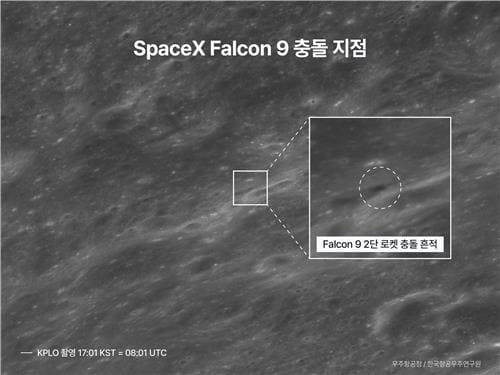
The lunar mission captured before-and-after imagery of a Falcon 9 upper stage striking near Einstein Crater, offering scientists new data on human-made impacts on the lunar surface.
KEY TAKEAWAYS
- ·South Korea's Danuri orbiter captured before-and-after images of a SpaceX Falcon 9 upper stage impacting the moon's far side near Einstein Crater on Wednesday.
- ·The documentation provides scientists with rare visual evidence of how human-made debris alters the lunar surface, offering controlled impact data with known parameters.
- ·The observation highlights growing space activity in cislunar space and South Korea's advancing capabilities in deep-space missions nearly four years into Danuri's operation.
Rare Observation from Lunar Orbit
South Korea's Danuri spacecraft has documented the moment a SpaceX Falcon 9 rocket upper stage collided with the moon, marking one of the few times scientists have obtained visual evidence of space hardware impacting the lunar surface. The Korea Aerospace Administration announced that the rocket component struck the far side of the moon near Einstein Crater on Wednesday afternoon, Korean time.
The orbiter's position allowed it to capture imagery both before and after the collision, a scientific opportunity that rarely presents itself. Most lunar impacts occur without direct observation, leaving researchers to study only the aftermath through crater analysis or relying on seismic data from instruments already deployed on the surface.
Technical Details of the Impact
According to the Korea Aerospace Administration, the impact occurred at 3:34 p.m. Korea time on Wednesday. The Falcon 9 upper stage hit the moon's far side, the hemisphere permanently facing away from Earth, in the vicinity of Einstein Crater, a large impact basin named after the physicist.
Danuri's cameras were oriented to observe the impact zone, positioning the spacecraft to record changes to the terrain caused by the collision. The rocket stage, which had completed its operational mission and been left in space, followed a trajectory that eventually intersected with the moon's orbit.
The far side location means ground-based telescopes on Earth could not observe the event directly, making Danuri's documentation particularly valuable for the scientific community.
Scientific Value of Impact Documentation
Human-made objects striking the moon provide researchers with controlled experiments in impact mechanics. Unlike natural meteoroid strikes, which vary widely in composition, velocity, and angle, spent rocket stages offer known parameters. Scientists can calculate the mass, speed, and trajectory with precision, then compare predictions against actual crater formation.
The Korea Aerospace Administration indicated that the before-and-after images will help scientists understand how the lunar regolith responds to high-velocity impacts. The data could inform future missions that intentionally crash spacecraft into the moon for research purposes, a technique NASA and other agencies have employed to study subsurface composition.
Danuri's imaging system captured the impact site under consistent lighting conditions, eliminating one variable that often complicates crater analysis. The orbiter's resolution should reveal whether the rocket stage created a single crater or fragmented on impact, producing multiple smaller depressions.
Danuri's Mission Profile
South Korea launched Danuri in August 2022 aboard a SpaceX Falcon 9 rocket from Cape Canaveral, making it the country's first spacecraft to reach lunar orbit. The mission aims to demonstrate South Korea's deep-space capabilities and collect scientific data on the moon's surface composition, magnetic anomalies, and resource distribution.
The orbiter carries multiple instruments, including a high-resolution camera, a magnetometer, and a gamma-ray spectrometer. Its polar orbit takes it over both the near and far sides of the moon, allowing comprehensive coverage that equatorial orbits cannot achieve.
The spacecraft has been operational for nearly four years, exceeding its initial design life and continuing to transmit data to ground stations in South Korea. The mission represents a significant milestone in Seoul's space program, which has accelerated investments in satellite technology and launch capabilities over the past decade.
Debris in Lunar Orbit
Spent rocket stages and defunct satellites occasionally end up in trajectories that intersect with the moon. Without an atmosphere to slow them down, these objects eventually succumb to gravitational perturbations from Earth and the sun, altering their orbits until they collide with the lunar surface.
Space agencies typically track large debris in cislunar space, the region between Earth and the moon, but precise impact predictions remain challenging. The Falcon 9 upper stage's trajectory had been monitored by tracking networks, allowing the Korea Aerospace Administration to position Danuri for observation.
The growing volume of space activity has increased the number of objects in Earth-moon space. As more missions launch toward the moon and beyond, the frequency of unintended lunar impacts is expected to rise, making systematic documentation increasingly important for understanding the cumulative effects on the lunar environment.
Regional Space Ambitions
South Korea's space program has expanded rapidly, driven by government funding and partnerships with private industry. The country successfully launched its first domestically developed orbital rocket, Nuri, in 2022, and has announced plans for additional lunar missions, including a lander targeted for the early 2030s.
Danuri's successful operation has positioned South Korea alongside a small group of nations with active lunar missions. China, India, Japan, and the United States currently operate or have recently operated spacecraft in lunar orbit or on the surface, reflecting intensified interest in the moon as a destination for scientific research and potential resource extraction.
The Korea Aerospace Administration has indicated that data from Danuri will inform the design of future missions, including landing site selection and instrument development. The orbiter's longevity and operational success have bolstered confidence in South Korea's ability to execute complex deep-space missions.
RELATED STORIES

South Korea Mobilizes Conglomerates for Humanoid Robot Push
Cheng Wei-Lun · 3 min

SK Hynix Eyes Stake Sale in $3 Billion China Packaging Facility
Cheng Wei-Lun · 2 min
Posco Future M Lands 190,000-Ton LFP Cathode Contract in Energy Storage Push
Jun-ho Seo · 3 min

LG Uplus Hits Record Quarterly Profit as AI Data Centers Offset Revenue Dip
Cheng Wei-Lun · 3 min
Spot something wrong? Email editor@briefasia.com. We log every correction publicly.