Technology · Products
South Korea Mobilizes Conglomerates for Humanoid Robot Push
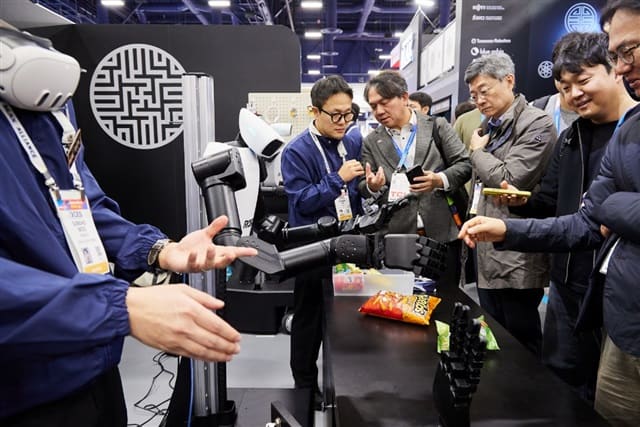
Seoul's industrial giants are mounting a coordinated effort to claim a stake in the global humanoid robotics market as competition intensifies between US and Chinese players.
KEY TAKEAWAYS
- ·South Korea's major conglomerates are entering the humanoid robot market in a coordinated push to compete with US and China.
- ·The chaebol system provides vertical integration advantages in batteries, sensors, and manufacturing that compress development timelines.
- ·Timing aligns with market shift from pilot programs to commercial procurement as logistics and manufacturing sectors evaluate deployments.
Seoul's Strategic Play
South Korea is assembling a third front in the global humanoid robotics race, deploying its conglomerates to challenge the established US-China duopoly. The coordinated industrial push marks Seoul's attempt to carve out a strategic position in a market that has attracted billions in capital and represents a potential inflection point in manufacturing and service automation.
The country's move comes as humanoid robotics transitions from research curiosity to commercial reality. Major economies view the sector as critical infrastructure for future competitiveness, particularly as labor shortages intensify across advanced manufacturing and aging societies face mounting care burdens.
The Conglomerate Advantage
South Korea's approach leverages the chaebol system, the family-controlled industrial groups that dominate the economy. These conglomerates bring integrated capabilities spanning electronics, batteries, automotive systems, and precision manufacturing that are essential for humanoid robot production.
The coordination allows for rapid scaling and vertical integration that standalone robotics startups struggle to achieve. Component supply chains, battery technology, sensor arrays, and actuator systems can be sourced internally, compressing development timelines and reducing dependency on external suppliers.
This structural advantage mirrors South Korea's successful playbook in semiconductors, displays, and electric vehicle batteries, where conglomerate resources and government coordination enabled the country to move from follower to leader within a decade.
Market Dynamics Shift
The humanoid robot market is experiencing a structural shift. Early movers in the US and China have demonstrated technical feasibility, but commercialization requires manufacturing scale, supply chain depth, and cost reduction that favor established industrial players over venture-backed startups.
South Korean firms enter with mature production systems already optimized for complex electromechanical products. The country's strengths in precision motors, advanced batteries, and display technology translate directly to humanoid robot requirements.
The timing aligns with growing demand signals. Logistics operators, automotive manufacturers, and healthcare systems are moving from pilot programs to procurement discussions, creating a window for new entrants with credible production capacity.
Regional Implications
South Korea's entry reshapes the competitive landscape in Asia. The country sits between China's massive domestic market and scale advantages, and Japan's robotics legacy and automation expertise. Seoul's strategy appears to target export markets where geopolitical concerns about Chinese technology create openings, while leveraging cost structures more competitive than Japanese manufacturers.
The move also reflects broader industrial policy trends across Northeast Asia, where governments view robotics as essential to maintaining manufacturing competitiveness amid rising labor costs and demographic headwinds. South Korea faces one of the world's fastest aging populations, making automation not just an export opportunity but a domestic imperative.
Technology and Talent
The conglomerate mobilization brings substantial R&D budgets and engineering talent pools into humanoid robotics. South Korean firms have invested heavily in AI research, battery chemistry, and mechatronics over the past decade, creating technical capabilities that can be redirected toward humanoid platforms.
The country also benefits from dense collaboration between industry and research institutions, a model that proved effective in semiconductor development. Government research funding and university programs are being aligned with commercial priorities to accelerate progress.
What Comes Next
South Korea's ability to execute will determine whether it becomes a genuine third force or remains a secondary player. The conglomerates must navigate technical challenges around bipedal stability, energy efficiency, and AI integration that have stalled previous robotics ambitions.
Success depends on moving beyond hardware manufacturing to develop the software and AI systems that enable humanoid robots to perform useful work. This represents a departure from South Korea's traditional hardware-centric approach and will test the country's ability to compete in AI development against US and Chinese capabilities.
The global humanoid robot market remains nascent, with commercial deployments measured in hundreds rather than thousands of units. But the trajectory suggests rapid scaling ahead, and South Korea's conglomerates are positioning to capture a meaningful share as the market matures. Whether Seoul's industrial coordination can match Silicon Valley's innovation velocity and China's manufacturing scale will shape the robotics landscape for the next decade.
RELATED STORIES

SK Hynix Eyes Stake Sale in $3 Billion China Packaging Facility
Cheng Wei-Lun · 2 min
South Korea's Danuri Orbiter Photographs SpaceX Rocket Impact on Moon's Far Side
Cheng Wei-Lun · 4 min
Posco Future M Lands 190,000-Ton LFP Cathode Contract in Energy Storage Push
Jun-ho Seo · 3 min

LG Uplus Hits Record Quarterly Profit as AI Data Centers Offset Revenue Dip
Cheng Wei-Lun · 3 min
Spot something wrong? Email editor@briefasia.com. We log every correction publicly.