Asia · Business
SingPost Chair Confirms State Aid Discussions as Postal Losses Mount
Teo Swee Lian tells shareholders confidential talks with Singapore government are underway but cannot be disclosed without official approval
KEY TAKEAWAYS
- ·SingPost chairperson Teo Swee Lian confirmed active discussions with Singapore government over support for the postal operator's loss-making mail business at the July 23 annual meeting.
- ·Teo declined to disclose the substance of confidential talks, stating she cannot reveal details until authorities decide to make information public.
- ·The postal division faces structural decline as digital communication replaces physical mail, while universal service obligations require costly nationwide delivery infrastructure regardless of commercial viability.
Government Talks Confirmed
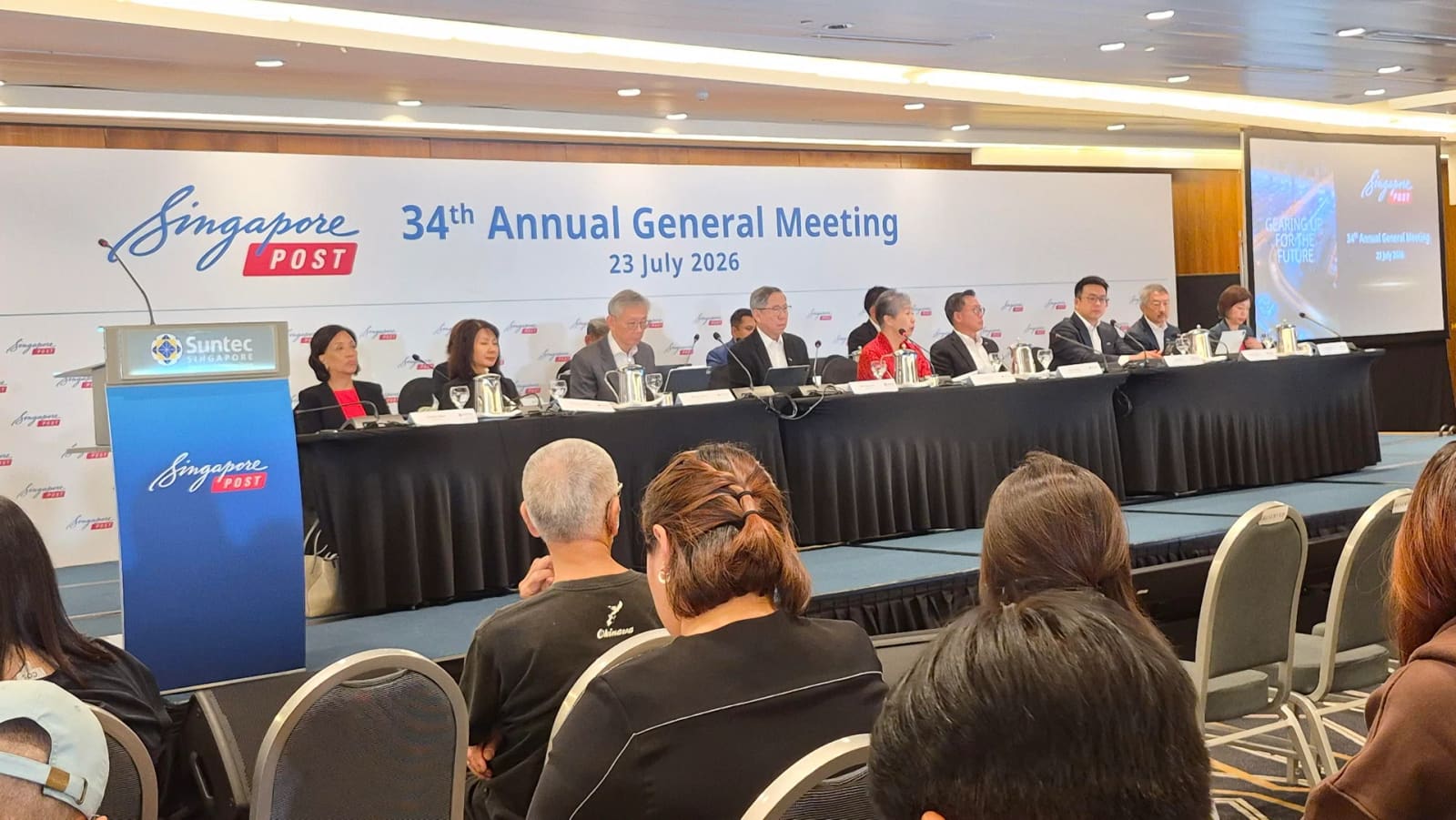
Singapore Post chairperson Teo Swee Lian has confirmed the national postal operator is in active discussions with the government over potential support for its loss-making postal operations, though she declined to share specifics during a shareholder meeting on July 23.
The acknowledgment came in response to a direct question from a shareholder at the company's 34th annual general meeting held at Suntec Singapore. The session, which ran approximately two and a half hours, saw 12 resolutions approved by attendees.
Teo stated she could not reveal the substance of the confidential exchanges until authorities decide to make the information public. The chairperson's careful phrasing underscores the sensitivity surrounding any potential state intervention in what remains a strategically important but financially troubled segment of SingPost's operations.
Postal Business Under Pressure
The postal division has become an increasing drag on SingPost's overall performance as mail volumes continue their structural decline across developed markets. Traditional letter post has faced years of erosion as digital communication replaces physical mail, while e-commerce growth has shifted the business mix toward parcel handling with different cost structures and competitive dynamics.
Singapore's universal postal obligation requires SingPost to maintain nationwide delivery infrastructure and service standards regardless of commercial viability. This mandate creates a cost base that revenue from shrinking mail volumes cannot sustain without cross-subsidy from other business lines or external support.
The tension between public service obligations and commercial realities has prompted similar discussions in postal systems across Asia and beyond. Japan Post, Australia Post, and Royal Mail in the United Kingdom have all navigated various forms of government support, regulatory relief, or structural reform to address the same fundamental challenge.
Regional Context for State Support
Across Asia, governments have taken divergent approaches to supporting postal operators as they transition from traditional mail to logistics and digital services. The question is not whether state support is warranted, but what form it should take and how to structure it without distorting competitive markets.
In Japan, the postal system operates with implicit government backing despite privatization, maintaining extensive retail networks that serve financial and insurance functions alongside mail. South Korea has allowed its postal operator to expand aggressively into logistics and e-commerce fulfillment, leveraging its network as strategic infrastructure.
Singapore's situation differs in scale but not in kind. The city-state's compact geography makes last-mile delivery efficient but offers limited scope for the cross-subsidies that larger postal systems can extract from profitable urban routes to fund rural obligations. SingPost has diversified into e-commerce logistics, international mail, and property, yet the core postal mandate remains a structural challenge.
Any government support would need to balance several considerations: maintaining universal service, avoiding unfair competitive advantage in commercial parcel markets where private operators compete, and establishing a sustainable financial model that does not require recurring bailouts.
Transparency and Shareholder Concerns
Teo's refusal to elaborate on the discussions reflects standard practice around confidential government negotiations, but it also highlights the information asymmetry facing minority shareholders in a company where Temasek Holdings, Singapore's sovereign wealth fund, holds a significant stake.
Shareholders have reason to seek clarity. The trajectory of the postal business directly affects SingPost's valuation, capital allocation, and dividend capacity. If state support materializes in the form of subsidies for universal service obligations, it could stabilize cash flow and free management to pursue commercial opportunities without the burden of cross-subsidizing unprofitable mail routes.
Alternatively, support could take regulatory form through relaxed service standards, price adjustments, or cost-sharing arrangements that reduce the financial gap without direct fiscal transfers. The structure matters as much as the quantum.
Strategic Implications
The outcome of these discussions will shape SingPost's strategic options for the next decade. A clear framework for funding universal postal obligations would allow management to make investment decisions in logistics, automation, and regional expansion without the constant drag of legacy mail losses.
For Singapore, the question touches on broader themes of how the state manages strategic infrastructure in sectors undergoing digital disruption. Postal networks, like telecommunications and transport, occupy a middle ground between pure public goods and competitive markets. Getting the support structure right matters not just for SingPost but as a template for other sectors facing similar transitions.
The AGM provided no timeline for when the government might make a decision or announcement. Until then, shareholders and market observers are left to parse limited disclosures and await official word. What is clear is that the discussions are active, senior leadership is engaged, and the outcome will have material consequences for how SingPost navigates the structural decline of its founding business while building its future in logistics and digital commerce.
RELATED STORIES
Vietnam Draws $7.5 Billion From Singapore in Seven Months
Priyanka V. Rao · 3 min
Singapore Eyes Global Investment Court as UN Talks Near Final Stage
Priyanka V. Rao · 3 min
Singapore Economists Lift 2026 Growth Outlook to 5% as Chip Exports Surge
Priyanka V. Rao · 3 min
Singapore Inflation Climbs on Power Tariffs, Stays Below Forecasts
Lim Hui Ying · 5 min
Spot something wrong? Email editor@briefasia.com. We log every correction publicly.