Asia · Business
Singapore Eyes Global Investment Court as UN Talks Near Final Stage
The Republic has announced plans to compete for the seat of a permanent tribunal designed to hear investor-state disputes, as negotiations advance at UNCITRAL
KEY TAKEAWAYS
- ·Singapore has formally announced a bid to host the Multilateral Investment Tribunal, a permanent court under negotiation at UNCITRAL to replace ad hoc arbitration for investor-state disputes.
- ·More than half of all treaty-based investor-state cases filed since 1987 have emerged in the past decade, straining a system criticized for inconsistent rulings and arbitrator independence concerns.
- ·The Republic will build a dedicated tribunal facility and fund participation by developing countries, with UNCITRAL member states set to address final procedural issues in October.
A New Architecture for Investment Disputes
Singapore has formally declared its intention to compete for the permanent seat of a Multilateral Investment Tribunal, a body under negotiation at the United Nations Commission on International Trade Law that aims to replace today's fragmented arbitration model for investor-state conflict resolution.
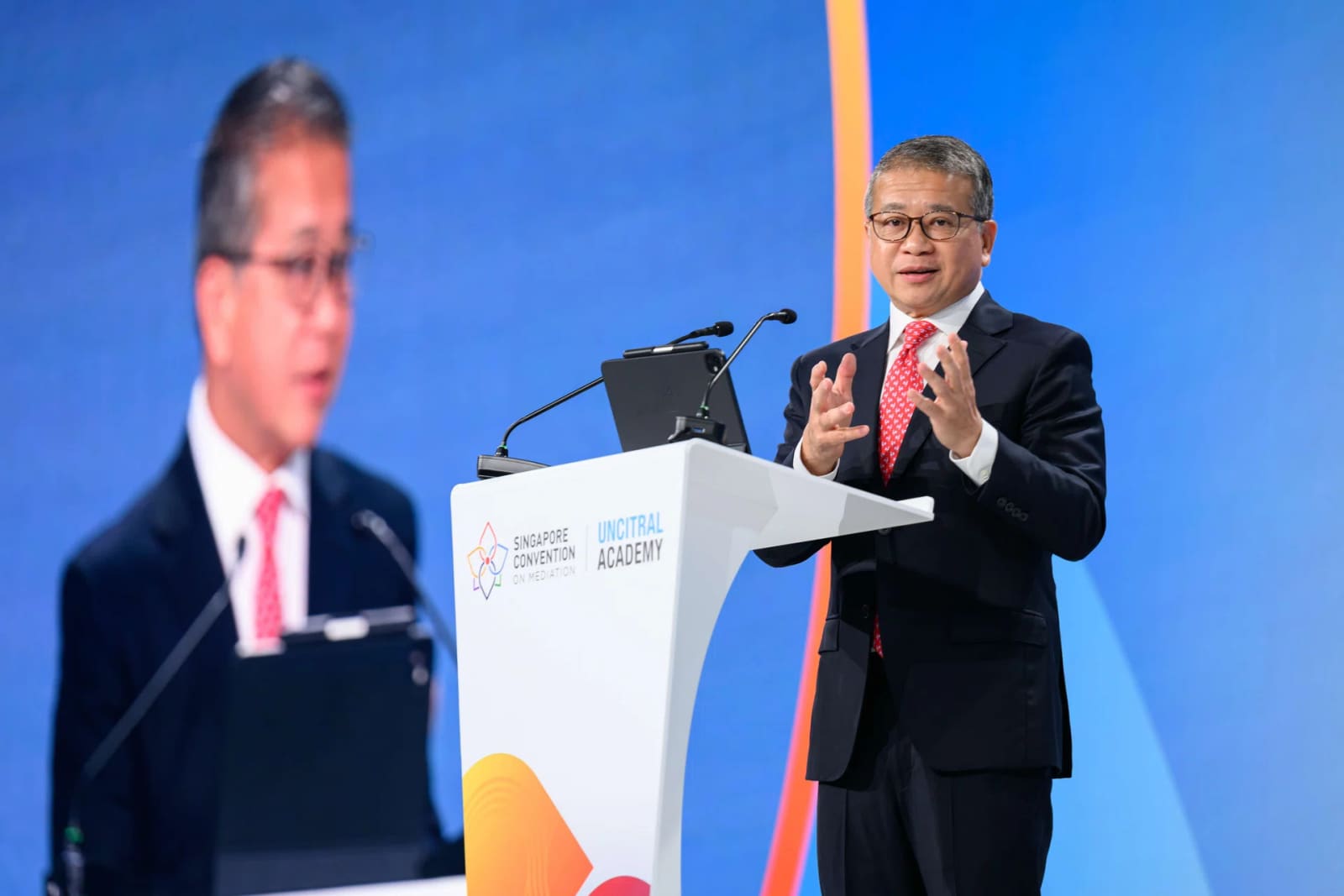
Law Minister Edwin Tong unveiled the bid on August 25 during remarks at the UNCITRAL Academy Conference, framing the move as a response to structural pressures in the current system. Working Group III at UNCITRAL has been refining draft statutes for both the tribunal and an appellate layer since 2017, with procedural details slated for discussion at an October session.
Why the Push for a Standing Court
The existing framework relies on ad hoc panels convened under bilateral investment treaties, a structure that has drawn fire for producing contradictory rulings and raising questions about arbitrator neutrality. More than half of all treaty-based investor-state cases filed since 1987 have emerged in the past ten years, according to figures cited by Tong, straining a system that critics say lacks coherence.
Governments today face disputes tied to decisions on public health measures, energy infrastructure, climate regulation, and security controls. Each intervention carries the risk of a claim, yet the current arbitration model offers little consistency in how those claims are adjudicated. A permanent tribunal with a defined roster of judges and an appellate mechanism is intended to address those gaps, delivering predictability without constraining policy flexibility.
Singapore's Case
Tong outlined three pillars underpinning the Republic's candidacy. First, Singapore presents a jurisdiction anchored in the rule of law, with no legacy ties to former colonial powers that might compromise perceptions of neutrality. Second, the city-state has built a dense ecosystem of dispute resolution institutions over the past two decades, including the Singapore International Arbitration Centre, the Singapore International Commercial Court, and the Singapore International Mediation Centre. Third, Singapore's geographic position and treaty network connect it to both developed and emerging economies across Asia, the Middle East, and Africa.
The government plans to construct a dedicated facility for the tribunal, complete with hearing rooms, registry space, and accommodation for judges. Tong also pledged financial support for a fund that would subsidize participation by developing and least-developed countries, covering translation, transcription, and related costs. Additional details of the proposal will be released at a later date.
A Distinct Field
Toby Landau, head of chambers at Duxton Hill Chambers in Singapore, noted that the Multilateral Investment Tribunal would operate in a domain separate from commercial arbitration. Investor-state disputes arise under approximately 3,000 bilateral and regional investment treaties, often involving sums that dwarf typical commercial claims and touching on sovereign regulatory decisions that carry political sensitivity.
While Singapore is the first jurisdiction to publicly announce a bid, Landau expects competition from other candidates. He argued that the center of gravity in investment law should migrate toward Asia, given the region's share of treaty relationships and its rising weight in global capital flows. Routing disputes involving Asian parties through European institutions by default, he said, makes less practical sense in today's economic geography.
A New Research Hub
In parallel, the Ministry of Law and the National University of Singapore announced the establishment of a Centre for Arbitration and International Dispute Resolution, to be led by Professor Stavros Brekoulakis. The center will focus on transparency, governance, and investor-state settlement, and will launch an advanced-studies program aimed at experienced arbitration practitioners rather than entry-level candidates.
Admission will be selective, with small cohorts and a curriculum blending theory with practical skills such as procedural strategy and advocacy. Tong said the program is designed to build a durable professional network among participants and to generate research informed by live disputes.
Singapore has invested heavily in international law infrastructure since 2009, when the Centre for International Law was established at NUS. The new center extends that footprint into investor-state work, an area where the Republic has had less visibility but where demand is growing as treaty-based claims multiply.
What Comes Next
UNCITRAL's October meeting will address outstanding procedural questions, moving the draft statutes closer to adoption. Once member states finalize the framework, a decision on the tribunal's location will follow. Singapore's bid positions it as a contender in a process that will shape the architecture of cross-border investment protection for decades.
The Republic's pitch rests on infrastructure, neutrality, and connectivity. Whether those assets prove decisive will depend on how negotiators weigh geographic balance, political considerations, and the practical demands of running a permanent judicial body serving a global constituency.
RELATED STORIES
Singapore Rolls Out $55,000 Per Child in Push Against 0.87 Fertility Rate
Lim Hui Ying · 3 min

DBS Hires 10% More Staff in Singapore as AI Adoption Tops 70%
Priyanka V. Rao · 3 min
Singapore's Full Childcare Leave Reimbursement Wins Employer Praise Despite Staffing Worries
Lim Hui Ying · 3 min
Singapore and Vietnam Launch Strategic Dialogue on Talent and Technology
Priyanka V. Rao · 3 min
Spot something wrong? Email editor@briefasia.com. We log every correction publicly.