Asia · Trade
Singapore's Tuas Port Crosses 25 Million TEU Mark as Region Faces $90 Billion Infrastructure Shortfall
The automated facility has processed over 25 million containers since 2022, while a World Bank study warns East Asia and Pacific ports need $12 billion annually to keep pace with trade growth.
KEY TAKEAWAYS
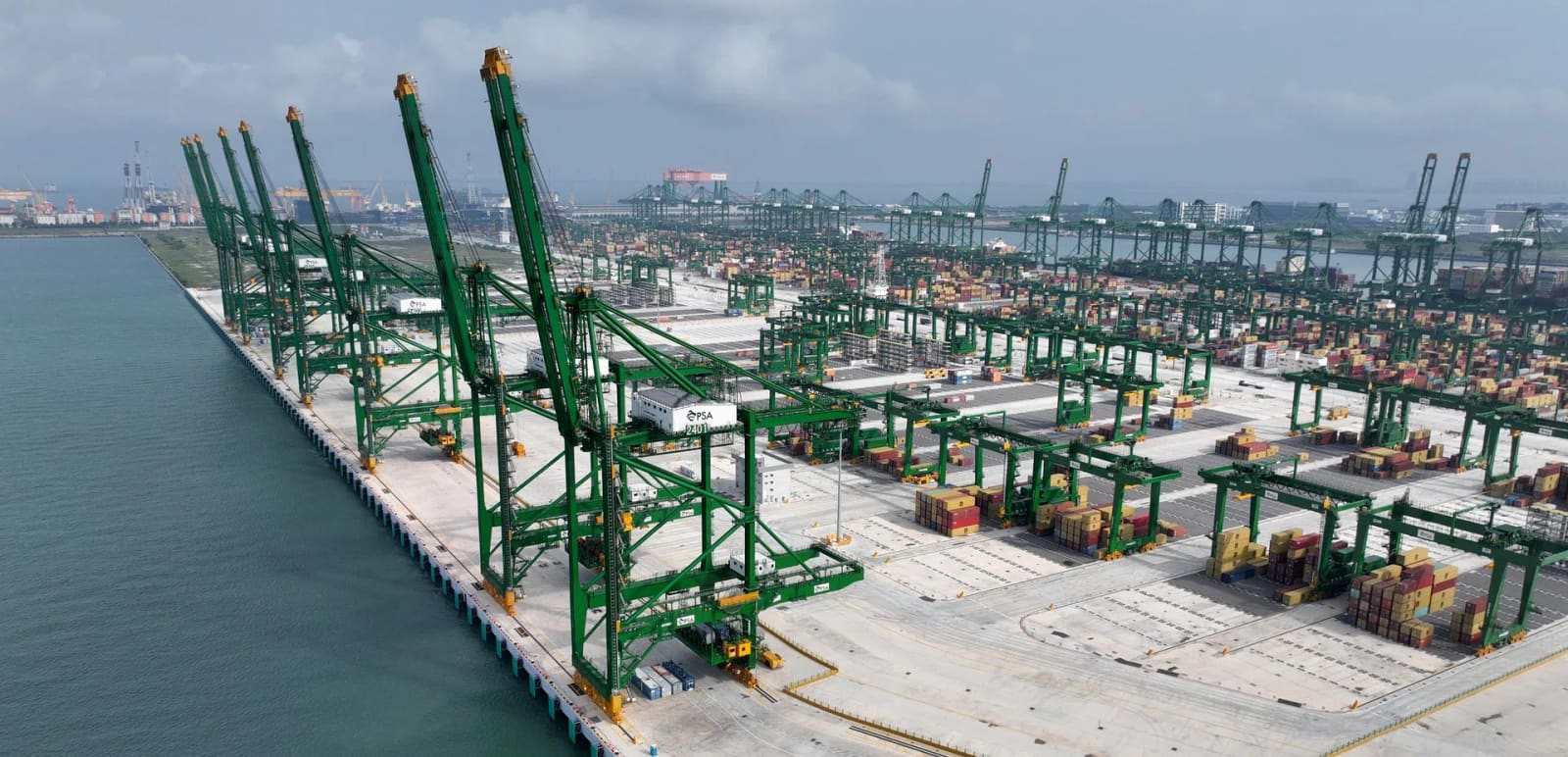
- ·PSA Singapore's Tuas Port has processed 25 million twenty-foot equivalent units since opening in September 2022, with 14 berths operational and expansion to 18 planned by 2027.
- ·A World Bank study shows East Asia and Pacific ports need $12 billion in annual investment through 2040 to nearly double capacity to 300 million TEUs and keep pace with trade growth.
- ·Singapore, the Philippines, Indonesia, Thailand, and Malaysia will require approximately 25 percent of the $90 billion total regional investment needed over the next fifteen years.
Automated Operations Scale Beyond Proof-of-Concept Phase
PSA Singapore announced Thursday that Tuas Port has processed 25 million twenty-foot equivalent units since beginning operations in September 2022, marking a significant operational milestone for what the port operator calls the world's largest fully automated container terminal.
The volume demonstrates that the facility's automation systems can handle substantial cargo flows without the operational bottlenecks that have plagued other automated port projects globally. Tuas currently operates 14 berths and is scheduled to expand to 18 by 2027, according to PSA.
"With global trade patterns becoming increasingly complex, robust coordination across ports and supply chain nodes has become more essential than ever," PSA International group chief executive Ong Kim Pong said.
The port forms a central piece of PSA's regional strategy, connecting Singapore's transshipment operations with the company's network of 600 ports worldwide. PSA Singapore processed 44.5 million TEUs in 2025 across its facilities.
Regional Capacity Crunch Looms
The Tuas milestone arrives as a late-July World Bank study revealed a stark infrastructure investment gap across East Asia and the Pacific. Ports in the region require $12 billion in annual investment between 2025 and 2040 to maintain efficiency and expand capacity.
Assuming container trade grows at 3.5 to 4 percent annually, the region needs $90 billion in total investment over the period, equivalent to $6 billion per year. That investment would nearly double regional capacity to 300 million TEUs by 2040, according to the World Bank.
Singapore, the Philippines, Indonesia, Thailand, and Malaysia account for roughly 25 percent of the required capital outlay. The figures underscore the scale of infrastructure spending needed to prevent port congestion from becoming a structural constraint on Asian trade growth.
Singapore's Bet on Automation and Integration
Tuas Port represents Singapore's response to shifting cargo patterns and the need for resilient supply chain infrastructure. The facility is designed to absorb fluctuations in global trade flows and provide buffer capacity during geopolitical disruptions.
Beyond moving containers, PSA has built digital tools and logistics services that provide supply chain visibility and coordinate freight movements across multiple nodes. The company positions these capabilities as differentiators in a market where pure throughput volume is no longer the sole competitive metric.
The port's expansion timeline suggests PSA is confident in sustained demand. Adding four berths by 2027 will increase the terminal's capacity to handle larger vessel calls and accommodate growth in intra-Asian trade routes, which have seen volume increases as supply chains regionalize.
What the Numbers Mean for Asia's Trade Corridors
The $90 billion regional investment figure reflects more than infrastructure maintenance. It signals that port capacity must expand faster than historical rates to accommodate manufacturing shifts, e-commerce logistics demands, and the physical infrastructure requirements of decarbonization efforts.
Ports in Southeast Asia face additional pressure from vessel upsizing. Larger container ships require deeper berths, stronger cranes, and more sophisticated yard management systems. Automation, while capital-intensive upfront, offers long-term labor cost advantages and operational consistency that manual terminals struggle to match.
Tuas Port's performance provides a data point for other regional operators considering automation investments. The 25 million TEU figure, achieved in under three years of operations, suggests the technology can deliver throughput at scale when integrated with robust digital infrastructure.
PSA's network approach also reflects a broader industry shift. Ports increasingly compete not on individual terminal performance but on their ability to offer integrated logistics solutions across multiple geographies. That shift favors operators with capital, technology platforms, and existing port networks, raising the competitive bar for smaller regional players.
RELATED STORIES
Singapore Wage Council Opens Consultation for 2026-2027 Guidelines
Priyanka V. Rao · 2 min
Singapore's Religious Sector Collected $1.4 Billion in Donations Last Year
Priyanka V. Rao · 4 min
Utah Positions Itself as Lower-Profile Alternative to Texas for Asian Capital
Priyanka V. Rao · 4 min
Singapore Banks Hit Record Highs on Wealth Management Surge
Priyanka V. Rao · 2 min
Spot something wrong? Email editor@briefasia.com. We log every correction publicly.