Asia · Business
Singapore's Religious Sector Collected $1.4 Billion in Donations Last Year
Faith-based charities commanded nearly 40% of all charitable giving in FY2024, powered by megachurches, Buddhist temples, and centralized Islamic funds
KEY TAKEAWAYS
- ·Religious charities in Singapore received $1.4 billion in donations during FY2024, representing 38% of all charitable contributions filed with the Commissioner of Charities.
- ·New Creation Church reported $154.7 million in tithes and offerings for FY2025 and holds accumulated reserves exceeding $1 billion, including substantial commercial property assets.
- ·Islamic giving flows through centralized channels managed by MUIS, which collected $73 million in zakat and $48.9 million in MBMF contributions during 2024.
Largest Single Recipient Category
Religious charities in Singapore collected $1.4 billion in donations during FY2024, making faith-based organizations the single largest recipient category among the city-state's roughly 2,400 registered charities. That figure represents 38% of the $3.68 billion in total charitable donations recorded that year, according to data filed with the Commissioner of Charities.
The sum places the religious sector ahead of education, healthcare, and social services in terms of donor contributions. When government grants and other revenue streams are included, total receipts for religious charities reached $2.02 billion for the year. Other income sources contributed $597.5 million, spanning program fees, investment returns, membership dues, and merchandise sales. Government grants added another $17.4 million.
The figures underscore the financial scale of faith-based institutions in a city-state where weekend worship still draws tens of thousands. Donations arrive via cash envelopes, PayNow transfers, and automated GIRO deductions, funding not just religious services but also schools, eldercare facilities, healthcare providers, and overseas mission work.
Christian Megachurches Lead Disclosure
Large Christian congregations dominate the upper end of disclosed donation figures, partly because their centralized structures make financial reporting more transparent. New Creation Church reported total receipts of $205.4 million in FY2025, with $154.7 million derived from tithes and offerings. That donation total rivals the annual fundraising of major universities and hospitals in Singapore.
The church holds accumulated reserves exceeding $1 billion, maintained under a policy requiring at least three months of operating expenses in reserve. It spent $149.8 million during the year. Much of its commercial activity runs through Rock Productions, a wholly owned subsidiary that operates The Star Performing Arts Centre and The Star Vista Mall, along with a bookshop and travel agency. Rental income from these properties contributed $35 million, or 17.2% of the church's total receipts.
Other large congregations file comparable numbers. City Harvest Church, Cornerstone Community Church, and Faith Community Baptist Church all report substantial donation and expenditure totals annually.
Buddhist and Hindu Institutions Match Scale
Buddhist temples rank among Singapore's most prolific fundraisers, though their financial data is less centrally aggregated than Christian megachurches. Kwan Im Thong Hood Cho Temple collected $35.96 million in total receipts during FY2025, with $28.79 million coming directly from donations. The temple spent $19.71 million and held $238.29 million in accumulated reserves.
Buddha Tooth Relic Temple and Museum reported $24.85 million in total receipts, roughly half from donations and ceremony-related income. It spent $18.79 million and ended the year with $74.53 million in reserves.
Hindu institutions operate under partial centralization through the Hindu Endowments Board, a statutory body administering four major temples. HEB reported $19.6 million in total income for FY2025, including $4.6 million in donations and $5.5 million in temple service income. It managed $92.2 million in total funds. Independent Hindu temples also receive significant sums. Arulmigu Velmurugan Gnana Muneeswarar Temple reported $4.16 million in total income for FY2023, while Murugan Hill Temple recorded $1.73 million in FY2025.
Islamic Giving Flows Through Centralized Channels
Muslim charitable giving in Singapore operates through a more centralized system than most other faiths. The Islamic Religious Council of Singapore oversees all mosques and administers zakat collections and the Mosque Building and Mendaki Fund. MBMF contributions, collected through the CPF system, are mandatory by default for working Muslims, who contribute between $3 and $26 monthly.
MBMF contributions climbed from $421,203 in 1975 to $48.9 million in 2024, with accumulated reserves reaching $230.6 million by year-end. MUIS collected $73 million in zakat during 2024. Voluntary sadaqah donations, which are not centrally tracked, are estimated by Islamic Finance Singapore to total around $105 million annually across the city-state's roughly 70 mosques, based on a sample of audited financial statements.
Property Holdings Add Substantial Value
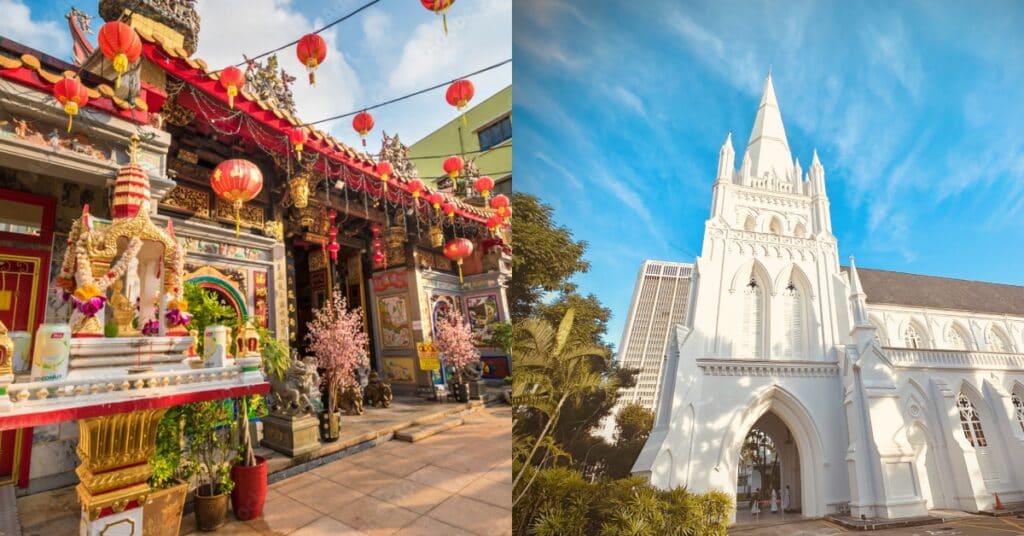
Beyond cash flow, many religious organizations hold significant real estate. Historic sites such as Lian Shan Shuang Lin Monastery, Sri Mariamman Temple, and Church of St. Joseph occupy freehold or long-tenure land acquired decades ago. Newer government land sales for places of worship typically offer 30-year leasehold terms.
Some organizations have invested heavily in commercial property. Rock Productions spent close to $500 million acquiring The Star Performing Arts Centre and The Star Vista Mall, assets that now generate rental income for New Creation Church.
Tax Treatment and Compliance
Registered charities in Singapore, including religious organizations, are generally exempt from income tax on income applied to charitable purposes. Commercial subsidiaries, however, face corporate income tax like any other business. Property used exclusively for public worship or charitable purposes may receive full or partial exemption under the Property Tax Act.
Charities with Institution of a Public Character status can issue tax-deductible receipts, encouraging larger donations. IPC status, tax exemptions, and charity registration all carry ongoing compliance requirements and can be revoked.
Regulatory oversight of religious finances intensified after the City Harvest Church scandal. A statutory inquiry opened in 2010 uncovered a scheme involving about $50 million, including $23 million channeled into sham bond investments used to finance the music career of Sun Ho, wife of founder Kong Hee. The case remains Singapore's most significant instance of religious-charity misconduct and prompted stricter governance standards across the sector.
RELATED STORIES
Singapore Wage Council Opens Consultation for 2026-2027 Guidelines
Priyanka V. Rao · 2 min

Utah Positions Itself as Lower-Profile Alternative to Texas for Asian Capital
Priyanka V. Rao · 4 min
Singapore Banks Hit Record Highs on Wealth Management Surge
Priyanka V. Rao · 2 min
Allianz Acquires HSBC Singapore Insurance Operations in $2.3 Billion Deal
Priyanka V. Rao · 3 min
Spot something wrong? Email editor@briefasia.com. We log every correction publicly.