Finance · Markets
Singapore's STI Falls as Fed Stance Rattles Regional Markets
The benchmark index dropped 0.7 percent after US equities posted their steepest decline in over a year, with local banks and industrials leading losses.
KEY TAKEAWAYS
- ·Singapore's Straits Times Index fell 0.7 percent to 5,673.58 on Thursday, with losers outnumbering gainers 328 to 272 as 1.2 billion securities worth S$2.3 billion traded hands.
- ·The decline followed a 1,000-point drop in the Dow Jones Industrial Average after Fed chair Kevin Warsh held rates at 3.5 to 3.75 percent while signaling renewed focus on price stability without providing forward guidance.
- ·Local banks led losses with OCBC down 2.3 percent to S$29.10, while Keppel dropped 4.3 percent to S$11.48 after reporting a 59 percent decline in first-half net profit.
Regional Equities Under Pressure
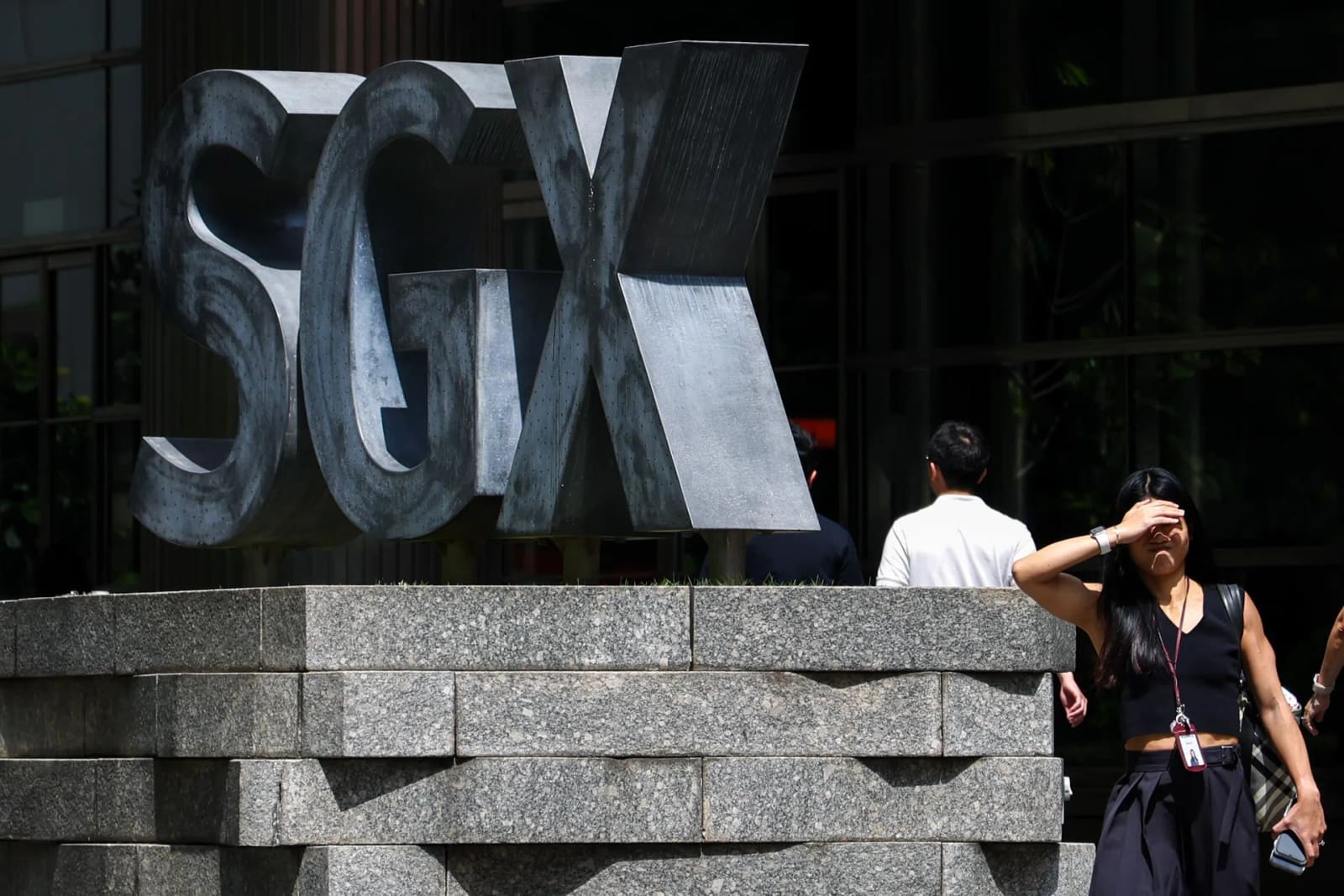
Singapore's equity market stumbled Thursday morning as ripples from the Federal Reserve's latest policy stance reached Asia-Pacific trading floors. The Straits Times Index shed 39.61 points to close at 5,673.58, marking a 0.7 percent decline after touching an intraday low of 5,638.94 earlier in the session.
The retreat followed a steep sell-off on Wall Street, where the Dow Jones Industrial Average plunged over 1,000 points in its largest single-day drop since April 2025. The S&P 500 hit its lowest level for the month, signaling heightened anxiety among investors grappling with persistent inflation concerns and limited clarity on the central bank's next moves.
Trading volume on the Singapore Exchange reflected the cautious mood. Losers outnumbered gainers 328 to 272, with 1.2 billion securities worth S$2.3 billion changing hands. The breadth of the decline underscored broad-based pressure across sectors, though some pockets of resilience emerged by the close.
Banks and Industrials Lead Declines
Singapore's three major banks absorbed the brunt of the sell-off. OCBC dropped 2.3 percent to S$29.10, shedding S$0.68 per share. DBS slipped 0.2 percent to S$74.85, while UOB edged down 0.02 percent to S$43.88. The financial sector's sensitivity to interest rate expectations made it particularly vulnerable as markets recalibrated their outlook following the Fed's decision.
Keppel tumbled 4.3 percent to S$11.48 after disclosing a 59 percent decline in first-half net profit, hitting an intraday low of S$11.35 during afternoon trading. The conglomerate's earnings miss added to the weight on the index.
Semiconductor-related counters also felt pressure. AEM Holdings fell 3.7 percent to S$7.57 after opening 6.4 percent lower, while UMS Holdings dropped 0.9 percent to S$2.17, having started the session down 3.2 percent. Both stocks recovered some ground as the morning progressed, but remained firmly in negative territory.
Energy plays showed divergent paths. Oiltek International declined 0.7 percent, while RH PetroGas bucked the trend with a 2.4 percent gain, highlighting sector-specific dynamics amid broader market weakness.
Fed Policy Ambiguity Fuels Volatility
The source of investor unease traces back to Fed chair Kevin Warsh's decision to hold rates steady in the 3.5 to 3.75 percent range. While the unchanged policy met baseline expectations, the accompanying statement signaled a renewed commitment to price stability without endorsing any implicit inflation target above 2 percent. Markets interpreted this as a hawkish tilt, yet the absence of forward guidance left the policy trajectory unclear.
Tiger Brokers market strategist James Ooi noted that the Fed's retreat from providing explicit guidance offers the central bank greater flexibility but leaves investors navigating uncertainty. Futures markets currently price in a September rate hike, though Ooi cautioned that such pricing reflects sentiment rather than a reliable forecast of how Federal Open Market Committee members will vote.
The ambiguity is particularly challenging for Asia-Pacific markets, where monetary policy coordination with the Fed often shapes domestic rate decisions and capital flows. Singapore's financial sector, deeply integrated into global funding markets, faces headwinds if US rates remain elevated or move higher, compressing net interest margins and dampening loan growth.
Mixed Picture Across the Region
Regional bourses painted a varied picture Thursday. Hong Kong's Hang Seng Index advanced 0.2 percent, while Japan's Nikkei 225 climbed 0.7 percent, suggesting some resilience in North Asian markets. South Korea's Kospi fell 1.2 percent, mirroring Singapore's weakness, while Malaysia's FTSE Bursa Malaysia KLCI rose 0.3 percent.
The divergence reflects differing exposures to US monetary policy and domestic growth dynamics. Markets with heavy technology and export weightings, such as South Korea and Singapore, tend to be more sensitive to shifts in dollar funding costs and global demand expectations. Conversely, markets with stronger domestic consumption drivers or commodity linkages have shown greater insulation.
For Singapore, the interplay between Fed policy and local economic conditions remains critical. The city-state's open capital account and status as a regional financial hub make it a barometer for investor sentiment toward emerging Asia. Continued volatility in US equities and uncertainty around the Fed's inflation fight are likely to weigh on the STI in the near term, particularly if corporate earnings disappoint or regional growth forecasts are revised downward.
The Thursday session underscores the fragility of risk appetite as the second half of 2026 unfolds. With the Fed prioritizing inflation control over growth support, Asia-Pacific investors face a more challenging environment for equities, especially in rate-sensitive sectors like financials and industrials.
RELATED STORIES
Singapore Brokerages Raise STI Targets on Earnings Strength
Jun-ho Seo · 3 min
Frencken Stock Falls 7.5% After $100 Million Share Placement
Cheng Wei-Lun · 3 min
Singapore REITs Raise S$4.5 Billion in Nine Months as Fundraising Momentum Extends Into 2026
Priyanka V. Rao · 3 min

DBS Doubles Down on Asia, Ruling Out Global Expansion
Anand Sundaram · 3 min
Spot something wrong? Email editor@briefasia.com. We log every correction publicly.