Real Estate · Offices
Singapore Investors Capture 62% of Hong Kong Commercial Property Sales in Q2
Sharp office price corrections draw capital from the Lion City as mainland Chinese buyers retreat from a market that has fallen as much as 50%
KEY TAKEAWAYS
- ·Singapore-based investors spent HKD 3.37 billion on Hong Kong commercial property in Q2 2026, accounting for 62% of overseas capital, while mainland Chinese buyers dropped to 23% after dominating the previous quarter.
- ·Office asset prices in Hong Kong have fallen as much as 50% from peak levels, drawing opportunistic capital from Singapore seeking quality assets at discounted entry points.
- ·Grade A office rents in Central rose 7.3% in the first half of 2026, the strongest half-year growth in 15 years, with vacancy falling to 8.8% from 10.9% at year-end 2025.
A Shift in Regional Capital Flows
Singapore-based investors poured HKD 3.37 billion into Hong Kong commercial property during the second quarter of 2026, claiming 62% of all overseas investment in the sector and eclipsing mainland Chinese buyers for the first time in recent memory. The shift marks a turning point in regional capital allocation as years of price corrections create what many view as a generational buying opportunity in one of Asia's most expensive property markets.
Total non-local and mainland Chinese investment in Hong Kong commercial real estate reached HKD 5.46 billion (USD 696.23 million) in the April-June period, according to Colliers. Mainland investors, who led the previous quarter with HKD 4.73 billion in acquisitions, pulled back sharply to HKD 1.23 billion, representing just under 23% of the total.
The reversal was stark. During the first quarter, Singapore-based buyers made zero commercial property acquisitions in Hong Kong, while mainland capital dominated. By the second quarter, the dynamic had flipped entirely.
Pricing Becomes Irresistible
Thomas Chak, head of capital markets and investment services at Colliers, pointed to pricing as the primary driver. Office asset values in Hong Kong have declined as much as 50% from their peaks following several years of market correction, creating entry points that Singapore capital finds compelling.
"Singaporean investors are drawn to Hong Kong more prominently in the second quarter because pricing has become significantly more attractive after several years of correction," Chak noted. "Many see this as an opportunity to acquire quality assets at a discount while positioning for a longer-term market recovery."
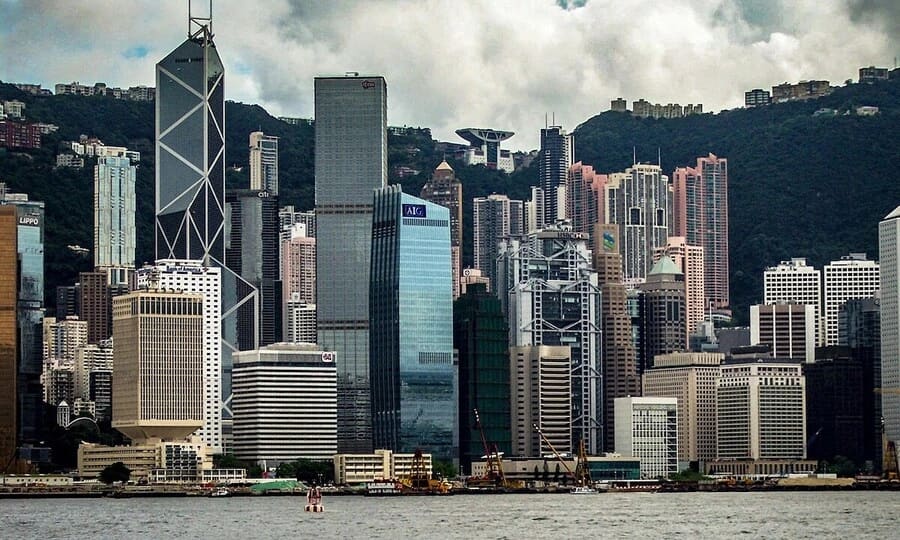
DBS Bank (Hong Kong) led the charge with its acquisition of 14,121 square meters of office space across multiple floors at The Center, a landmark tower in Hong Kong's central business district. The bank paid approximately HKD 2.62 billion for the space. Singapore-listed Wee Hur Holdings followed with the purchase of One Bedford Place, a 17,098-square-meter office building in Tai Kok Tsui, for HKD 748.8 million.
Green Shoots in Central
While the broader Hong Kong office market remains under pressure, prime properties in Central have begun to stabilize. Grade A office rents in the district rose 7.3% in the first half of 2026, the strongest half-year rental growth in 15 years, according to JLL. Vacancy rates in the same segment fell to 8.8% from 10.9% at the end of 2025.
The recovery in Central stands in contrast to the wider office leasing market, which continues to grapple with oversupply and shifting tenant preferences in the wake of remote work adoption and corporate consolidation. The divergence suggests a flight to quality, with tenants and investors alike gravitating toward the best-located and most prestigious buildings.
What Comes Next
Chak expects Singapore demand to remain strong in the near term, driven by the scale of price adjustments and the relative stability of Hong Kong's institutional framework. Looking ahead, he anticipates investors will focus on stable income-generating assets, particularly in the education and living sectors, as well as strategically located commercial properties suitable for owner-occupation and future expansion.
The shift in buyer composition reflects broader trends in Asian capital markets. Singapore has emerged as a regional wealth hub over the past decade, attracting family offices, private equity funds, and institutional capital from across Asia and beyond. With domestic real estate prices in Singapore at record highs, outbound investment has become an increasingly attractive strategy for diversification.
Hong Kong, meanwhile, faces a more complex calculus. The city's office market has been buffeted by a confluence of factors: economic uncertainty, corporate relocations, and a slower-than-expected recovery in cross-border activity. For bargain hunters with patient capital and a long-term view, the current environment presents both risk and opportunity.
Singapore's ascent as the top overseas buyer group in Hong Kong commercial real estate is unlikely to be a one-quarter phenomenon. With pricing having reset dramatically and yields rising, the fundamentals for opportunistic investment are now in place. Whether mainland Chinese buyers return in force, or whether Singapore capital continues to dominate, will depend on how quickly Hong Kong's office market finds a floor and begins its climb back.
RELATED STORIES
Hong Kong Awards First Northern Metropolis Land to Mainland-Local Consortium
Cheng Wei-Lun · 3 min
Shein Drops 4% in Hong Kong Debut as Tariff Pressure Weighs on Valuation
Priyanka V. Rao · 4 min

Private Capital Floods Asia's MedTech Sector as Brain Interfaces and Robotics Draw Investors
Priyanka V. Rao · 4 min
China's Social Security Fund Doubles Offshore Holdings to $86 Billion
Jun-ho Seo · 3 min
Spot something wrong? Email editor@briefasia.com. We log every correction publicly.