Finance · Markets
Seoul Stocks Slip as Foreign Investors Pull Back on Hormuz Strait Concerns
The KOSPI fell 0.6 percent despite an early rally, reflecting broader regional unease over Middle East supply routes
KEY TAKEAWAYS
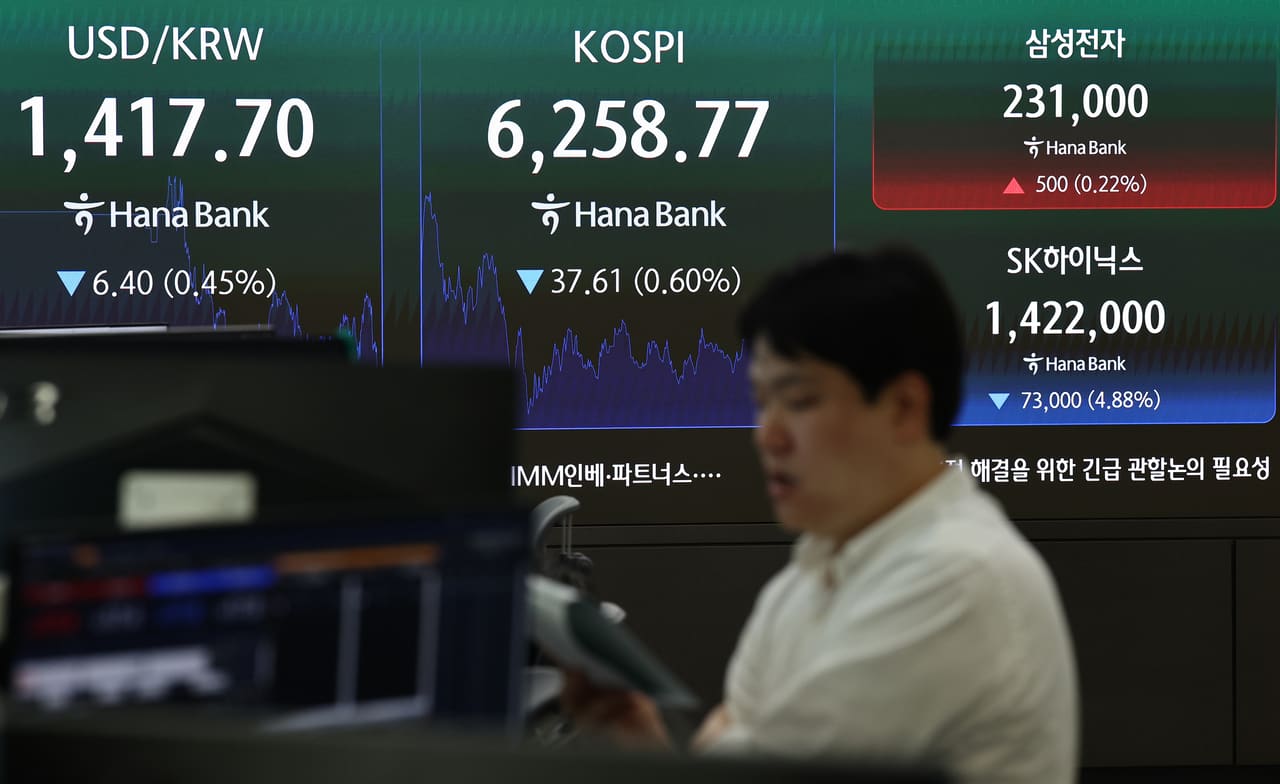
- ·The Korea Composite Stock Price Index fell 0.6 percent to 6,258.77, erasing an early 1.09 percent gain on foreign selling.
- ·Renewed tensions around the Strait of Hormuz, a key oil transit route, dampened sentiment across energy-importing Asian markets.
- ·The Korean won strengthened against the dollar despite equity outflows, signaling divergent capital flows in stocks and currency.
Market Reversal Reflects Regional Risk Appetite
South Korean equities gave up an early rally Friday, closing lower for the second consecutive session as foreign investors turned net sellers. The Korea Composite Stock Price Index fell 37.61 points, or 0.6 percent, to 6,258.77, according to exchange data.
The benchmark opened 1.09 percent higher but steadily lost ground through the afternoon session, touching an intraday low of 6,158.73. Trading volume reached 297.18 million shares valued at 24.3 trillion won, equivalent to $17.1 billion at current rates.
Energy Corridor Concerns Weigh on Sentiment
The reversal comes as renewed tensions around the Strait of Hormuz, through which roughly a fifth of global oil flows, rattled investors across Asia's energy-importing economies. South Korea relies on crude imports for nearly all its petroleum needs, with significant volumes transiting the narrow waterway between Iran and Oman.
While no immediate disruption to tanker traffic has been reported, the renewed geopolitical focus on the strait has historically correlated with risk-off positioning in Seoul, Tokyo, and other manufacturing-heavy bourses dependent on stable energy input costs.
Foreign Capital Outflows Drive Decline
Net foreign selling was the primary technical driver of the session's losses. Offshore investors have turned cautious on Korean equities in recent weeks, rotating capital toward defensive positions as macro uncertainty builds. The won, however, strengthened against the dollar, reflecting divergent flows in equity and currency markets.
The currency's resilience suggests that while portfolio capital may be exiting stocks, underlying demand for Korean exports and debt instruments remains intact. That divergence often signals short-term tactical repositioning rather than a broader withdrawal from the economy.
Winners Outnumbered Losers Despite Index Drop
Despite the headline decline, advancing shares outnumbered decliners on the day, a sign that selling pressure was concentrated in large-cap index constituents rather than broad-based. Heavyweight exporters, particularly those in energy-intensive sectors such as chemicals and steel, bore the brunt of the selloff.
The pattern mirrors behavior seen in previous episodes of Middle East supply anxiety, when investors trimmed exposure to companies with high energy input ratios or significant revenue tied to oil-linked economies in the Gulf.
Asia's Energy Import Dependency in Focus
The session underscores a structural reality for Northeast Asian markets: geopolitical events thousands of kilometers away can ripple through equity valuations in Seoul, Tokyo, and Taipei within hours. All three economies import the vast majority of their energy, making them acutely sensitive to perceived risks in key chokepoints like Hormuz, Malacca, and the Suez Canal.
For South Korea specifically, any sustained disruption to Middle Eastern crude flows would force refiners to source alternative supply from West Africa, the Americas, or Russia, typically at higher freight costs and longer lead times. That operational friction feeds directly into margin pressure for downstream manufacturers.
What Comes Next
Market participants will watch for any further escalation in the Strait of Hormuz situation, as well as official commentary from Seoul's energy ministry on contingency planning. The government maintains strategic petroleum reserves equivalent to roughly 100 days of consumption, a buffer designed for precisely this type of scenario.
In the near term, foreign positioning will remain a key variable. If tensions ease or if global risk appetite steadies, Seoul could see a snapback as tactical sellers cover positions. Conversely, a sustained rise in Brent crude or further geopolitical flashpoints could deepen the correction.
The won's relative strength offers a partial hedge, lowering the local-currency cost of dollar-denominated oil imports. That dynamic may limit downside for energy-intensive stocks if the current episode proves short-lived.
RELATED STORIES
Seoul Market Climbs on Tech Rally After US Jobs Data
Cheng Wei-Lun · 3 min
South Korea's Pension Giant Faces Questions Over Market Timing
Jun-ho Seo · 3 min

KT&G Posts Fourth Consecutive Quarter of Double-Digit Profit Growth
Cheng Wei-Lun · 3 min
South Korean Retail Investors Pivot to US Leveraged ETFs After Domestic Crackdown
Cheng Wei-Lun · 3 min
Spot something wrong? Email editor@briefasia.com. We log every correction publicly.