Finance · Markets
Seoul Retail Investors Reverse Course After Home Market Loses Third of Value
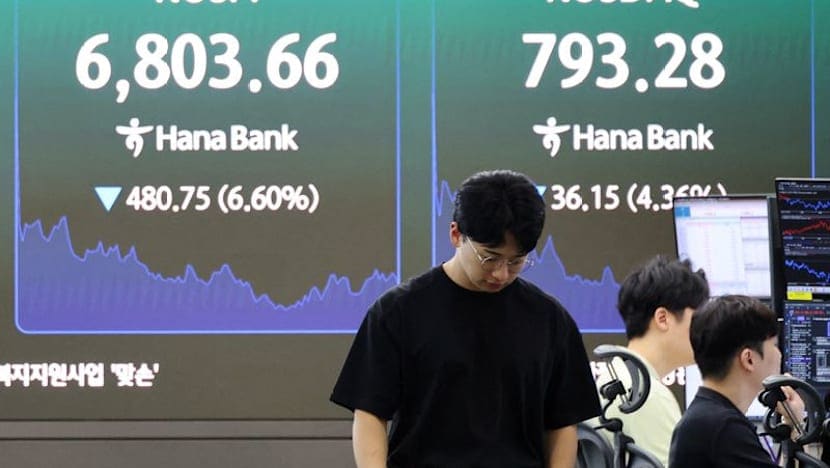
Individual traders poured $4.6 billion into U.S. equities in July as the KOSPI posted its worst monthly drop since 2008, threatening the won and undermining government efforts to retain domestic capital
KEY TAKEAWAYS
- ·South Korean retail investors allocated $4.6 billion to U.S. equities in July, the largest monthly flow since February and above the 2025 average of $2.7 billion.
- ·The KOSPI benchmark fell 33% from its June peak, with Samsung Electronics and SK Hynix accounting for 76% of the 2,257.8 trillion won market value loss.
- ·Deposits in government-backed Re-shoring Investment Accounts declined for the first time in July, while domestic stock trading account balances dropped to the lowest level since mid-February.
Capital Flight Resumes
Individual investors in South Korea redirected $4.6 billion into U.S. equities during July, according to Korea Securities Depository figures, the largest single-month allocation to American markets since February. The shift reversed a brief period of domestic market enthusiasm and exceeded the $2.7 billion monthly average recorded throughout 2025.
The outflow coincided with the KOSPI benchmark index suffering its steepest monthly decline since the 2008 financial crisis. From its June peak, the index has surrendered 33% of its value, erasing 2,257.8 trillion won ($1.59 trillion) in market capitalization. For the first time since February, purchases of U.S. shares by retail traders surpassed their buying of domestic stocks.
Two semiconductor manufacturers, Samsung Electronics and SK Hynix, accounted for 76% of the market value destruction. Investor concerns centered on the sustainability of artificial intelligence infrastructure spending and rising competition from Chinese chip producers. Leveraged exchange-traded funds tracking these companies amplified price swings, intensifying losses for retail holders.
Tax Incentives Fail to Retain Capital
Seoul policymakers had introduced Re-shoring Investment Accounts in March, offering tax breaks to individuals who liquidated foreign holdings and reinvested proceeds in domestic equities. The program recorded its first monthly deposit decline in July, data from the Korea Financial Investment Association showed.
Deposits held in domestic stock trading accounts dropped to 102.8 trillion won by early August, the lowest level since mid-February and well below the 140 trillion won peak reached in early June. The decline signals evaporating confidence in local equities despite multi-year efforts to improve corporate governance and shareholder returns.
Kwon Ah-min, a foreign exchange analyst at NH Investment Securities in Seoul, noted that the brief reversal in capital flows had been contingent on domestic market strength. The collapse in the KOSPI reinforced long-held preferences among retail traders for U.S. markets, where the Nasdaq remained relatively flat over the same period.
Currency and Policy Implications
The won appreciated 8% in July to a nine-month high, its strongest monthly gain since November 2022. SK Hynix contributed to the rally by repatriating a portion of the $26.5 billion it raised in a recent funding round. However, the stronger currency reduces the incentive for investors to bring overseas holdings home and can encourage fresh foreign asset purchases, particularly as U.S. interest rates remain elevated relative to Korean benchmarks.
Bank of America analysts warned that sustained underperformance of Korean equities relative to U.S. counterparts could trigger a renewed wave of retail outflows. The bank characterized the path to sustained won appreciation as narrow, contingent on portfolio flow dynamics that remain fragile.
Retail investors, colloquially known as "ants" for their collective market behavior, have historically favored U.S. markets over domestic options. South Korea's export-driven economy, concentrated in electronics, shipbuilding, and manufacturing, has left the KOSPI vulnerable to sector-specific shocks. The recent selloff in semiconductor stocks underscored this concentration risk.
August Trends Continue
In the first week of August, retail investors purchased a net $278 million of overseas equities as Wall Street reached new highs. Meanwhile, volatility in the KOSPI persisted. Some capital flowed into funds holding Korean assets, including $319 million into the Direxion Daily MSCI South Korea Bull 3X ETF in July, but larger sums moved into U.S. stocks and U.S.-focused funds.
The reversal in retail sentiment threatens to revive a pattern that has long pressured the won and frustrated policymakers. For several months earlier this year, the AI boom and government incentives had succeeded in channeling domestic savings into local equities. That momentum has dissipated as chipmaker stocks collapsed and retail investors reassessed their exposure to a market dominated by cyclical technology exporters.
The coming months will test whether Seoul can stabilize domestic equity flows or whether the recent selloff marks the beginning of a prolonged period of capital flight. With the KOSPI down sharply and U.S. markets near record highs, the incentive structure for retail investors has shifted decisively in favor of offshore allocations.
RELATED STORIES
South Korean Retail Investors Pivot to US Leveraged ETFs After Domestic Crackdown
Cheng Wei-Lun · 3 min
South Korea's Pension Giant Faces Questions Over Market Timing
Jun-ho Seo · 3 min
Seoul Market Climbs on Tech Rally After US Jobs Data
Cheng Wei-Lun · 3 min
Asian Tech Stocks Surge as Weak US Jobs Data Dims Rate Hike Outlook
Cheng Wei-Lun · 4 min
Spot something wrong? Email editor@briefasia.com. We log every correction publicly.