Asia · Politics
Seoul's New President Opens Business Talks with SK Chairman Amid Chip Investment Debate
Lee Jae-myung's first corporate meeting focuses on semiconductor strategy as Washington presses Seoul on domestic production commitments
KEY TAKEAWAYS
- ·South Korean President Lee Jae-myung held his first corporate meeting with SK Group chairman Chey Tae-won, focusing on semiconductor and AI investment strategy.
- ·The talks occur as Washington presses Korean chipmakers to expand US manufacturing, raising questions about capital allocation and domestic priorities.
- ·High-bandwidth memory demand from AI workloads has made SK hynix capacity decisions critical to global supply chains and bilateral negotiations.
First Business Engagement Sets Industrial Tone
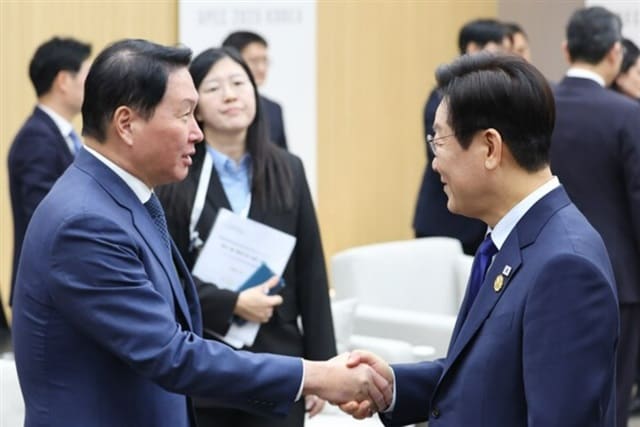
South Korean President Lee Jae-myung has initiated direct consultations with the country's largest conglomerates, beginning with a private dinner meeting with Chey Tae-won, chairman of SK Group. The timing underscores the urgency around semiconductor investment decisions as Washington intensifies calls for Korean chipmakers to expand manufacturing capacity inside the United States.
The meeting marks Lee's opening move in what observers expect will be a sustained dialogue with chaebol leaders. SK Group operates SK hynix, the world's second-largest memory chip maker and a critical supplier to Nvidia and other AI hardware vendors. Any shift in SK's capital allocation carries immediate implications for global supply chains already stretched thin by surging demand for high-bandwidth memory and advanced packaging.
Pressure From Washington and the Domestic Calculus
American officials have made clear they want more Korean semiconductor production on US soil, particularly for chips that power defense systems and next-generation data centers. The CHIPS and Science Act offers subsidies, but those incentives come with strings: recipients must commit to long-term capital expenditure, workforce development, and technology-sharing arrangements that some Seoul executives view as intrusive.
For Lee, the challenge is balancing those external demands with domestic priorities. South Korea's own industrial strategy hinges on maintaining leadership in memory and logic fabrication, sectors that require multi-billion-dollar investments in new fabs, equipment upgrades, and research partnerships. Diverting capital to US projects risks diluting the pace of innovation at home, yet refusing Washington's overtures could strain the bilateral relationship at a moment when security and economic interests overlap more than ever.
AI and the Memory Bottleneck
Artificial intelligence workloads have reshaped the memory market. High-bandwidth memory, once a niche product, has become a bottleneck for training large language models and running inference at scale. SK hynix holds a commanding position in HBM, but capacity constraints have driven customers to lock in multi-year supply agreements and, in some cases, invest directly in fab expansions.
The dinner conversation between Lee and Chey likely touched on how government policy can accelerate capacity additions without triggering oversupply cycles that have historically plagued the industry. South Korea has floated tax incentives, streamlined permitting for new fabs, and expanded R&D grants. Whether those measures are sufficient to keep pace with rivals in Taiwan, Japan, and the United States remains an open question.
What Comes Next for Corporate Dialogue
Lee's outreach to SK Group is expected to be the first in a series of meetings with heads of Samsung, Hyundai, LG, and other conglomerates. Each conversation will carry its own agenda, but semiconductors and AI infrastructure are common threads. The administration has signaled it wants faster decision-making on major investments, clearer commitments on workforce training, and closer coordination with government agencies on export controls and supply-chain resilience.
For the chaebol, these talks represent both opportunity and risk. Closer government partnership can unlock financing and regulatory support, but it also invites scrutiny over corporate governance, labor practices, and succession planning. Chey himself has navigated legal challenges and shareholder disputes in recent years, making the political optics of high-profile meetings particularly sensitive.
The broader question is whether South Korea can craft an industrial policy that satisfies Washington's demands, preserves its own technological edge, and avoids the subsidy races that have distorted investment decisions elsewhere. Lee's willingness to engage directly with business leaders suggests he understands the stakes, but execution will depend on details that remain under negotiation.
RELATED STORIES

South Korea Channels AI Tax Windfall Into New Growth Fund
Cheng Wei-Lun · 3 min
South Korea's August Exports Jump on Record Chip Sales
Cheng Wei-Lun · 3 min
SK Hynix Shifts Profit Bonuses to Equity, Links Pay to Loss Risk
Cheng Wei-Lun · 3 min

South Korea Tests Low-Cost Attack Drones as North Expands Fleet
Jun-ho Seo · 3 min
Spot something wrong? Email editor@briefasia.com. We log every correction publicly.