Technology · AI
Samsung and Broadcom Near $200 Billion AI Chip Deal as Hyundai Accelerates Robotics Investments
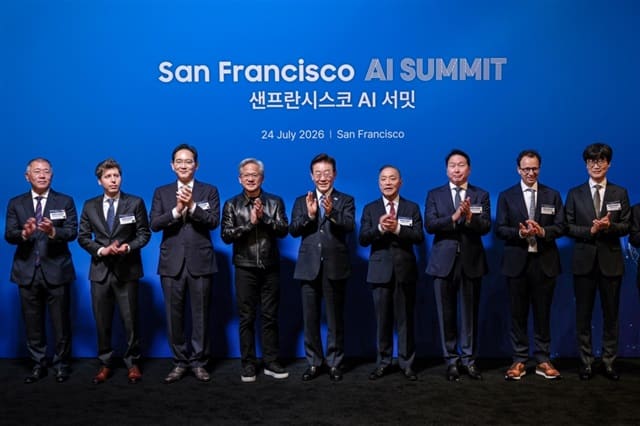
Two of South Korea's largest conglomerates outlined competing AI strategies at the San Francisco summit, signaling a shift in regional semiconductor and automation priorities.
KEY TAKEAWAYS
- ·Samsung Electronics is finalizing a semiconductor supply deal with Broadcom valued at over $200 billion, one of the largest chip agreements on record.
- ·Hyundai Motor Group outlined expanded robotics and autonomous vehicle plans at the same San Francisco AI Summit, targeting humanoid platform commercialization by late 2027.
- ·Both strategies reflect South Korea's effort to secure positions across the AI value chain amid rising competition from Taiwan's foundries and China's subsidized EV sector.
A Quarter-Trillion-Dollar Semiconductor Bet
Samsung Electronics is closing in on a semiconductor supply agreement with Broadcom valued at over $200 billion, according to industry sources familiar with the discussions. The pact, if finalized, would represent one of the largest single chip deals in history and cement Samsung's position as a critical foundry partner for custom AI accelerators beyond Nvidia's dominant platforms.
The deal was signaled during the San Francisco AI Summit, where Samsung Vice Chairman Jay Y. Lee met with Broadcom CEO Hock Tan alongside Hyundai Motor Group Executive Chair Euisun Chung. The gathering underscored how South Korea's two largest industrial groups are pursuing divergent but complementary paths into artificial intelligence.
Samsung has been courting hyperscale customers seeking alternatives to Nvidia's GPU architecture, positioning its advanced packaging capabilities and 3-nanometer process nodes as enabling technologies for custom silicon. Broadcom supplies custom AI chips to several major cloud providers, including Google and Meta, and has been diversifying its foundry relationships to reduce reliance on TSMC.
Hyundai Charts a Robotics Course
While Samsung doubled down on semiconductors, Hyundai used the same summit to outline an expanded robotics and autonomous vehicle roadmap. The automaker has been integrating AI into factory automation, logistics robots, and next-generation driver-assistance systems, leveraging acquisitions including Boston Dynamics and partnerships with Aptiv.
Hyundai's strategy reflects a broader industrial shift in Asia, where traditional manufacturers are racing to embed AI across operations. The company has already deployed thousands of collaborative robots in its Korean and overseas plants, and executives have signaled plans to commercialize humanoid platforms for warehouse and service applications by late 2027.
The robotics push also ties into Hyundai's ambitions in autonomous mobility. The group's Motional joint venture has been testing Level 4 robo-taxis in select U.S. cities, though regulatory and technical hurdles have slowed commercial rollout. Hyundai's investment in on-device AI inference chips, sourced from suppliers including Qualcomm and Samsung, is intended to reduce latency and dependency on cloud connectivity.
Regional Implications for AI Supply Chains
The parallel announcements highlight South Korea's effort to secure multiple footholds in the AI value chain. Samsung's foundry ambitions face stiff competition from TSMC, which commands roughly 60% of the advanced logic market, and from Intel's revived IDM 2.0 strategy. A long-term Broadcom commitment would provide revenue visibility and technical validation for Samsung's 2-nanometer roadmap, expected to enter volume production in 2027.
At the same time, equipment lead times for extreme ultraviolet lithography tools and high-bandwidth memory have doubled over the past year, creating bottlenecks that could delay capacity expansion. Both Samsung and SK Hynix have been negotiating workarounds with ASML and memory module suppliers, though details remain closely held.
For Hyundai, the robotics pivot is part of a defensive strategy as Chinese automakers like BYD and Geely scale AI-enabled vehicles faster and at lower price points. Beijing has poured subsidies into EV and autonomous driving stacks, leaving traditional incumbents scrambling to match software development velocity. Hyundai's edge lies in manufacturing scale and established dealer networks, but software remains a vulnerability.
What Comes Next
Neither Samsung nor Broadcom has confirmed the $200 billion figure, and final terms are expected to hinge on yield performance, process node migration schedules, and geopolitical export controls. U.S. restrictions on advanced chip technology exports to China have reshaped foundry economics, pushing more design activity toward allied suppliers in South Korea, Japan, and Taiwan.
Hyundai's robotics timeline is similarly contingent on regulatory approvals and customer adoption curves. The company has yet to disclose specific revenue targets for its robotics division, though analysts estimate the global market for industrial and service robots will exceed $80 billion annually by 2030.
The San Francisco summit served as a stage for both conglomerates to signal intent, but execution will depend on capital allocation, technical execution, and the durability of AI demand. South Korea's industrial champions are betting that scale, vertical integration, and manufacturing prowess can counter Taiwan's foundry lead and China's cost advantages. Whether that wager pays off will become clearer as production ramps and customer commitments solidify over the next eighteen months.
RELATED STORIES
Samsung and SK Hynix Turn Down KEPCO's Multibillion-Dollar Prepayment Demand
Cheng Wei-Lun · 4 min
LG Pivots to AI-Defined Vehicle Platform as Korea Chases China's Self-Driving Lead
Jun-ho Seo · 3 min
SK Hynix May Fast-Track Gwangju Fab Investment Alongside Yongin Expansion
Jun-ho Seo · 3 min
South Korea Taps Three Telecom Giants to Deliver Free AI Services Nationwide
Cheng Wei-Lun · 3 min
Spot something wrong? Email editor@briefasia.com. We log every correction publicly.