Asia · Trending
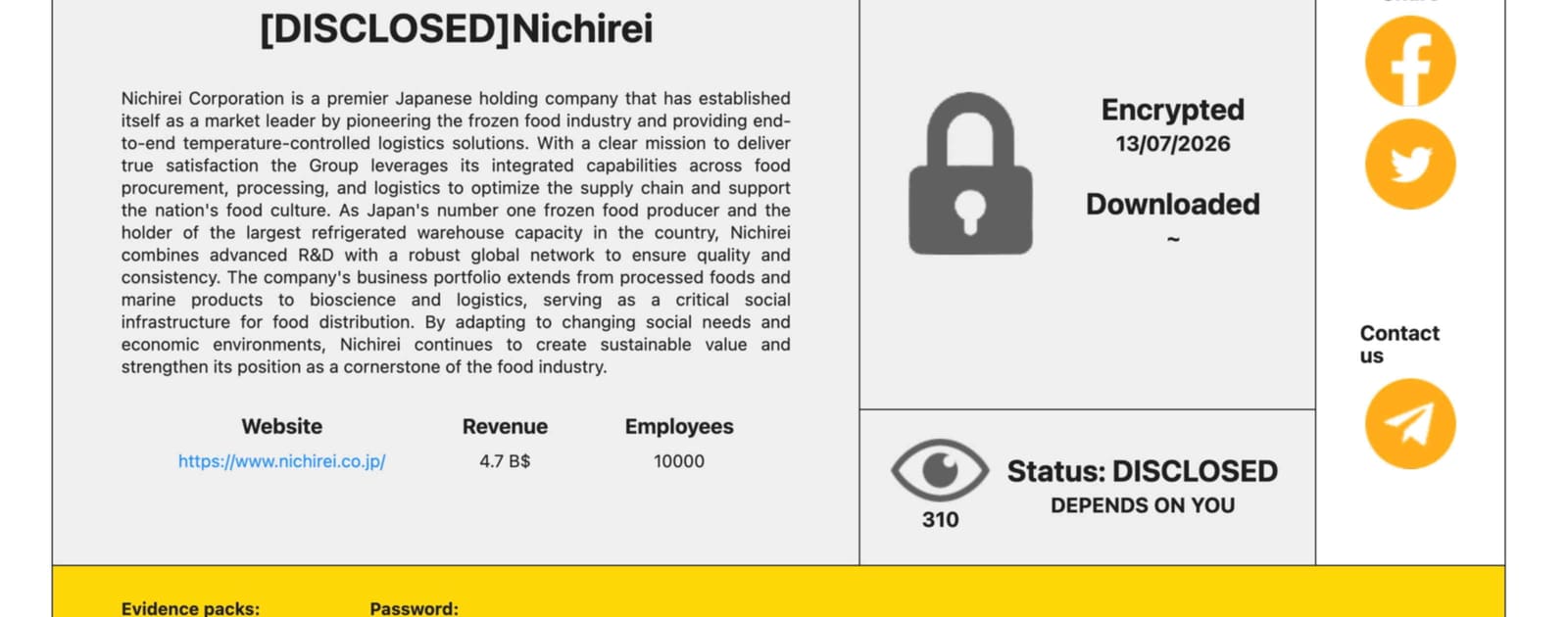
Ransomware Group Publishes Stolen Data From Japan's Nichirei
Cold-storage and logistics firm confirms breach includes HR, accounting, and partner records as hackers make files public
KEY TAKEAWAYS
- ·Hacker group RansomHouse published data stolen from Nichirei, Japan's major cold-storage and logistics provider, including HR, accounting, and business partner files.
- ·The breach exposes downstream risks for restaurants and retailers reliant on Nichirei's frozen food supply chain and distribution network.
- ·Japanese firms remain vulnerable due to legacy systems and limited cybersecurity investment, prompting government push for zero trust architecture.
Public Leak After Corporate Breach
A hacker collective identifying itself as RansomHouse released data stolen from Nichirei, the Japanese cold-storage and logistics company, on Monday. The published files are believed to include general affairs, human resources, accounting, and business partner information, according to Nichirei.
The company confirmed that personal information may be among the leaked data. Nichirei operates one of Japan's largest frozen food supply chains, serving major restaurant chains and retailers across the country. The breach and subsequent publication mark an escalation in targeted attacks against Japanese food infrastructure.
What Was Taken
The stolen dataset spans multiple operational domains. Human resources files typically contain employee names, contact details, compensation records, and performance reviews. Accounting records can include vendor contracts, payment terms, and transaction histories. Business partner information often encompasses supplier agreements, pricing structures, and distribution networks.
Nichirei has not disclosed the volume of records published or the specific time frame the data covers. The company is conducting an internal audit to determine the full scope of compromised information.
RansomHouse's Pattern
The group behind the leak operates differently from traditional ransomware syndicates. Rather than encrypting victim systems and demanding payment for decryption keys, RansomHouse focuses on data exfiltration and public shaming. The collective typically steals sensitive files, then threatens to publish them unless the target pays.
This incident follows a broader wave of cyberattacks targeting Japanese corporations. In recent months, fast-food chains faced supply disruptions after attacks on logistics providers, and beverage companies were forced to revert to fax and phone communication when email systems went offline.
Supply Chain Vulnerability
Nichirei's role in Japan's food distribution network amplifies the potential impact. The company manages cold-storage facilities and coordinates deliveries for restaurants, convenience stores, and supermarkets. Access to business partner data could expose downstream customers to secondary attacks or competitive intelligence gathering.
Food logistics companies hold particularly valuable datasets because they sit at the intersection of multiple industries. A single breach can reveal relationships between suppliers, distributors, and retailers, along with pricing and volume data that competitors would pay to obtain.
Japan's Cybersecurity Posture
Japanese firms have historically lagged behind Western counterparts in adopting advanced security controls. Legacy systems, siloed IT infrastructure, and limited investment in threat detection leave many companies vulnerable to sophisticated intrusions.
The Japanese government has begun pushing "zero trust" architecture across critical sectors, particularly after defense-related incidents involving infected USB drives. However, implementation remains uneven, especially among mid-tier companies in manufacturing and logistics.
Immediate Response
Nichirei is working with cybersecurity specialists to assess the breach and notify affected individuals and partners. The company has not publicly stated whether it received a ransom demand before the data was published, nor whether it considered paying.
Under Japanese data protection law, companies must report breaches involving personal information to regulators and affected individuals within a specified time frame. Nichirei faces potential regulatory scrutiny and civil liability depending on the nature of the leaked data and the company's security posture at the time of the breach.
The incident underscores a growing reality for Asian corporations: operational resilience now depends as much on cybersecurity as on physical infrastructure. As ransomware groups refine their tactics and target high-value supply chain nodes, companies across the region are being forced to treat data security as a core operational risk rather than an IT afterthought.
RELATED STORIES
Japan's Trading Houses Defy Conglomerate Discount as Buffett's Successor Plans First Visit
Cheng Wei-Lun · 4 min

China's Rare Earth Giants Post Strong Profits Amid Supply Chain Tensions
Cheng Wei-Lun · 3 min
Japanese Companies Push for Currency Stability as Weak Yen Squeezes Margins
Aiko Nakamura · 3 min
Japan Plans Lending Rule Changes to Unlock Startup Capital
Aiko Nakamura · 3 min
Spot something wrong? Email editor@briefasia.com. We log every correction publicly.