Technology · AI
Posco Future M Rolls Out AI Strategy Across Battery Materials Production
South Korean manufacturer targets full AI integration from procurement to quality control by first half of 2028
KEY TAKEAWAYS
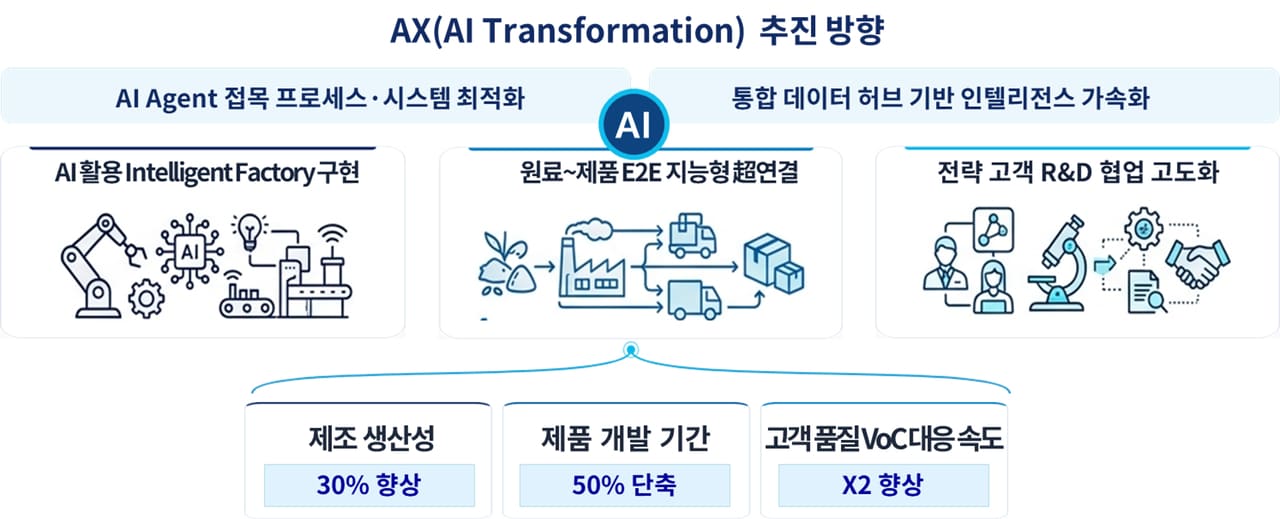
- ·Posco Future M will deploy AI across raw material procurement, manufacturing, product development, quality control, and customer collaboration with systems targeted for completion by first half of 2028.
- ·The South Korean battery materials supplier's initiative addresses competitive pressure from Chinese producers and margin compression in the Asian EV supply chain.
- ·AI applications in cathode production focus on process optimization, predictive maintenance, yield improvement, and real-time defect detection to reduce waste and improve consistency.
Full-Chain AI Integration
Posco Future M announced Tuesday a companywide artificial intelligence transformation that will span its entire battery materials value chain. The South Korean manufacturer plans to deploy AI systems across raw material procurement, manufacturing processes, product development, quality control, and customer collaboration, according to the company.
The initiative forms part of a broader digital innovation framework the company calls "Battery of Things Ecosystem Game Changer." Posco Future M has set a completion target of the first half of 2028 for the related infrastructure and systems.
Strategic Timing in a Shifting Market
The move comes as Asian battery material suppliers face mounting pressure to improve efficiency and reduce costs amid intensifying competition from Chinese producers and slowing electric vehicle demand growth in key Western markets. South Korea's battery materials sector, which includes cathode and anode manufacturers supplying global EV makers, has been investing heavily in automation and data analytics to maintain competitiveness.
Posco Future M, a subsidiary of steelmaking giant Posco Group, produces cathode materials used in lithium-ion batteries for electric vehicles and energy storage systems. The company supplies major battery manufacturers including LG Energy Solution, SK On, and Samsung SDI, which in turn provide cells to automakers worldwide.
Manufacturing Innovation at the Core
The company has identified manufacturing innovation as a central pillar of its AI strategy. While specific technical details of the planned systems remain undisclosed, industry observers note that AI applications in battery materials production typically focus on process optimization, predictive maintenance, yield improvement, and defect detection.
Battery cathode manufacturing involves precise control of chemical composition, particle size distribution, and coating uniformity. Even minor variations can affect battery performance, safety, and lifespan. AI-driven quality control systems can analyze production data in real time to detect anomalies faster than traditional methods, potentially reducing waste and improving consistency.
Upstream and Downstream Integration
Beyond the factory floor, Posco Future M's AI ambitions extend to raw material sourcing and customer engagement. In procurement, machine learning algorithms can analyze commodity price trends, supply chain risks, and demand forecasts to optimize purchasing decisions. This capability has grown more valuable as lithium, nickel, and cobalt prices have experienced significant volatility over the past three years.
On the customer side, AI tools can facilitate technical collaboration with battery manufacturers by analyzing performance data, accelerating product development cycles, and enabling more responsive customization. As battery specifications grow more complex and differentiated by application, such capabilities may become a competitive differentiator.
Regional Context and Competitive Pressure
South Korea's battery materials industry occupies a strategic position in the global EV supply chain but faces challenges on multiple fronts. Chinese competitors benefit from lower production costs and closer proximity to raw material sources and downstream battery plants. Meanwhile, Western governments are increasingly prioritizing domestic or allied supply chains through policies such as the U.S. Inflation Reduction Act.
In response, Korean manufacturers are betting on technology leadership and operational excellence. Posco Future M's AI initiative aligns with similar digital transformation efforts across the country's battery ecosystem, including battery cell makers and equipment suppliers.
The company's 2028 timeline suggests a phased rollout rather than an immediate overhaul. Building AI systems that integrate legacy manufacturing equipment, supply chain software, and customer data platforms requires substantial investment in data infrastructure, talent, and change management.
What Comes Next
Industry watchers will be monitoring how Posco Future M's AI deployment translates into measurable operational improvements. Key metrics will include production yield rates, unit costs, time-to-market for new materials, and customer satisfaction scores.
The success or failure of this initiative may influence investment decisions across Asia's battery materials sector, where margins have tightened and differentiation has become more difficult. If AI proves to be a genuine productivity lever rather than a buzzword, expect competitors in South Korea, Japan, and China to accelerate their own digital strategies.
For now, Posco Future M has drawn a clear line in the sand, signaling that data and algorithms will shape the next chapter of battery materials manufacturing in one of Asia's most critical industrial sectors.
RELATED STORIES
SK Hynix May Fast-Track Gwangju Fab Investment Alongside Yongin Expansion
Jun-ho Seo · 3 min
South Korea Taps Three Telecom Giants to Deliver Free AI Services Nationwide
Cheng Wei-Lun · 3 min
Samsung and SK Hynix Turn Down KEPCO's Multibillion-Dollar Prepayment Demand
Cheng Wei-Lun · 4 min
LG Pivots to AI-Defined Vehicle Platform as Korea Chases China's Self-Driving Lead
Jun-ho Seo · 3 min
Spot something wrong? Email editor@briefasia.com. We log every correction publicly.