Sustainability · Energy
Philippines Plans Renewable Auction to Replace Diesel in Remote Islands
Energy department targets 367,000 MWh across 20 off-grid communities now paying 8× subsidized rates for fossil-fuel power
KEY TAKEAWAYS
- ·The Philippines Department of Energy is preparing a renewable auction for 20 off-grid sites with 367,000 MWh combined demand currently reliant on diesel.
- ·Generation costs in remote areas reach ₱62 per kilowatt-hour but consumers pay ₱7-8 thanks to cross-subsidies from grid-connected users nationwide.
- ·The auction aims to lower subsidy costs and accelerate hybrid renewable deployment in isolated communities across Mindanao, Palawan, and the Visayas.
Auction Framework Takes Shape
The Department of Energy is preparing a competitive bidding mechanism to bring renewable power to the Philippines' most isolated communities, a move designed to curb the country's reliance on diesel generators that cost up to eight times what consumers actually pay.
The agency recently met with prospective developers to outline a green energy auction tailored for areas served by the National Power Corporation's small power utilities group, where fossil-fuel generation remains the primary source. According to the DOE, Napocor has identified 20 priority sites for the inaugural round, covering communities with combined annual demand near 367,000 megawatt-hours.
The initiative mirrors the structure of existing on-grid renewable auctions, which award fixed tariffs to winning projects and recover costs through a consumer charge embedded in electricity bills. Details on contract duration, capacity targets, and tariff ceilings have not yet been disclosed.
Diesel Economics in the Periphery
Power generation in off-grid zones carries a steep price. Even before recent oil volatility, the true cost of electricity in small island utilities reached ₱62 per kilowatt-hour for generation alone, excluding transmission and distribution. End-users, however, pay closer to ₱7-8 per kWh.
The gap is bridged by the universal charge for missionary electrification, a non-bypassable levy collected from grid-connected consumers nationwide. That cross-subsidy has kept rates affordable in remote provinces but has also entrenched diesel dependency, with little commercial incentive for private capital to deploy cleaner alternatives.
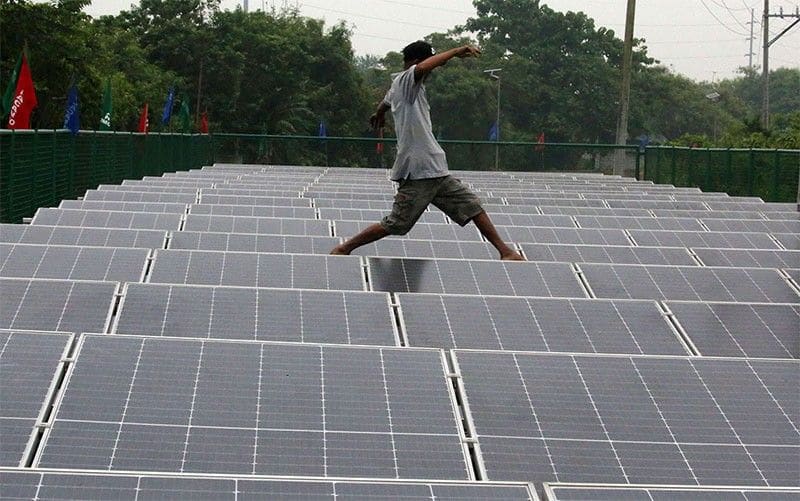
Hybrid renewable systems combining solar, battery storage, and backup diesel have proven technically viable in similar geographies across Southeast Asia. The auction is intended to create a revenue framework that makes such projects bankable without requiring upfront government capital.
Balancing Subsidy and Investment
The DOE expects the auction to lower the overall subsidy burden by replacing high-cost diesel with cheaper renewable generation. If successful, the shift could reduce the missionary electrification charge paid by on-grid consumers while stabilizing rates in the target communities.
The agency has positioned the program within a broader clean energy transition agenda, which includes raising the national renewable share, phasing out coal in baseload generation, and expanding access in unelectrified barangays. Off-grid electrification has historically lagged due to logistics, low load density, and the expense of extending transmission infrastructure across archipelagic terrain.
Private developers have shown interest in mini-grid and hybrid projects in recent years, particularly as battery costs have declined and solar panel efficiency has improved. The auction could formalize that interest into long-term contracts with defined offtake and tariff certainty.
Implementation Timeline Unclear
The DOE has not announced a timeline for the auction's launch or the selection process. Industry observers expect the agency to release draft rules for public comment before finalizing bid parameters.
The 20 priority sites have not been named, though Napocor's SPUG portfolio includes island utilities in Mindanao, Palawan, and the Visayas. Developers will likely weigh site-specific factors such as solar irradiance, land availability, grid interconnection requirements, and community engagement when preparing bids.
If the pilot round succeeds, the government may expand the auction to additional off-grid areas, potentially unlocking hundreds of megawatts of distributed renewable capacity over the next decade. The model could also inform electrification strategies in other archipelagic nations facing similar cost and subsidy challenges.
The DOE emphasized its commitment to working with government agencies and industry stakeholders to advance policies supporting clean energy and inclusive electrification. For now, the auction remains in the planning stage, with commercial terms and competitive dynamics yet to be defined.
RELATED STORIES
Seventeen Firms Compete for Manila's $200 Million Geothermal Risk Fund
Priyanka V. Rao · 3 min

Koloma Targets Fourth Philippine Hydrogen Block in Offshore Palawan Push
Tran Quoc Bao · 3 min

Philippines Energy Budget Climbs 26% as Electric Vehicle Funding Surges
Priyanka V. Rao · 3 min

Jollibee Shifts IPO Plans to Hong Kong After US Listing Target
Cheng Wei-Lun · 3 min
Spot something wrong? Email editor@briefasia.com. We log every correction publicly.