Asia · Business
Philippine Growth Forecast Cut as Consumer Spending Stalls
Deutsche Bank lowers full-year GDP estimate to 3.5 percent amid weak household demand and infrastructure delays, while Bank of America sees no second-half rebound.
KEY TAKEAWAYS
- ·Deutsche Bank cut the Philippines' 2026 GDP forecast to 3.5 percent from 3.7 percent, with Bank of America holding at 2.5 percent, as second-quarter growth slowed to 2.3 percent.
- ·Private consumption rose just 2.8 percent in the second quarter while investment spending contracted 9.2 percent, with domestic demand advancing only 0.9 percent.
- ·A meaningful recovery depends on faster infrastructure spending and easing price pressures, though elevated rates and oil prices may weigh on consumption and business confidence through year-end.
Banks Lower Expectations
Deutsche Bank has trimmed its Philippines full-year GDP growth projection to 3.5 percent from 3.7 percent, placing the estimate at the lower end of Manila's revised official range of 3.5 to 4.5 percent. The bank anticipates second-half expansion of 4.4 percent, up from 2.6 percent in the first six months, contingent on accelerated infrastructure outlays and targeted subsidies to cushion price pressures. Bank of America Global Research takes a more cautious stance, holding its 2026 forecast at 2.5 percent and seeing little improvement in the second half.
The divergence reflects mounting uncertainty over how quickly the domestic economy can regain momentum after second-quarter GDP growth slowed to 2.3 percent from 2.8 percent in the opening quarter. The first-half average settled at 2.6 percent, well below the pace needed to meet official targets.
Household Caution and Investment Retreat
Private consumption, which typically drives more than two-thirds of Philippine output, expanded just 2.8 percent in the second quarter. Deutsche Bank attributes the weakness to households pulling back on discretionary purchases after a spike in inflation eroded purchasing power. Investment spending contracted 9.2 percent over the same period, reflecting persistent caution among businesses.
Domestic demand, encompassing consumption, government spending, and investment, advanced only 0.9 percent in the second quarter, down from 2.1 percent in the first. The deceleration underscores the fragility of the recovery and raises questions about the sustainability of any second-half pickup.
Elle Jamil, head of equities at Manulife Investments Philippines, noted that checks with consumer companies and distribution channels confirm tepid household demand. Banks continue to report strong growth in consumer loans, particularly credit cards and personal loans, suggesting that some spending is being sustained by borrowing rather than income growth. Corporate and middle-market lending has concentrated on working capital and major infrastructure projects, signaling that businesses remain reluctant to commit to expansion.
Earnings and Policy Pressure
The weak operating environment is weighing on corporate earnings expectations. Jamil warned that elevated oil prices and interest rates could remain an overhang on consumption and business confidence throughout the year. Big-ticket consumer spending is likely to stay subdued, keeping pressure on interest-rate-sensitive sectors such as property. Consumer companies with strong brands and pricing power may prove more resilient, while banks with robust deposit franchises could continue to grow if they contain asset-quality deterioration.
The slowdown complicates the policy calculus for Bangko Sentral ng Pilipinas, which must balance subdued growth against inflation that remains above target. Jean Olivia de Castro, head of fixed income at Manulife Investments Philippines, expects the central bank to opt for a measured 25-basis-point rate increase followed by a hawkish pause, rather than pursuing faster tightening that could further dampen activity.
Infrastructure as a Wild Card
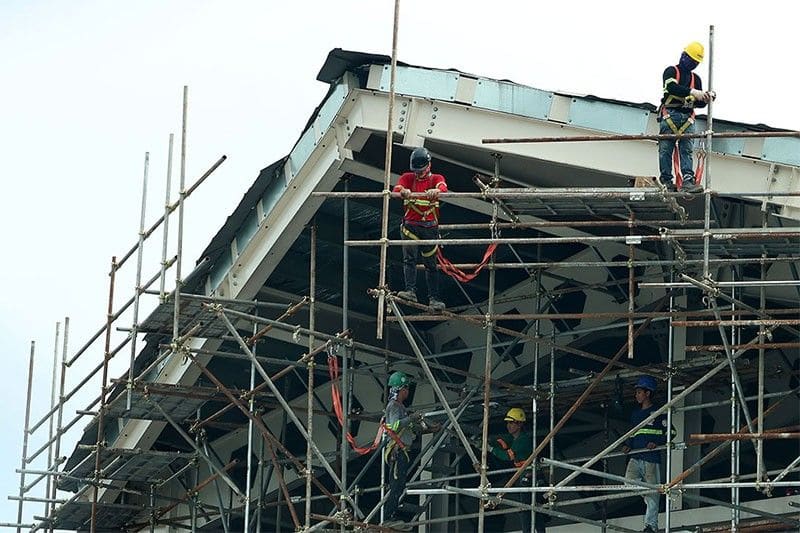
Deutsche Bank's more optimistic second-half scenario hinges on a meaningful acceleration in public infrastructure spending, which has lagged in recent quarters. Faster disbursement of capital budgets and the rollout of government subsidies could provide a buffer for consumers and inject momentum into construction and related industries. Bank of America, however, sees lower fuel prices and higher minimum wages as factors that may support industrial activity and consumption only late in the year, limiting their impact on the full-year outcome.
The contrasting outlooks highlight the narrow path the Philippines faces. Without a swift revival in household spending and a pickup in both public and private investment, the economy risks falling short of even the downgraded forecasts, further dimming prospects for one of Southeast Asia's historically faster-growing markets.
RELATED STORIES
Wilcon Depot Posts 3.5% Earnings Growth as Philippine Home Improvement Demand Strengthens
Mariel D. Santos · 3 min
Yuchengco Group Completes $38 Million Buyout of Philippine Wind Developer
Mariel D. Santos · 3 min
Philippine Foreign Investment Falls 65% to Lowest Since 2015
Priyanka V. Rao · 4 min
Philippines Regulator Seeks to Drop VAT on Power System Losses
Mariel D. Santos · 2 min
Spot something wrong? Email editor@briefasia.com. We log every correction publicly.