Technology · AI
Nvidia's Madison Huang Tours Asia Robotics Hubs in Seoul and Beijing
The chip giant's physical AI executive visited LG Electronics and the World Robot Conference within 48 hours, signaling deeper regional engagement.
KEY TAKEAWAYS
- ·Nvidia executive Madison Huang visited LG Electronics in Seoul and Beijing's World Robot Conference within a 48-hour span in August 2026.
- ·The stops highlight Nvidia's push into physical AI partnerships across Asia's two largest technology manufacturing centers.
- ·Huang's tour signals operational-level engagement beyond high-profile keynotes as robotics moves toward commercial deployment.
Rapid-Fire Asia Tour
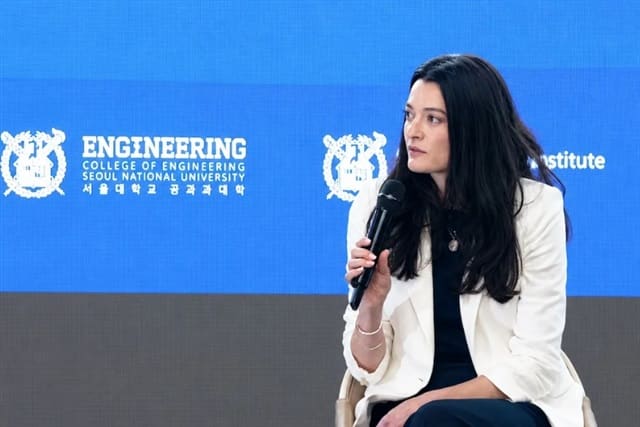
Madison Huang, a senior executive in Nvidia's physical AI division, appeared at the 2026 World Robot Conference in Beijing on August 20, just two days after touring LG Electronics' robotics operations in Seoul. The compressed itinerary reflects Nvidia's intensifying focus on robotics partnerships across the region's two largest technology manufacturing centers.
The visits come as Nvidia pushes deeper into embodied AI, the branch of artificial intelligence that enables physical machines to perceive and interact with their environments. The company has positioned its Jetson platform and Isaac simulation software as foundational infrastructure for next-generation robots, from warehouse automation systems to humanoid assistants.
LG and Seoul's Robotics Ambitions
Huang's stop at LG Electronics marks a notable engagement with one of South Korea's leading conglomerates. LG has invested heavily in service robotics, including autonomous cleaning machines, delivery bots, and guide robots deployed in airports and hotels. The company has also explored industrial applications, particularly in its own manufacturing facilities.
South Korea's government has backed robotics development through its national AI strategy, allocating budget for research clusters and offering tax incentives to companies developing intelligent machines. Seoul itself has emerged as a testing ground for service robots in public spaces, with trials in subway stations and government buildings.
Nvidia has supplied compute modules to several Korean robotics firms, though specific commercial agreements with LG have not been publicly detailed. The Seoul visit suggests discussions may be advancing beyond component supply toward deeper collaboration on perception algorithms or simulation environments.
Beijing Conference Spotlights China's Scale
The World Robot Conference, held annually in Beijing, serves as a showcase for China's domestic robotics industry. The 2026 edition drew manufacturers ranging from industrial arm makers to consumer-facing humanoid developers, many of whom have adopted Nvidia's GPU architectures for training and inference workloads.
China represents both a massive market and a complex regulatory environment for foreign chip companies. Export controls imposed by the United States restrict Nvidia's ability to sell its highest-performance data center GPUs to Chinese customers, though lower-tier products and embedded modules remain available.
Huang's attendance at the conference signals Nvidia's intent to maintain visibility in the Chinese robotics ecosystem despite trade restrictions. The company has emphasized that many robotics applications, particularly those involving edge inference on mobile platforms, fall outside the scope of current export rules.
Physical AI as Strategic Priority
Nvidia CEO Jensen Huang, unrelated to Madison Huang, has described physical AI as the next major wave following generative AI. The company's Isaac platform combines simulation tools, pre-trained models, and reference architectures designed to accelerate robot development cycles.
The platform addresses a persistent challenge in robotics: the difficulty of training models in the real world. By running millions of simulated scenarios, developers can teach robots to navigate environments, manipulate objects, and respond to unexpected situations before deploying hardware.
Nvidia's strategy involves partnerships across the stack, from chip integration with robot manufacturers to cloud-based simulation services for developers. The Asia tour suggests the company is prioritizing relationships with established electronics giants like LG alongside engagement with China's fast-growing robotics sector.
Regional Competition Heats Up
Asia has become the primary battleground for robotics commercialization. Japan's industrial robot makers hold dominant positions in manufacturing automation, while Chinese firms are scaling production of logistics and service robots. South Korea's conglomerates are leveraging their electronics expertise to enter new categories.
Nvidia's positioning as a platform provider allows it to work across these competitive camps, supplying the computational substrate without directly competing in hardware. The company's challenge lies in navigating divergent regulatory environments and ensuring its technology remains accessible amid shifting trade policies.
Huang's back-to-back appearances in Seoul and Beijing underscore the geographic concentration of robotics activity. Both cities host dense clusters of engineering talent, manufacturing infrastructure, and corporate research labs, making them essential stops for any company seeking to shape the physical AI landscape.
The visits also highlight Nvidia's tactical approach to executive visibility. Rather than relying solely on Jensen Huang's high-profile keynotes, the company is deploying specialized executives like Madison Huang to cultivate partnerships at the operational level, where technical decisions and integration roadmaps take shape.
As robotics moves from research labs into commercial deployment, the next 18 months will clarify which partnerships translate into shipped products and which remain exploratory. Nvidia's Asia push suggests the company views the region not as a secondary market but as the primary theater where physical AI will prove its commercial viability.
RELATED STORIES
Chinese Manufacturers Command Over 70% of Global LCD TV Panel Market
Cheng Wei-Lun · 2 min

Google Plans Full Exit From China Manufacturing for Pixel Devices by 2027
Cheng Wei-Lun · 3 min
Tsinghua Unigroup Cuts Ties With Collapsed Dongguan Semiconductor Project
Cheng Wei-Lun · 3 min
Baidu Reports AI Operations Now Half of Core Revenue as Robotaxi Fleet Expands
Cheng Wei-Lun · 3 min
Spot something wrong? Email editor@briefasia.com. We log every correction publicly.