Sustainability · Climate
Malaysia Maps Adaptation Finance as Southeast Asia Faces $422 Billion Resilience Shortfall
UNDP official calls for reframing climate preparedness as economic strategy while private sector contribution remains under 2 per cent of tracked adaptation capital
KEY TAKEAWAYS
- ·ASEAN economies spend roughly $3.2 billion annually on climate adaptation but need $422 billion cumulatively by 2030, with private capital supplying under 2 per cent of tracked resilience finance globally.
- ·Malaysia's 2021 floods caused RM8 billion in direct damage and RM9.5 billion in economic losses, with insurance covering only 35 per cent of affected households as premiums rise.
- ·Malaysia's first National Adaptation Plan embeds financing mechanisms across five sectors and aims to convert climate vulnerability assessments into short, medium and long-term investment pipelines for private capital.
The Missing Private Capital
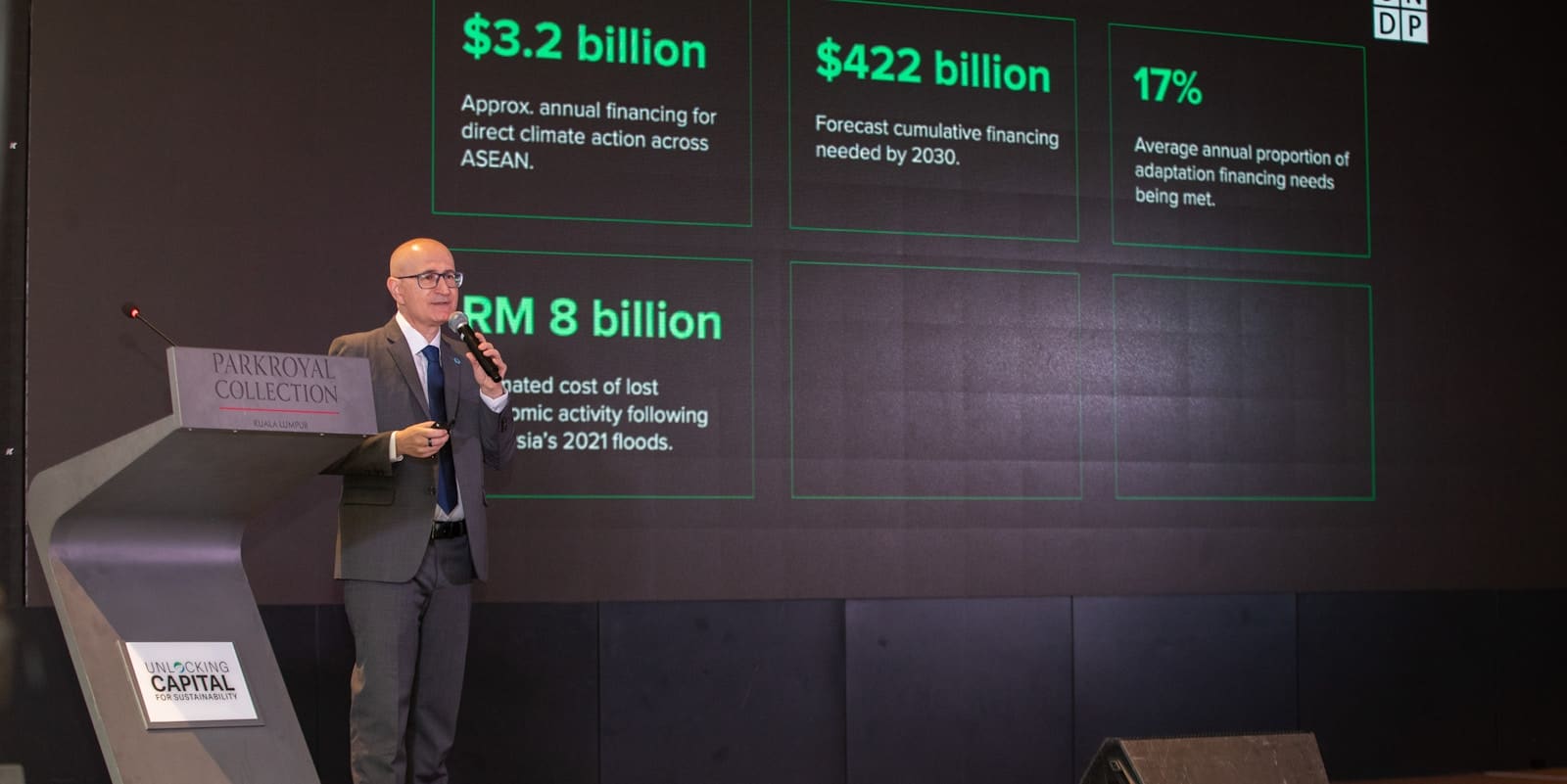
Southeast Asia's climate preparedness faces a structural financing challenge: annual spending on adaptation sits at roughly $3.2 billion across ASEAN economies, yet the region requires a cumulative $422 billion by decade's end to prepare infrastructure, agriculture and communities for intensifying climate impacts.
Edward Vrkić, who leads UNDP operations across Malaysia, Singapore and Brunei Darussalam, told an industry gathering in Kuala Lumpur that the gap reflects a perception problem rather than a lack of capital. Private investors channel less than 2 per cent of tracked adaptation finance globally, while 17 per cent of all climate capital flows toward resilience measures. The remainder targets mitigation projects with clearer revenue models.
The skew toward renewable energy and electric mobility stems from measurable returns, Vrkić noted at the Unlocking capital for sustainability forum on 23 July. Flood barriers, upgraded drainage systems and reinforced coastal infrastructure generate value through losses prevented, a calculus that institutional investors and banks struggle to model against quarterly earnings targets.
Malaysia's 2021 flooding offers a tangible reference point. The disaster inflicted RM8 billion in direct damage and erased RM9.5 billion in economic output. Insurance covered 35 per cent of affected households, and premiums have climbed as underwriters price in higher frequency events. Vrkić framed the episode as evidence that upfront resilience spending costs less than reactive disaster response.
National Adaptation Plan Takes Shape
Malaysia is assembling its first National Adaptation Plan, a framework designed to translate climate vulnerability into project pipelines that financiers can evaluate. Noor Akmar Shah Mohd Nordin, who directs the MyNAP initiative, said the plan departs from conventional policy documents by embedding financing mechanisms at the design stage.
The framework spans five sectors: water and coastal resources, public health, forestry and biodiversity, infrastructure and cities, and agriculture and food security. Each sector undergoes climate vulnerability and risk assessment to quantify exposure and convert it into short, medium and long-term investment requirements.
MyNAP aims to provide granular estimates that differentiate preparedness spending from post-disaster recovery, a distinction that matters to lenders evaluating repayment timelines. The plan is expected to clarify which projects can generate direct cash flows and which require blended finance structures combining public guarantees with private capital.
The Missing Middle and MSME Access
Micro, small and medium enterprises account for a significant share of Malaysia's economic activity yet face disproportionate barriers when seeking climate and nature-related financing. According to UNDP data, 60 per cent of climate-focused MSMEs in Malaysia encounter difficulty securing capital, citing lengthy application processes, limited investor appetite and insufficient operational track records.
The financing gap is most acute for businesses seeking between RM100,000 and RM3 million in capital, a segment Vrkić described as critical for economic innovation. On the supply side, at least half of surveyed investors and financial institutions cite scarce bankable projects, inadequate data and uncertain returns as obstacles to deployment.
Zakiah Mat Esa, chief sustainability officer at Bank Pembangunan Malaysia and SME Bank Malaysia, said the Climate Finance Innovation Lab, an accelerator under the Joint Committee on Climate Change (JC3), is working to strengthen commercial viability before connecting project developers with financiers. The bank applies blended finance structures tested in energy transition deals, layering catalytic capital to de-risk early-stage ventures and attract private co-investment.
Development finance institutions evaluate adaptation projects on broader economic and social outcomes rather than purely financial metrics, a practice Zakiah said could standardise across the industry as adaptation becomes a recognised asset class.
Measuring Avoided Loss
Quantifying adaptation benefits remains a technical hurdle. Unlike emissions reductions, which can be tracked through carbon accounting protocols, resilience investments depend on future climate scenarios and avoided damages that are inherently probabilistic.
Supun Nigamuni, managing director of Control Union Malaysia, said the industry needs harmonised methodologies and independent verification frameworks if adaptation is to achieve parity with mitigation in capital markets. Investors require reliable climate data and standardised risk metrics to compare projects across geographies and sectors.
Natural system degradation costs the global economy approximately $2.7 trillion annually, equivalent to 2.3 per cent of global GDP, according to World Bank estimates. Yet annual spending on ecosystem restoration totals around $220 billion, against $7.3 trillion flowing into sectors that continue environmental harm, based on this year's UN Environment Programme report.
Vrkić argued that forests, watersheds and other natural assets should be treated as infrastructure that underpins economic stability. The convergence of climate and nature finance reflects recognition that ecological resilience and physical infrastructure are interdependent, particularly in coastal and agricultural zones exposed to storm surges and drought.
Reframing the Cost Equation
The private sector's limited participation in adaptation finance reflects a valuation challenge rather than a shortage of opportunities, Vrkić suggested. Institutional investors typically model risk over three to seven-year horizons, while adaptation benefits accrue over decades and materialise as disasters that do not occur.
Shifting that calculus requires integrating avoided losses into project appraisals and recognising that resilience spending protects existing asset values. For insurers, higher premiums and narrower coverage areas signal rising climate exposure; for corporates, supply chain disruptions and facility downtime translate into direct revenue impacts.
Malaysia's experience with flooding, heatwaves and water stress positions the country to pilot financing models that other ASEAN economies can replicate. The National Adaptation Plan's sectoral approach allows tailored structures: agriculture and food security projects may lean on off-take agreements and parametric insurance, while coastal infrastructure could combine public guarantees with user fees or land value capture mechanisms.
As the region navigates the gap between current spending and projected needs, the question is no longer whether adaptation warrants investment, but how resilience projects can be packaged to meet the return and liquidity requirements of institutional capital. The answer will determine whether Southeast Asia builds ahead of climate impacts or continues to pay for them after the fact.
RELATED STORIES
Laos Hydropower Faces Solar and Wind Competition as Regional Grid Expands
Tran Quoc Bao · 4 min

Five ASEAN Members Back Regional Oil Stockpile as Study Nears Completion
Tran Quoc Bao · 3 min
Malaysia Breaks Ground on 500km Transmission Backbone to Unlock Renewable Capacity
Priyanka V. Rao · 3 min

Southeast Asian Firms Overlook Digital Pact Worth USD 2 Trillion
Lim Hui Ying · 4 min
Spot something wrong? Email editor@briefasia.com. We log every correction publicly.