Technology · Products
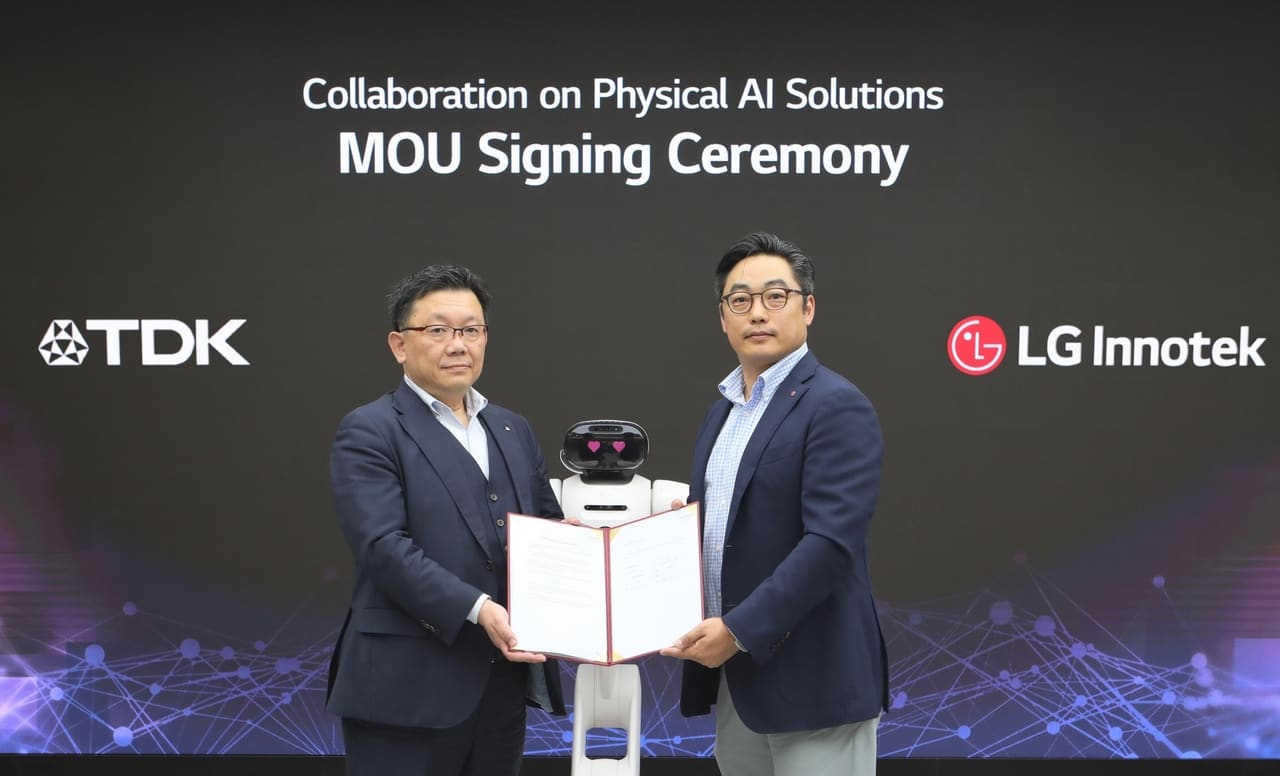
LG Innotek and TDK Join Forces on Robotics Sensing Technology
The Korean component maker is moving beyond camera modules to build tactile and vision systems for physical AI robots
KEY TAKEAWAYS
- ·LG Innotek and TDK announced a partnership to develop integrated vision and tactile sensing modules for physical AI robots, combining optical systems with force and motion sensors.
- ·Asia accounted for 74 percent of global industrial robot installations in 2025, with 384,000 units deployed as manufacturers adopt machines requiring advanced sensing for safe human collaboration.
- ·LG Innotek will begin sampling the integrated sensor modules in the second half of 2026, with volume production planned for 2027 pending design wins with robot manufacturers.
A New Layer of Robot Perception
LG Innotek is pushing deeper into robotics hardware, adding tactile sensing to its existing camera module business through a partnership with Japanese sensor specialist TDK. The collaboration, announced Tuesday, will combine LG Innotek's precision optics with TDK's sensor portfolio to create integrated modules for physical AI robots that need both vision and touch.
The Korean components supplier has built a substantial business supplying camera modules to smartphones and automotive systems. Now it sees robots as the next major platform, particularly as manufacturers in South Korea, Japan, and China accelerate development of humanoid and industrial robots that can manipulate objects in unstructured environments.
TDK brings a catalog of sensing technologies to the partnership, including inertial measurement units that track motion and acceleration, position sensors that determine spatial orientation, and force sensors that measure pressure and contact. LG Innotek will integrate these into compact modules designed for robotic hands, arms, and vision systems.
Physical AI Drives Demand
The partnership reflects a broader shift in robotics toward machines that interact physically with the world rather than operating in controlled factory cages. These physical AI systems require multiple sensing modalities: cameras to see objects, IMUs to track limb position, and tactile sensors to gauge grip force and detect contact.
South Korean conglomerates have invested heavily in this space. Hyundai Motor Group acquired Boston Dynamics in 2021 and has since expanded its robotics division. Samsung Electronics operates a robotics lab focused on manipulation and mobility. LG itself spun off LG Robotics in 2023 to develop service robots for commercial buildings.
According to the International Federation of Robotics, installations of industrial robots in Asia reached 384,000 units in 2025, accounting for 74 percent of global deployments. The region's manufacturing density and aging workforce demographics are driving adoption of collaborative robots that work alongside humans, a segment where advanced sensing is critical for safety and dexterity.
Engineering Integration
LG Innotek's strength lies in miniaturizing and packaging optical systems. Its smartphone camera modules combine multiple lenses, image sensors, and autofocus actuators in assemblies smaller than a fingernail. Applying that integration capability to robot sensors could reduce the size and cost of perception systems.
TDK, headquartered in Tokyo, produces a range of electronic components including magnetic sensors, MEMS devices, and power supplies. The company has supplied automotive and industrial customers for decades and more recently targeted robotics as a growth market. Its sensor division reported revenue of 180 billion yen in fiscal 2025.
The two companies did not disclose financial terms or specify which robot manufacturers they are targeting. LG Innotek said the modules will be designed for both humanoid robots and specialized industrial machines used in logistics and assembly.
Competitive Landscape
The partnership positions LG Innotek against other component suppliers moving into robotics sensing. Japan's Sony has developed vision sensors for industrial robots, while China's Sunny Optical supplies camera modules to drone and robotics makers. Germany's Bosch Sensortec offers IMU and environmental sensor packages aimed at collaborative robots.
South Korea's component industry has historically focused on consumer electronics and automotive applications. Robotics represents a newer opportunity, though one with longer sales cycles and more fragmented demand than smartphones. Success will depend on whether the physical AI market scales as quickly as proponents expect.
LG Innotek plans to begin sampling integrated sensor modules to select customers in the second half of 2026. Volume production is targeted for 2027, pending design wins with robot manufacturers. The company has not broken out robotics revenue separately but includes it within its broader industrial components segment, which generated 1.2 trillion won in sales last year.
What Comes Next
The robot sensing market remains in early stages, with standards still evolving and most manufacturers building custom sensor arrays. LG Innotek's bet is that off-the-shelf integrated modules will eventually replace bespoke designs as the industry matures, similar to how smartphone camera modules became standardized components.
Whether that standardization happens depends partly on how quickly robot designs converge. Humanoid robots, logistics bots, and surgical systems have different sensing requirements, which could fragment the market. But if a dominant form factor emerges, suppliers with proven integration capabilities will have an advantage.
For now, the partnership gives LG Innotek a foothold in tactile sensing while leveraging its existing optical expertise. TDK gains a manufacturing and integration partner in a region where most robotics production is concentrated. Both companies are positioning for a market that is still taking shape but could grow substantially if physical AI lives up to its industrial promise.
RELATED STORIES

SK Hynix Eyes Deeper Collaboration With Japan's Chip Sector
Cheng Wei-Lun · 4 min
Samsung and SK Hynix Turn Down KEPCO's Multibillion-Dollar Prepayment Demand
Cheng Wei-Lun · 4 min

South Korea Records Highest September Export Start on Semiconductor Demand
Tran Quoc Bao · 3 min
Hyosung Heavy Gains Ground in US Power Grid Market With Early Manufacturing Push
Jun-ho Seo · 4 min
Spot something wrong? Email editor@briefasia.com. We log every correction publicly.