Asia · Trade
Indonesia Pushes BRICS to Uphold Trade Rules as Global Fragmentation Looms
Jakarta warns of risks from economic splintering while seeking concrete cooperation benefits for developing nations within the expanded bloc
KEY TAKEAWAYS
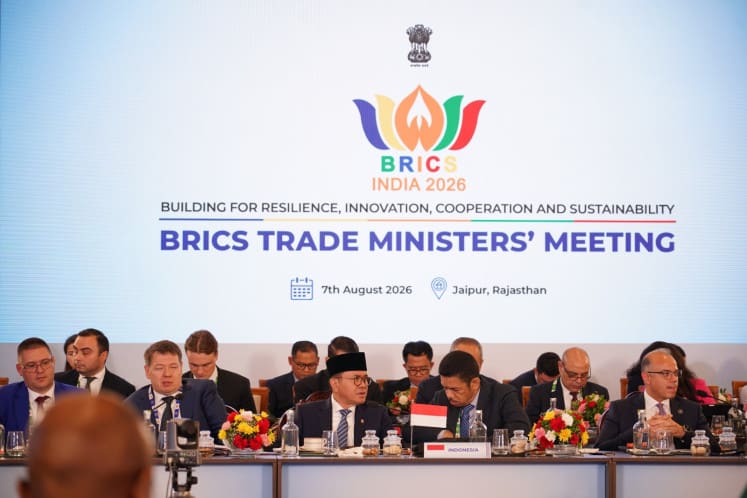
- ·Indonesia's Trade Minister Budi Santoso urged BRICS members to defend WTO-centered multilateral trade rules at an August 6-7 ministerial meeting in Jaipur that ended without a joint statement.
- ·Jakarta warned that growing protectionism and economic fragmentation could leave the world divided and less capable of addressing shared challenges.
- ·Indonesia is separately pursuing a preferential trade deal with Mercosur after broader Indonesia-Mercosur comprehensive partnership negotiations stalled.
Jakarta's Warning at Jaipur
Indonesia pressed BRICS members to defend the multilateral trading system during a ministerial meeting that concluded without a joint statement, exposing fault lines within the expanded bloc as trade tensions reshape global commerce.
Trade Minister Budi Santoso told counterparts in Jaipur, India, on August 6-7 that the group must pursue cooperation delivering concrete benefits while maintaining rules-based trade anchored by the World Trade Organization. The meeting addressed SME internationalization, resilient value chains, and market opening among members, yet failed to produce a unified declaration despite agreement on most agenda items, Budi confirmed on Saturday.
"Indonesia stresses the importance of maintaining a rules-based multilateral trading system through a strong, inclusive and adaptive WTO," Budi said. "At the same time, the BRICS need to continue delivering concrete cooperation that directly benefits the growth of developing countries."
Fragmentation Risks
As the bloc's newest and nonaligned member, Indonesia used its platform to caution against the dangers of economic splintering. While acknowledging that protectionist measures represent a natural response to uncertainty, Budi warned that fragmentation could undermine collective problem-solving capacity.
"The world could become increasingly divided, fragile and less able to address common challenges," he added.
The inability to issue a joint communiqué underscores the difficulty of forging consensus within BRICS, which expanded in recent years to include countries with divergent economic models and geopolitical alignments. Indonesia joined the group seeking access to emerging markets and alternative trade channels, but Jakarta has consistently signaled its commitment to multilateral frameworks and nonaligned positioning.
Concrete Cooperation Over Rhetoric
Indonesia's intervention reflects a pragmatic calculation. Jakarta wants BRICS cooperation to translate into measurable economic gains for developing members rather than serve as a platform for geopolitical posturing. The emphasis on SME access and value chain resilience aligns with Indonesia's domestic priorities, where export diversification and upgrading remain central to industrial policy.
The trade ministry also revealed that Indonesia is pursuing a preferential trade agreement with Mercosur, South America's customs union, after broader negotiations for a comprehensive Indonesia-Mercosur economic partnership stalled. The Mercosur pivot illustrates Jakarta's strategy of hedging trade relationships across multiple blocs and regions, reducing dependence on any single market or alliance structure.
What Comes Next
The Jaipur meeting's inconclusive outcome raises questions about BRICS' capacity to coordinate economic policy as membership grows and internal priorities diverge. For Indonesia, the test will be whether the bloc can move beyond declarations to implement trade facilitation measures, investment flows, and technology transfer that benefit its manufacturing and digital economy sectors.
With temporary US tariff measures set to expire and trade policy uncertainty persisting, Indonesia's call for rules-based multilateralism reflects both principle and self-interest. Jakarta needs predictable trade frameworks to attract investment and sustain export growth, even as it explores alternative partnerships outside traditional Western-led institutions.
Whether BRICS can deliver on that agenda without fragmenting further remains an open question. Indonesia's message in Jaipur was clear: cooperation must produce results, not just rhetoric.
RELATED STORIES
Destry Damayanti Emerges as Top Candidate for Bank Indonesia Governor
Priyanka V. Rao · 3 min

Indonesia Questions Whether Foreign Investment Builds Capability or Just Serves Market Access
Priyanka V. Rao · 4 min
Indonesia's Rupiah Defense Drains Reserves as Central Bank Rethinks Strategy
Siti Nuraini · 2 min
Indonesia Names Interim Central Bank Chief as Sole Nominee for Permanent Role
Siti Nuraini · 2 min
Spot something wrong? Email editor@briefasia.com. We log every correction publicly.