Asia · Business
Indonesia Launches Domestic Electric Motorcycle Push to Absorb Nickel Surplus
Jakarta pairs state-backed credit with local battery manufacturing requirements as lithium alternatives gain ground in regional EV markets
KEY TAKEAWAYS
- ·President Prabowo launched the Molinas program to build a domestic electric motorcycle industry using Indonesia's 46 percent share of global nickel reserves for battery production.
- ·At least ten local manufacturers will participate, coordinated by state integrator PT Len Industri and sovereign fund Danantara, with eased credit access for buyers.
- ·The initiative creates captive demand for nickel-based batteries as global EV makers shift toward lithium-iron-phosphate chemistries that use no nickel.
A Nickel Play Disguised as Transport Policy
President Prabowo Subianto rolled out a national electric motorcycle initiative at a manufacturing plant in Cikarang this week, framing the effort as a bid to cut fuel imports and electrify transport. The deeper ambition is industrial: channeling Indonesia's nickel reserves into battery cells and packs at a moment when global EV makers are shifting toward lithium chemistries.
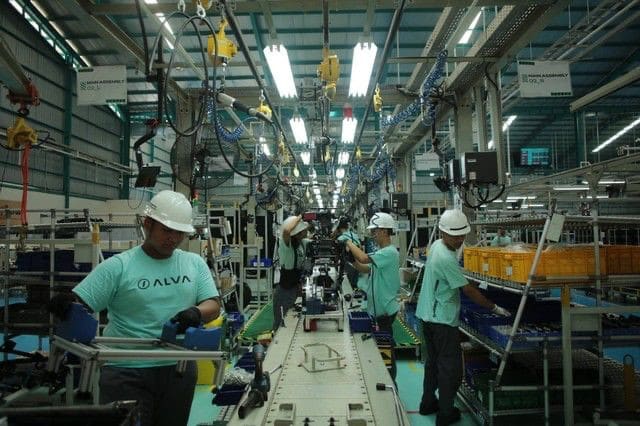
The program, called Molinas, will coordinate vehicle assembly, battery production, charging networks, and service infrastructure. At least ten domestic motorcycle manufacturers have cleared local-content thresholds and will work with state-owned integrator PT Len Industri and sovereign wealth vehicle Danantara, according to Danantara CEO Rosan Roeslani. The launch took place at the Alva electric motorcycle facility operated by PT Ilectra Motor Group, a unit of mining group PT Indika Energy.
Indonesia holds roughly 46 percent of the world's nickel reserves, Rosan noted. The government wants to move up the value chain by processing ore into battery components domestically rather than exporting raw or semi-finished material. Electric motorcycles offer a smaller, faster deployment path than passenger cars, and two-wheelers dominate transport across Indonesian cities.
Eased Credit and Local Battery Mandates
The government is extending easier credit access to buyers of locally assembled electric motorcycles, a lever Jakarta has used before to stimulate adoption of EVs built on Indonesian soil. Details on interest rates and loan tenures were not disclosed, but the financing will be tied to vehicles that meet domestic-content rules.
Battery chemistry is the hinge. Nickel-rich cathodes, particularly nickel-cobalt-manganese and nickel-cobalt-aluminum variants, were once the preferred format for energy density in EVs. But cost pressures and supply-chain diversification have accelerated the shift toward lithium-iron-phosphate batteries, which use no nickel and have become the dominant chemistry in China's EV sector. That trend threatens Indonesia's bet on downstream nickel processing.
By mandating nickel-based batteries in the Molinas program, Jakarta is creating captive domestic demand. Whether that demand proves sufficient to sustain cell production at scale, or competitive enough to attract export orders, remains an open question. Regional competitors, including Vietnam and Thailand, are also building EV ecosystems with different mineral strategies and more established automotive supply chains.
Ten Manufacturers, One Integrator
Danantara and PT Len Industri will coordinate the program's moving parts. Len, a state defense and electronics firm, will act as lead integrator, a role that includes overseeing technology standards, component sourcing, and production timelines. Danantara, the holding vehicle for reorganized state assets, will marshal financing and cross-company collaboration.
The ten participating manufacturers have not been named publicly, but Indonesia's motorcycle market includes both legacy combustion-engine producers and newer entrants focused on electric drivetrains. Alva, the showcase brand at the launch, has positioned itself as a premium electric two-wheeler with battery-swap capability, a feature that addresses range anxiety and charging time in dense urban settings.
Rosan emphasized affordability as a program goal. Domestic battery production, he argued, would lower unit costs and make electric motorcycles accessible to middle-income buyers who currently rely on gasoline scooters. Fuel imports remain a fiscal drag; Indonesia is a net oil importer despite being a major energy exporter overall, and transport fuel accounts for a large share of that import bill.
The Regional EV Landscape
Indonesia's push arrives as Southeast Asia's EV market fragments along different technology and policy paths. Thailand has attracted major automakers with tax incentives and is emerging as a regional production hub for battery-electric cars, many using LFP cells. Vietnam is scaling domestic EV brands with a mix of nickel and lithium chemistries, backed by conglomerate VinGroup. Singapore, meanwhile, remains a test bed for charging infrastructure and fleet electrification but lacks manufacturing scale.
Indonesia's comparative advantage lies in upstream resources, not downstream assembly or consumer electronics expertise. The Molinas program attempts to bridge that gap by yoking mineral wealth to industrial policy. Success will hinge on execution: whether the state-led integrator model can move quickly enough, whether credit subsidies prove sufficient to shift consumer behavior, and whether nickel-based batteries remain cost-competitive as lithium chemistries continue to improve.
The program also carries political symbolism. Prabowo has made resource nationalism and value-added processing central themes of his economic agenda, and the Molinas launch offers a tangible example of that vision. Electric motorcycles are visible, everyday products, easier for voters to grasp than smelter economics or export tonnage.
What Comes Next
Infrastructure rollout will be the next test. Charging stations for two-wheelers require different real estate and grid connections than car chargers, and battery-swap networks demand standardization across manufacturers, a coordination challenge in a fragmented market. Danantara and Len will need to align incentives among the ten participating companies, some of which compete directly in the same price segments.
Export potential is another variable. If Indonesia can produce nickel-battery motorcycles at competitive cost and quality, markets across Southeast Asia, South Asia, and Africa could absorb volume. But Chinese manufacturers already dominate low-cost electric two-wheelers globally, and they benefit from scale, vertical integration, and established distribution networks.
The program's success will ultimately be measured in three metrics: domestic adoption rates, the share of nickel processed into batteries rather than exported as intermediate goods, and whether the ecosystem generates export revenue. Prabowo's government has set the framework; the market will decide whether nickel-based electric motorcycles can find a sustainable niche in a lithium-leaning world.
RELATED STORIES
Riau Battles Wildfire Surge With Skeleton Budget
Siti Nuraini · 2 min
Jakarta Charts Course for 8% Growth With State-Led Resource Strategy
Priyanka V. Rao · 4 min
Indonesia Takes Control of Whoosh Railway Debt as B2B Model Collapses
Siti Nuraini · 4 min
Indonesia's Mining Sector Contracts for Second Straight Quarter
Siti Nuraini · 3 min
Spot something wrong? Email editor@briefasia.com. We log every correction publicly.