Technology · AI
Indonesia and India Strike Deal to Exchange AI Tools for National Statistics
The two nations will share digital platforms and expertise to modernize data collection and accelerate real-time statistical capabilities.
KEY TAKEAWAYS
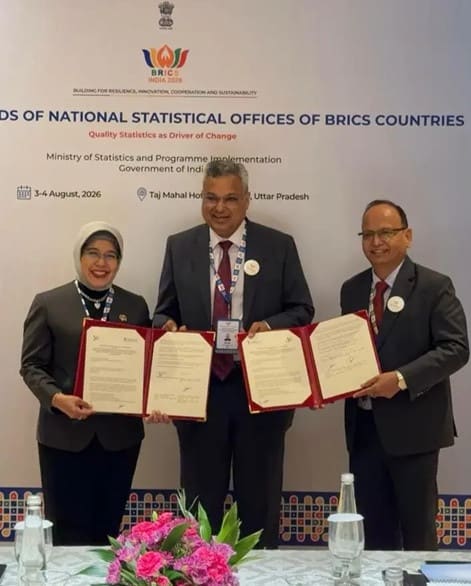
- ·Indonesia's BPS and India's MoSPI signed a Letter of Intent on August 4 to exchange AI applications and digital statistical platforms including FASIH and e-SIGMA.
- ·The partnership focuses on modernizing data collection, quality assurance, and survey operations to meet growing demand for real-time official statistics.
- ·Joint training programs and technical exchanges will begin within the next twelve months, with no direct financial commitments involved.
A Technical Exchange Between Asia's Data Giants
Indonesia's Statistics Indonesia (BPS) and India's Ministry of Statistics and Programme Implementation (MoSPI) have formalized a technology-sharing agreement aimed at modernizing their statistical infrastructure through artificial intelligence and digital platforms.
The Letter of Intent, signed on August 4 in Lucknow during the BRICS Meeting of Heads of National Statistical Offices, establishes a framework for technical cooperation between the two agencies. BPS chief statistician Amalia Adininggar Widyasanti and MoSPI Secretary Saurabh Garg committed both institutions to exchange expertise in AI applications, statistical dissemination methods, and business process modernization.
Platform Capabilities on the Table
The partnership centers on two proprietary systems. Indonesia will provide access to FASIH, its integrated digital platform designed for data collection and quality assurance across its archipelago of more than 17,000 islands. India, in turn, will share technical insights from e-SIGMA, a platform that supports survey operations and statistical management across its 1.4 billion population.
Both systems address similar challenges: coordinating field operations across vast geographies, ensuring data quality at scale, and reducing the lag between collection and publication. The exchange allows each agency to adapt techniques that have proven effective in comparably complex environments.
Training and Methodology in Focus
Beyond platform access, the agreement establishes joint training programs and technical cooperation initiatives. These will focus on enhancing the capacity of both statistical offices to produce data that meets the speed and reliability standards now expected by policymakers and investors.
The arrangement includes no direct financial commitments. Instead, it creates a working mechanism for knowledge transfer and technical exchanges, with implementation expected to begin within the next twelve months.
Pressure for Real-Time Data
The collaboration reflects mounting pressure on national statistical agencies across Asia to deliver faster, more granular data. Governments increasingly rely on near-real-time economic indicators to calibrate monetary policy, allocate budgets, and respond to shocks. Traditional survey methods, often requiring months to process and publish, struggle to keep pace.
AI and automated data collection offer a path to compress that timeline. Machine learning models can flag inconsistencies during field collection, reducing the need for manual validation. Digital platforms enable direct data entry from remote locations, cutting out paper-based workflows that add weeks to the process.
For Indonesia, the partnership comes as the country works to improve the timeliness and granularity of economic data used by Bank Indonesia and the Finance Ministry. For India, it supports ongoing efforts to digitize statistical operations and expand coverage in rural areas where connectivity has historically limited data quality.
What the Agreement Leaves Open
The Letter of Intent outlines broad areas of cooperation but stops short of specifying which AI models, algorithms, or datasets will be shared. It also does not address data sovereignty concerns that often complicate cross-border statistical collaboration, particularly when sensitive economic or demographic information is involved.
The success of the partnership will depend on how quickly both agencies can translate the framework into operational exchanges. Previous bilateral statistical agreements in the region have struggled with implementation, hampered by differing technical standards, bureaucratic inertia, and limited budgets for travel and training.
Still, the alignment of incentives is clear. Both countries face similar infrastructure challenges, both are investing heavily in digital government, and both stand to gain from reducing the cost and complexity of statistical modernization. If the technical exchange delivers measurable improvements in data quality or speed, it could serve as a template for broader regional cooperation among Asia's national statistical offices.
RELATED STORIES

Indonesia Eyes Natural Gas and Geothermal to Power AI Data Centers
Priyanka V. Rao · 3 min
Renminbi Faces Upward Pressure After US-Japan Yen Intervention
Cheng Wei-Lun · 3 min
Indonesia Plans to Slash State Enterprises to 300, Launch Probe Into Three Decades of Directors
Siti Nuraini · 4 min
Telkom Indonesia Faces SEC Inquiry Over Alleged Financial Fraud
Siti Nuraini · 3 min
Spot something wrong? Email editor@briefasia.com. We log every correction publicly.