Asia · Business
India's Young Farmers Adopt Drones and Digital Tools to Navigate Climate Pressures
A new generation embraces agricultural technology to boost efficiency and manage rising costs, but barriers around pricing, data governance, and small-farm access remain unresolved.
KEY TAKEAWAYS
- ·University students in Telangana are pooling resources to buy pesticide-spraying drones costing INR 2.5 to 6 lakh, offering services at INR 400 to 500 per acre to offset rising farm labour costs.
- ·India's Digital Agriculture Mission, launched in 2024, consolidates farmer data through platforms like Agri Stack and aims to export algorithms refined across diverse soils and climates to markets in Vietnam, Hungary, and Malaysia.
- ·High upfront costs and unclear data governance rules under the Digital Personal Data Protection Act limit technology adoption among small farmers, while precision agriculture may entrench rather than reduce chemical-intensive practices.
A Generation Turns to Drones
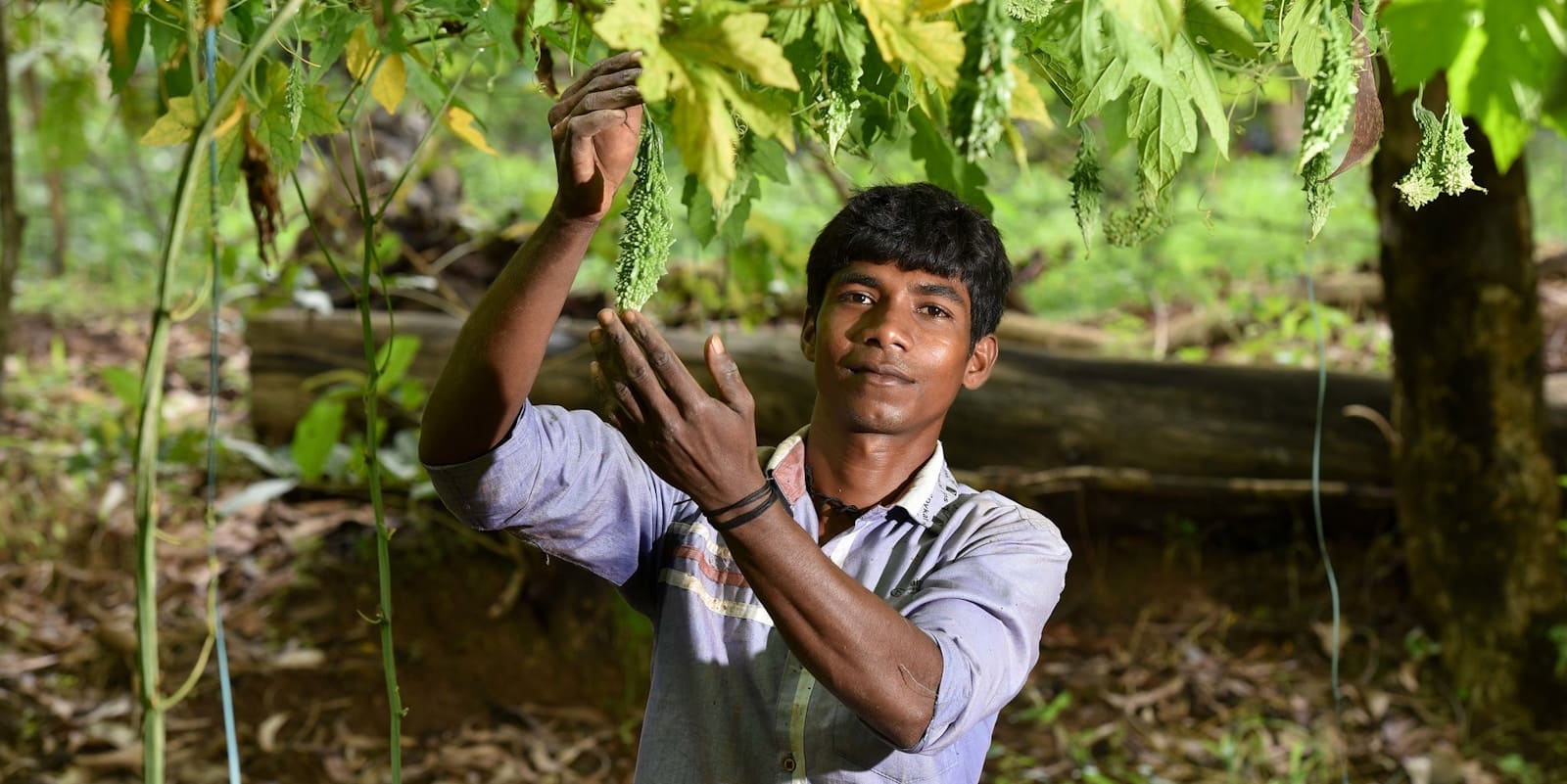
In an open field in Telangana's Nalgonda district, a group of university students take turns piloting an agricultural drone designed to spray pesticides. The session, organized by a local equipment vendor, draws young people from farming families who see the technology as both a labour-saving tool and a revenue stream. They plan to buy a drone collectively and offer spraying services to neighbouring farmers at INR 400 to 500 per acre, roughly four to five US dollars.
Shiva Reddy, 21, whose family cultivates 21 acres in the district, told local researchers his household already uses drones on its own crops. He estimates that offering the service commercially could generate annual income of INR 10 lakh, about USD 10,500. A basic 10 to 16-litre drone costs between INR 2.5 lakh and 6 lakh, depending on capacity and features.
For Reddy and his peers, the appeal is straightforward. Farm labour costs have climbed, and erratic weather driven by climate shifts has made traditional practices less predictable. Drones reduce the time and quantity of chemicals applied, cutting waste and limiting human contact with hazardous substances.
Digital Agriculture Takes Shape
India launched its Digital Agriculture Mission in 2024, assembling a suite of platforms intended to streamline data access for the country's farmers. Agri Stack consolidates records on landholdings, crops, and individual farmers to simplify subsidy applications, credit approvals, and advisory services. The Krishi Decision Support System analyzes satellite imagery, soil health reports, and weather patterns to generate yield forecasts and alert authorities to drought or flood risks. A mobile app for subsidized fertiliser procurement is being piloted across multiple states.
The government's ambition extends beyond domestic efficiency. Policymakers and entrepreneurs view India's diverse soils, cropping systems, and climatic zones as a proving ground for algorithms and sensors that can later be adapted for export. Rajashekar Reddy, director of Hyderabad-based Delta Things, noted that his company has already shipped agricultural sensors to Hungary and Malaysia, where customers use them to track nutrient absorption and refine fertiliser inputs.
According to Reddy, India's competitive edge lies not in hardware manufacturing but in refining data-driven use cases across varied environments. Predictive models trained on multiple crop cycles, irrigation regimes, and weather events generate datasets difficult to replicate in more homogeneous agricultural regions.
Older Farmers Navigate the Shift
Muthyala Sathaiya, 65, arrived at a farmer cooperative office in Nalgonda holding a handwritten note from his fertiliser dealer. He came to collect bags ordered online days earlier on his behalf. His neighbour, Vanam Jagan, 35, accompanied him in case digital complications arose. Sathaiya said he spent four days seeking help from younger villagers to obtain the one-time password required to register on the government's fertiliser app.
The average Indian farmer was 50 years old as of 2016, a cohort that witnessed the Green Revolution's mechanization drive in the 1960s, the expansion of irrigation infrastructure, and the surge in chemical inputs that lifted yields but also degraded soil, reduced beneficial insect populations, and created pesticide-resistant pests. India remains a significant source of methane emissions from rice paddies and nitrous oxide from nitrogen fertiliser breakdown, yet the agricultural sector faces no mandatory emissions reduction mandate.
Extreme weather now compounds those legacy pressures. Researchers at Monash University reported this year that a 20 percent drop in rainfall would reduce national average crop yields by 8 percent, with rice and cotton falling 11 percent. A one-degree Celsius temperature rise would cut pearl millet yields by 19 percent and maize by 16 percent. In Telangana, delayed monsoon rains this year pushed back sowing schedules, and low reservoir levels linked to El Niño conditions curtailed water availability for Kharif crops.
Precision Agriculture and Its Limits
Precision farming applies real-time sensor data and algorithms to tailor irrigation, fertiliser, and pesticide applications. Jella Satyanarayana, who leads the Agri-robotics Lab at Professor Jayashankar Telangana Agricultural University, said the approach reduces labour requirements, lowers input costs, and improves productivity by applying only the necessary quantities at optimal times.
A Tamil Nadu startup developed an AI-enabled system that monitors soil moisture, irrigation, and fertiliser use through sensors linked to a mobile platform. Deployed on a government-backed coconut farm, the system doubled yields, according to an official press note earlier this year. More than 3,500 farmers have since adopted the technology.
Kushang Mishra, a doctoral researcher at the University of Auckland studying India's agricultural digitization, said farmers in his interviews reported saving water, fertiliser, and pesticides after adopting data-informed practices. Yet he cautioned that precision agriculture does not automatically translate into sustainable agriculture. Instead of reducing reliance on agrochemicals, the technology may legitimize and entrench chemical-intensive methods by making them more efficient.
Jagan, who farms eight acres and has experimented with drones, mechanized equipment, and soil testing, said results have disappointed. He attributes soil degradation to years of applying chemical growth stimulants recommended by input dealers whom he suspects prioritized commission over agronomic advice. In bad weather years, he and neighbouring farmers still hire migrant labour for planting and harvest.
Mishra observed that farmers prioritize immediate concerns such as unpredictable rainfall, rising costs, and market prices. Farm data collection remains low on their list.
Data Governance and Export Ambitions
Soil quality, weather, and crop data hold commercial value. Mishra expressed concern that if accessible to large agrochemical or seed companies, the information could enable targeted advertising. Banks and insurers could also use the data to assess creditworthiness or price policies based on chemical profiles and soil moisture levels in specific areas.
India's Digital Personal Data Protection Act requires business compliance by May 2027, but how the law will treat agricultural data, which straddles personal and non-personal categories, remains unclear. Reddy of Delta Things said the industry is waiting to see how policy evolves.
Meanwhile, India is positioning its digital agriculture ecosystem for international reach. A joint statement between India and Vietnam on enhanced strategic partnership highlighted cooperation in digital technologies for smart agriculture, water management, and technology transfer, though it did not specify companies or products.
Experts noted that Indian algorithms and sensors will require adaptation to local soils, governance structures, infrastructure, and farming practices before they can succeed abroad. Satyanarayana pointed out that high upfront costs limit uptake domestically, and many digital tools are designed for large-scale operations rather than India's fragmented smallholdings. Large farms already deploy robots, drones, and sensors, he said, but small and marginal farmers cannot afford them.
The gap between technological ambition and on-the-ground reality persists, even as a younger generation tests new tools in the field.
RELATED STORIES
India Receives 20 Bids to Build Rare Earth Magnet Production Capacity
Rajesh K. Iyer · 3 min
Eureka Forbes Launches Probe After Child Labor Found at New Delhi Supplier
Priyanka V. Rao · 2 min
Modi Targets 50 Indian Companies in Fortune 500 With Seven-Pillar Growth Plan
Rajesh K. Iyer · 3 min

Tata Leadership Change Tests India's Semiconductor and Data Center Ambitions
Priyanka V. Rao · 4 min
Spot something wrong? Email editor@briefasia.com. We log every correction publicly.