Technology · AI
India's Infrastructure Suppliers Ride the AI Datacenter Wave
Fibre-optic and power equipment makers secure billion-dollar contracts as hyperscalers expand capacity across the subcontinent, even as broader tech sector faces automation headwinds.
KEY TAKEAWAYS
- ·Sterlite Technologies secured a $1.1 billion multi-year contract with a US hyperscaler, driving its share price up 400 percent in 2026 as fibre-optic demand surges.
- ·India hosts nearly a fifth of global data but less than 5 percent of data centre capacity, with hyperscalers committing $57 billion in new capacity over the past year.
- ·At least 75 US data centre projects worth $130 billion faced delays or cancellations in Q1 2026, though opposition in India remains limited so far.
The Infrastructure Play
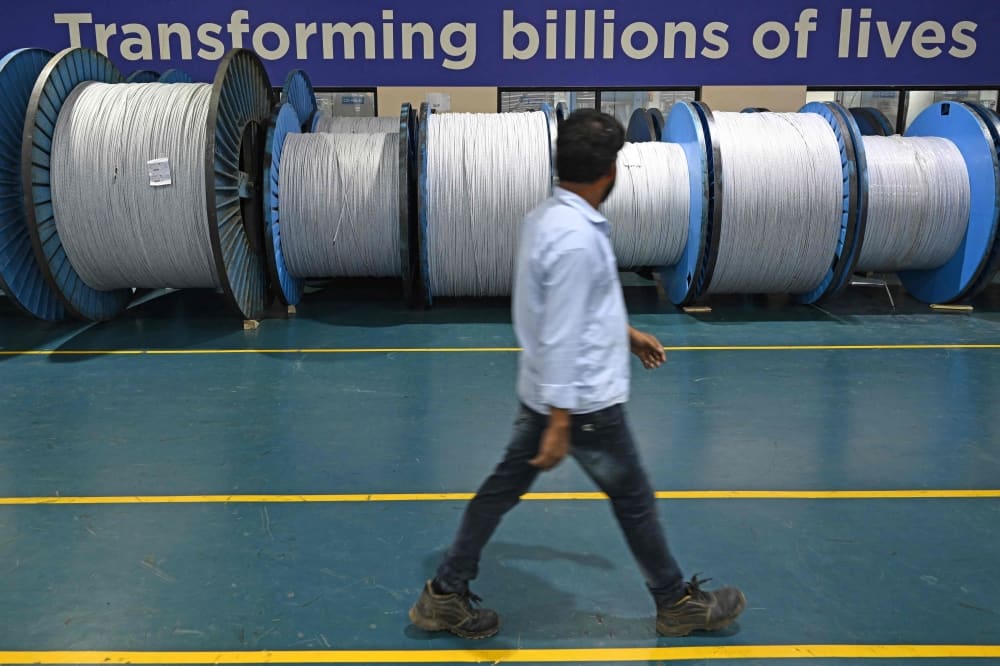
Inside a factory in western India, technicians operate in continuous shifts, transforming raw glass into fibre-optic strands thin as human hair. The destination for these cables: data centres that will power artificial intelligence workloads across the globe.
While India has yet to produce competitive large language models or advanced semiconductors, a different story is unfolding in the physical layer. Companies making cables, transformers, switchgear, and cooling systems are capturing a slice of the global AI buildout, even as investors fret about generative AI's potential to automate the tasks that built India's $315 billion IT services sector.
Sterlite Technologies announced a $1.1 billion multi-year supply agreement with a US hyperscaler earlier this year. The contract helped push the company's share price up 400 percent in 2026. Ankit Agarwal, the firm's managing director, describes the shift from traditional telecom supply chains to serving the world's largest technology operators as transformational.
Telecom equipment maker HFCL reported revenue more than doubling in the April-June quarter, driven by AI-related demand. Founder Mahendra Nahata says his company now expands capacity on a routine basis, a pace unthinkable in previous cycles when buildouts happened every three to five years.
Beyond Cables
The gains extend across multiple categories of infrastructure. TD Power Systems has seen its shares climb 68 percent on expectations tied to AI facility demand. MTAR Technologies has benefited from orders for power units used in fuel-cell systems that support large-scale cloud operators.
Fund managers at Shriram AMC frame the opportunity as a "picks and shovels" trade, referencing the California gold rush merchants who profited by selling tools rather than mining. Prateek Nigudkar notes that every data centre requires switchgear, transformers, cables, cooling systems, and grid connectivity. Indian manufacturers already occupy established positions in those supply chains.
The infrastructure thesis rests on a capacity gap. India hosts nearly a fifth of the world's data but accounts for less than 5 percent of global data centre capacity. Hyperscalers from the United States have committed roughly $57 billion in new Indian capacity over the past year, according to a review of funding announcements. Domestic conglomerates Adani and Reliance have pledged $100 billion toward digital and infrastructure projects.
Valuation and Resistance Risks
Analysts caution that valuations have stretched in some segments. A more immediate concern is rising opposition to energy-intensive data centre projects. According to Data Centre Watch, a tracker operated by AI intelligence firm 10a Labs, at least 75 projects in the United States worth approximately $130 billion faced delays or cancellations in the first quarter of 2026.
So far, India has experienced limited pushback. Sharad Agarwal, chief executive of data centre operator Sify Infinit Spaces, says opposition remains nascent. Operators have adopted technologies such as closed-loop water cooling to ease pressure on local water and power resources.
Sify operates 16 data centres and has nearly a dozen more under development. The company is considering an initial public offering that would make it India's first listed data centre operator. Agarwal estimates that reaching one gigawatt of computing capacity, a threshold often described as hyperscale, would require $5 billion in investment.
A Hedge Against Disruption
The infrastructure wave offers a counterbalance to concerns weighing on India's equity market. The benchmark Nifty 50 index is down roughly 7 percent in 2026, with foreign investors withdrawing over $27 billion from Indian equities. Much of the anxiety centres on whether generative AI will displace the customer service and application maintenance work long outsourced to Indian IT firms.
Executives in the infrastructure segment acknowledge that near-term sentiment could be volatile if opposition to data centre projects intensifies abroad. Yet they argue that domestic demand will eventually offset any slowdown in foreign orders. India's digital consumption continues to grow, and the country's data centre footprint remains small relative to the volume of data generated within its borders.
For companies like Sterlite and HFCL, the AI infrastructure buildout represents a rare window. The technology may be developed elsewhere, but the physical networks that support it require components these firms are positioned to supply at scale. Whether that advantage translates into sustained growth will depend on how quickly hyperscalers and domestic operators can navigate land, power, and regulatory constraints across India's states.
RELATED STORIES
Indian AI Firm Commits $8 Billion to Nvidia Infrastructure Buildout
Priyanka V. Rao · 3 min
India's Semiconductor Push Extends to Supply Chains and Advanced Manufacturing
Priyanka V. Rao · 4 min
India Shuts Down Hundreds of Google Firebase Accounts Linked to Banking Fraud
Priyanka V. Rao · 4 min
India's IT Outsourcers Shift to Performance Pricing as AI Upends Billable Hours
Priyanka V. Rao · 3 min
Spot something wrong? Email editor@briefasia.com. We log every correction publicly.