Technology · AI
Indian AI Firm Commits $8 Billion to Nvidia Infrastructure Buildout
AM Intelligence places binding order for 9,000 Vera Rubin systems as Asia races to secure scarce computing capacity amid multi-year backlogs
KEY TAKEAWAYS
- ·AM Intelligence ordered 9,000 Nvidia Vera Rubin systems under an $8 billion plan to deploy 1 gigawatt of AI computing capacity in southern India by next year.
- ·The Hyderabad facility will serve major cloud providers and AI labs across India, the US, Finland, and Malaysia, with initial capacity already purchased by an undisclosed US customer.
- ·Global supply of high-end Nvidia clusters remains constrained, with multi-year backlogs driven by hyperscale demand and Japan separately acquiring next-generation Rubin chips for a robotics AI model launching in 2028.
India Stakes Its Claim in the AI Infrastructure Race
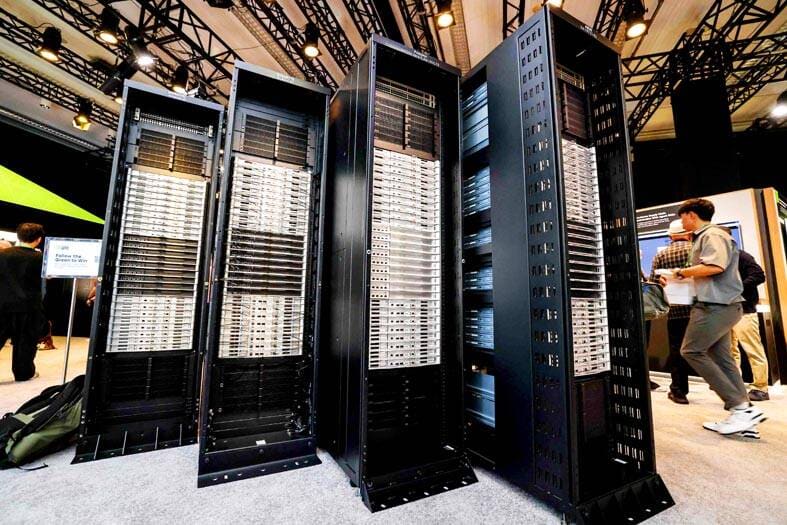
AM Intelligence, a Hyderabad-based artificial intelligence infrastructure company, has placed a binding order for 9,000 Nvidia Vera Rubin systems as part of an $8 billion initiative to establish 1 gigawatt of computing capacity. The servers are scheduled to come online next year in southern India, positioning the firm among Asia's earliest adopters of Nvidia's advanced rack-scale architecture.
The company disclosed that its customer base spans major cloud service providers, AI research labs, and organizations building indigenous Indian AI models. The initial capacity has already been secured by a US customer whose identity remains undisclosed under non-disclosure terms.
Supply Constraints Drive Regional Competition
High-end Nvidia compute clusters remain in short supply globally. Data center operators including Microsoft, Alphabet's Google, and Amazon continue to place orders that stretch delivery timelines into multi-year backlogs. The race to secure chips has intensified across Asia, with Japan separately planning to acquire next-generation Rubin processors to power a domestic foundational AI model for robotics. That Japanese data center is slated to begin operations in June 2028.
AM Intelligence's move reflects broader regional competition to lock down scarce infrastructure before availability tightens further. The firm aims to run trillion-parameter AI models and next-generation agentic AI applications from its Hyderabad facility.
Renewable Power as Competitive Edge
Mahesh Kolli, founder and president of Greenko Group, the renewable energy conglomerate that owns AM Intelligence, framed the company's advantage in economic terms. Access to low-cost renewable power from Greenko's portfolio gives the firm a structural cost advantage in what he described as "global token economics," where energy prices constitute a substantial portion of operating expenses.
"We're one of the lowest-cost AI computation infrastructure players globally," Kolli said. The group plans to offer computing capacity at competitive rates to customers in India, the United States, Finland, and Malaysia.
India faces minimal operational constraints for serving US customers, Kolli noted. Undersea cable connections enable American companies to access AI compute hosted in India with latency around 300 milliseconds, a threshold acceptable for many training and inference workloads.
Demand Dynamics and Financing
Kolli characterized customer behavior as "hunting desperately" for available capacity, a reflection of how quickly hyperscale demand has outpaced supply. The group intends to finance its proposed buildout through a combination of debt and equity, though specific terms and timelines were not disclosed.
The Hyderabad facility represents a test case for whether India can compete with established AI infrastructure hubs in North America, Europe, and East Asia. Success depends on execution speed, power reliability, and the ability to maintain cost discipline as chip prices rise. Nvidia recently informed its largest customers that server prices containing AI chips would increase by more than 15 percent in many configurations, with the hikes taking effect on systems shipped early next year.
Asia's Divergent Strategies
India's approach contrasts with Japan's state-led initiative and China's push for self-sufficiency under export controls. While Tokyo directs public resources toward a national AI model, New Delhi has allowed private capital and renewable energy groups to lead infrastructure investment. AM Intelligence's scale reflects ambition, but also the financial firepower required to compete in a market where lead times and upfront commitments run into the billions.
The southern India deployment will test whether latency, energy costs, and regulatory stability can offset the gravitational pull of US and European data center ecosystems. If AM Intelligence can deliver on its capacity targets and price commitments, it may catalyze a shift in how global AI workloads are geographically distributed.
For now, the company's binding order signals confidence that demand will remain robust through the deployment cycle. Whether that confidence is justified depends on how quickly AI model economics mature and whether the current supply-demand imbalance persists beyond 2027.
RELATED STORIES

India's Semiconductor Push Extends to Supply Chains and Advanced Manufacturing
Priyanka V. Rao · 4 min

Larsen & Toubro Lands $1.57 Billion AI Data Centre Contract in India
Priyanka V. Rao · 3 min

India's Semiconductor Fabs Face Critical Yield Challenge as Production Begins
Priyanka V. Rao · 4 min

India Ties Chip Expansion, AI Training, and Export Push to 2047 Self-Reliance Goal
Priyanka V. Rao · 3 min
Spot something wrong? Email editor@briefasia.com. We log every correction publicly.