Technology · AI
India Ties Chip Expansion, AI Training, and Export Push to 2047 Self-Reliance Goal
Prime Minister Modi outlined a coordinated technology and industrial strategy during Independence Day address, linking semiconductor capacity, workforce development, and trade policy under single framework.
KEY TAKEAWAYS
- ·Prime Minister Modi announced plans for additional semiconductor plants and mass AI training programs during India's 80th Independence Day address, linking both to a 2047 self-reliance target.
- ·The strategy frames chip manufacturing, AI workforce development, and export expansion as interconnected elements rather than separate policy tracks.
- ·Execution timelines, funding details, and trade-policy specifics remain unclear, with industry watching whether the first wave of chip plants delivers on schedule in the next two to three years.
A Three-Pronged Technology Push
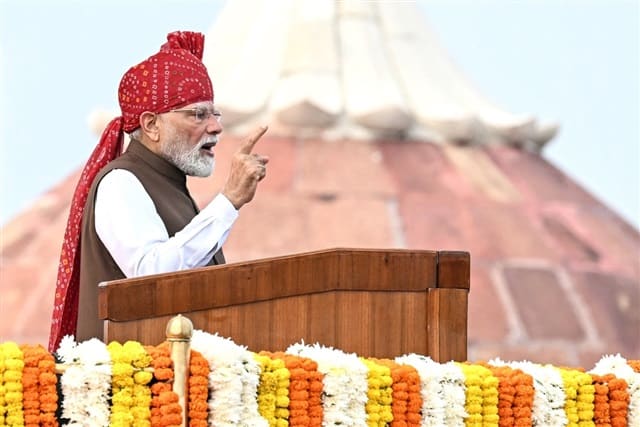
Prime Minister Narendra Modi used India's 80th Independence Day ceremony on August 15 to announce an integrated technology strategy that positions semiconductor manufacturing, mass artificial intelligence training, and export expansion as interconnected components of the country's self-reliance agenda. Speaking from the Red Fort, Modi framed the initiatives as essential building blocks toward achieving "Viksit Bharat" - developed India - by 2047, the centenary of independence.
The address signaled a shift from treating chip production, AI capability, and trade policy as separate tracks to presenting them as mutually reinforcing elements of a single industrial framework. Modi pledged government support for additional semiconductor fabrication plants beyond the three facilities already under construction, though he did not specify locations, timelines, or investment amounts.
Workforce Development at Scale
The Prime Minister outlined plans for large-scale AI training programs designed to build domestic technical capacity across multiple sectors. While details remain sparse, the emphasis on "mass training" suggests a push to create a workforce capable of supporting both domestic AI adoption and global services demand. India already hosts significant research and development centers for multinational technology firms; expanding AI skills at scale could deepen that role and support indigenous startups competing in machine learning, natural language processing, and enterprise automation.
The AI training initiative appears designed to complement semiconductor ambitions. As fabrication plants come online in Gujarat, Assam, and other states over the next three to five years, India will need engineers, process technicians, and software specialists capable of integrating hardware and AI-driven design tools. The government has previously allocated funding for skill development in electronics manufacturing; the Independence Day speech suggests AI will receive similar priority.
Export Strategy and Trade Integration
Modi also highlighted export growth as a pillar of the self-reliance framework, though he did not detail specific policy measures or target markets. India has pursued free-trade agreements with the European Union, the United Kingdom, and members of the Gulf Cooperation Council in recent years, and officials have signaled interest in deeper integration with Southeast Asian supply chains.
The export push carries particular weight in semiconductors. India's existing chip projects focus on assembly, testing, and packaging rather than advanced logic fabrication. To capture meaningful export revenue, the country will need to scale production, secure long-term contracts with global electronics manufacturers, and compete with established hubs in Malaysia, Vietnam, and Thailand. Government incentives under the India Semiconductor Mission have attracted commitments from Micron Technology, CG Power, and Tata Electronics, but moving from construction to consistent output remains the critical test.
Regional Context and Competitive Pressure
The speech arrives as Asian governments intensify efforts to capture a larger share of semiconductor and AI value chains. South Korea has committed tens of billions of dollars to chip R&D and production subsidies. Japan has lured TSMC to build multiple fabs on its soil. China continues to pour resources into self-sufficiency despite U.S. export controls. Singapore and Taiwan remain dominant in advanced packaging and design services.
India's strategy differs in its simultaneous emphasis on hardware manufacturing, talent development, and trade linkages. The country's demographic profile - more than half the population is under 30 - offers a structural advantage in workforce scaling, but education systems, infrastructure, and regulatory consistency will determine whether that potential translates into competitive advantage.
Implementation Gaps
The Independence Day address provided broad direction but left key questions unanswered. Funding mechanisms, coordination between central and state governments, and timelines for delivering on chip-plant commitments and AI training programs remain unclear. India has historically struggled to execute large-scale industrial projects on schedule; semiconductor fabs are capital-intensive, technically complex, and sensitive to delays.
Trade policy also requires clarity. Export growth depends not only on domestic production capacity but on tariff structures, customs efficiency, and trade-agreement negotiations that can take years to finalize. Modi's speech did not address whether India will lower import duties on critical components or streamline regulatory approvals for foreign partnerships, both of which industry groups have requested.
The 2047 target offers a long horizon, but semiconductor and AI markets move in much shorter cycles. Companies make capital-allocation decisions based on five- to ten-year outlooks; governments competing for investment must demonstrate momentum within that window. India's ability to convert the Red Fort vision into operational reality will depend on execution in the next two to three years, when the first wave of chip plants is scheduled to begin production and AI training programs must show measurable scale.
RELATED STORIES
Indonesia and India Strike Deal to Exchange AI Tools for National Statistics
Siti Nuraini · 3 min
India's Electronics Push Faces Water Scarcity and Visa Friction
Priyanka V. Rao · 3 min
Larsen & Toubro Lands $1.57 Billion AI Data Centre Contract in India
Priyanka V. Rao · 3 min
Seoul Semiconductor Secures Indian Court Ban on Patent-Infringing LED Products
Priyanka V. Rao · 3 min
Spot something wrong? Email editor@briefasia.com. We log every correction publicly.