Technology · Dev
Foxconn Plots Four-Phase Strategy for Low Earth Orbit Satellite Operations
The manufacturing giant is leveraging its Pearl satellite missions to build space hardware flight heritage and develop communications infrastructure from relay systems to AI-native networks.
KEY TAKEAWAYS
- ·Foxconn Research Institute has outlined a four-stage roadmap for low Earth orbit satellite development, beginning with relay systems and advancing to AI-native networks.
- ·The company is using its Pearl satellite missions to collect operational data and establish flight heritage for Foxconn-developed space hardware.
- ·Foxconn's push into space infrastructure reflects broader regional momentum in Asia, where manufacturers are pursuing vertical integration in satellite supply chains.
From Factory Floors to Orbital Paths
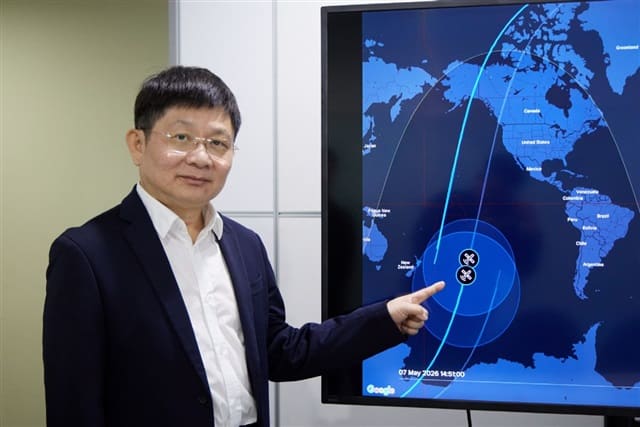
Foxconn is taking its manufacturing and systems integration capabilities into space. The company's research division has mapped out a phased approach to low Earth orbit operations, starting with relay satellites and advancing toward networks designed for artificial intelligence workloads.
The Foxconn Research Institute is using Pearl satellite missions as a testbed for this expansion. These missions serve dual purposes: collecting operational data on communications links and orbital conditions while simultaneously proving out hardware developed within the Foxconn group. The approach mirrors the company's long-standing methodology in terrestrial electronics - build, test, refine, then scale.
Building Flight Heritage Through Pearl Missions
The Pearl program functions as Foxconn's on-orbit laboratory. According to the Foxconn Research Institute, these missions are generating first-hand data on how communications systems perform in the space environment, how satellites behave across different orbital positions, and what design modifications are needed for sustained operations beyond Earth's atmosphere.
This empirical approach allows Foxconn to establish what the space industry calls "flight heritage" - the documented track record that hardware has operated successfully in space. For a company rooted in high-volume manufacturing, this is a necessary step before committing to larger production runs of space-qualified components.
The institute's four-stage roadmap begins with relay satellites, which handle basic signal forwarding between ground stations and other spacecraft. Subsequent phases push toward more complex capabilities, culminating in networks engineered specifically to support AI processing tasks in orbit.
Manufacturing Expertise Meets Space Demands
Foxconn's move into space infrastructure is not a pivot but an extension. The company brings decades of experience in assembly, integration, and testing - disciplines that translate directly to satellite production. The challenge lies in adapting those processes to the stricter environmental tolerances and reliability standards required for orbital hardware.
The Pearl missions provide real-world feedback loops. Engineers can observe how components behave under radiation exposure, thermal cycling, and microgravity, then feed those lessons back into design and manufacturing workflows. This iterative process is standard in aerospace but relatively new territory for a company whose primary reputation rests on consumer electronics and computing hardware.
Regional Context in Asia's Space Race
Foxconn's satellite ambitions unfold against a backdrop of intensifying space activity across Asia. Governments and private players in Japan, South Korea, India, and Taiwan are accelerating investments in satellite constellations, ground infrastructure, and launch capabilities. Taiwan's own space sector is expanding, with the National Space Organization coordinating efforts across research institutions and private firms.
For Foxconn, establishing a foothold in LEO systems aligns with broader regional trends. Asian manufacturers are increasingly seeking vertical integration in space supply chains - building not just components but entire satellite platforms and ground systems. This reduces reliance on Western suppliers and creates new revenue streams as satellite demand grows for broadband, Earth observation, and emerging use cases like edge computing in orbit.
Next Steps and Open Questions
The Foxconn Research Institute has not disclosed timelines for each phase of its roadmap, nor has it specified how many Pearl satellites are planned or what partnerships might support later-stage network deployment. The company's existing relationships with hyperscale cloud providers and telecom operators could offer pathways for integrating space-based infrastructure with terrestrial networks.
What remains clear is Foxconn's intent to treat space as another domain for its core competencies. The Pearl missions are early proof points. Whether the company can transition from experimental satellites to operational constellations will depend on how quickly it can industrialize space hardware production - and how effectively it can navigate the regulatory, financial, and technical complexities that have challenged even well-funded space startups.
For now, Foxconn is collecting data, proving hardware, and mapping a future where its assembly lines extend beyond Earth's surface.
RELATED STORIES

Foxconn's Foxtron Lands Mitsubishi EV Deal, Expands Taiwan Manufacturing Footprint
Cheng Wei-Lun · 5 min
TSMC Posts Record Monthly Revenue as AI Chip Demand Accelerates
Cheng Wei-Lun · 2 min

Foxconn Subsidiary Registers EV Charging Business in Vietnam
Cheng Wei-Lun · 5 min

British Semiconductor Delegation Heads to SEMICON Taiwan Seeking Strategic Partnerships
Cheng Wei-Lun · 2 min
Spot something wrong? Email editor@briefasia.com. We log every correction publicly.