Technology · Products
E Ink Cuts Revenue Forecast as Memory Prices Delay E-Reader Launches
The world's largest e-paper supplier now expects 10-15 percent growth this year, down from an earlier projection of 20-25 percent, as rising memory costs force customers to postpone new products.
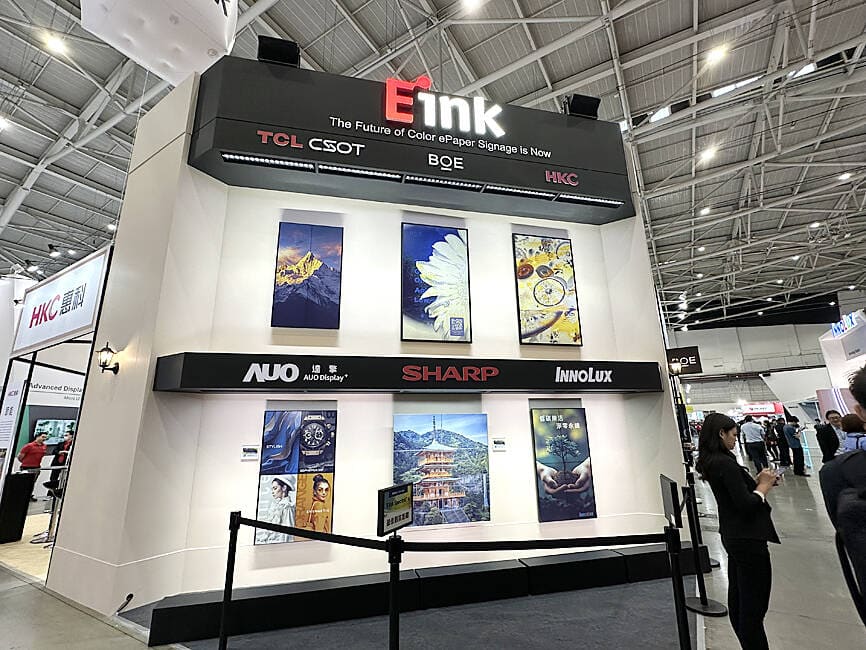
KEY TAKEAWAYS
- ·E Ink has cut its 2026 revenue growth forecast to 10-15 percent from 20-25 percent due to rising memory prices delaying e-reader and e-note product launches.
- ·The company's IoT segment, led by electronic shelf labels for US and European retailers, is expected to grow 20-25 percent despite consumer electronics weakness.
- ·E Ink reported second-quarter net profit of NT$3.73 billion, up 26 percent year-on-year, though the traditional third-quarter peak has shifted to the fourth quarter this year.
Memory Costs Hit Consumer Electronics Segment
E Ink Holdings, the dominant global supplier of e-paper displays, has lowered its annual revenue growth target to 10-15 percent for 2026, a sharp drop from its previous 20-25 percent forecast. The company attributes the revision to rising memory chip prices that have disrupted product launch schedules across the e-reader and e-note market.
The Hsinchu-based manufacturer had anticipated a continued shift from monochrome to color e-paper displays throughout this year. Instead, memory cost inflation has prompted device makers to postpone releases while demand for older-generation models has weakened as final prices climb, according to E Ink.
Chairman Johnson Lee described the situation as creating "headwinds mainly for consumer products such as e-readers and e-notes" during an earnings conference in Taipei. The consumer segment is experiencing a double-digit revenue decline, he said.
Electronic Shelf Labels Drive IoT Growth
Despite weakness in consumer electronics, E Ink maintains its bullish outlook for Internet-of-Things applications, particularly electronic shelf labels deployed by major retailers. The company projects IoT revenue will expand 20-25 percent this year, fueled by accelerating ESL adoption among large-scale US and European retail chains.
This divergence underscores how enterprise customers with longer procurement cycles and different cost structures continue to invest in digital transformation, even as consumer-facing products face price sensitivity.
E Ink is maintaining its NT$8 billion (US$248.69 million) capital expenditure plan for the year. The spending focuses on new production lines for large-format e-paper displays, aimed at improving unit economics for digital signage products.
Shifted Peak Season and Quarterly Outlook
Demand patterns are showing unusual behavior this year. Lee noted that the third quarter, traditionally E Ink's strongest period, will see moderately lower revenue compared to the NT$10.22 billion recorded in the second quarter. The company now expects the fourth quarter to become the peak sales period for 2026.
Digital signage displays measuring 8 to 15 inches are seeing robust demand, while 32-inch products have underperformed expectations due to affordability concerns. E Ink projects high-single-digit percentage growth for its digital signage segment this year.
The company's second-quarter financial results showed net profit of NT$3.73 billion, up 26 percent year-on-year from NT$2.97 billion. Earnings per share rose to NT$3.23 from NT$2.58, though gross margin slipped to 58.7 percent from 60 percent a year earlier.
For the first half of 2026, net profit climbed 26 percent to NT$6.52 billion from NT$5.17 billion in the comparable 2025 period, with EPS advancing to NT$5.65 from NT$4.50.
Memory Price Ripple Effects Across Asia Tech
The memory price surge affecting E Ink's customers reflects broader supply-demand imbalances in the semiconductor industry. DRAM and NAND flash prices have climbed steeply over the past year, driven by capacity constraints and strong demand from AI server applications. This has created a squeeze for consumer electronics manufacturers who face thinner margins and more price-sensitive end users.
Taiwan's position as a critical node in the global electronics supply chain means shifts in component pricing quickly cascade through the region's manufacturing ecosystem. E Ink's revised guidance offers a window into how cost pressures at the component level translate into delayed product cycles and dampened revenue growth for downstream suppliers.
The company's ability to sustain strong performance in enterprise-focused segments while consumer demand softens highlights the bifurcation emerging across Asian technology markets. Industrial and retail customers continue digital infrastructure investments, while consumer spending remains constrained by macroeconomic uncertainty and device upgrade fatigue.
E Ink's production expansion for larger display formats signals confidence in longer-term demand trends, even as near-term headwinds persist. The question facing investors is whether memory prices stabilize quickly enough for the consumer segment to recover in 2027, or whether elevated costs become structural.
RELATED STORIES
Taiwan's Compal Braces for Sharp PC Decline as Memory Costs Squeeze Demand
Cheng Wei-Lun · 3 min
Taiwan's Server Supply Chain Posts Mixed July Results Amid AI Build-Out
Cheng Wei-Lun · 4 min
TSMC and Sony Launch $4.69 Billion Sensor Joint Venture in Japan
Cheng Wei-Lun · 3 min

Taiwan Emerges as Critical Hub for Co-Packaged Optics Manufacturing
Cheng Wei-Lun · 3 min
Spot something wrong? Email editor@briefasia.com. We log every correction publicly.