Technology · AI
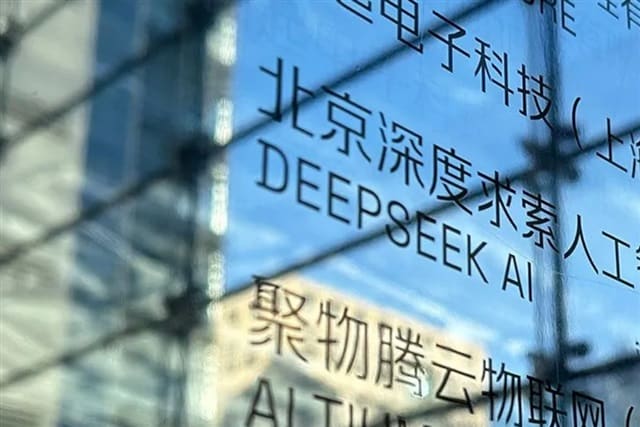
DeepSeek Backs Unitree With $20.8 Million Stake in Shanghai IPO
The AI developer's investment includes a partnership to build models for humanoid robots as China's robotics sector moves toward commercialization.
KEY TAKEAWAYS
- ·DeepSeek invested CNY 140.8 million in Unitree Robotics during its Shanghai IPO and agreed to co-develop AI models for humanoid platforms.
- ·The partnership aims to embed advanced language and reasoning capabilities into robots for real-world tasks in logistics, manufacturing, and urban environments.
- ·The deal reflects China's push for commercialization of humanoid robotics and a shift toward vertical integration between AI developers and hardware makers.
Strategic Entry at Market Debut
DeepSeek has committed CNY 140.8 million (approximately $20.8 million) to Unitree Robotics as part of the robotics manufacturer's initial public offering on the Shanghai exchange. The investment comes with a technical collaboration agreement focused on embedding advanced AI capabilities into humanoid platforms.
The deal positions DeepSeek alongside Unitree during a pivotal moment for China's robotics industry. Unitree has emerged as a domestic front-runner in quadruped and humanoid systems, competing with international players in a sector where hardware sophistication increasingly depends on software intelligence. DeepSeek, known for its large language models and reasoning architectures, brings computational depth that could accelerate decision-making and natural-language interaction in physical robots.
Bridging Models and Machines
The partnership centers on joint development of AI models tailored for embodied tasks. Unlike cloud-based assistants, robots operating in warehouses, factories, or urban environments require low-latency perception, real-time path planning, and adaptive manipulation. DeepSeek's expertise in multimodal inference and reinforcement learning aligns with Unitree's need to move beyond scripted routines toward autonomous behavior in unstructured settings.
Unitree has already demonstrated quadruped robots capable of navigating rough terrain and bipedal prototypes that handle basic assembly tasks. Integrating DeepSeek's models could enable those platforms to interpret spoken commands, adjust to changing workflows, and learn from human demonstrations without extensive reprogramming. For DeepSeek, the collaboration offers a testbed for applying its research outside purely digital domains, where data from sensors and actuators feed back into model refinement.
Timing and Market Context
The investment arrives as China accelerates policy support for humanoid robotics. Municipal governments in Shanghai, Shenzhen, and Beijing have earmarked subsidies and pilot zones, while the Ministry of Industry and Information Technology has published roadmaps targeting annual production volumes in the hundreds of thousands by the end of the decade. Unitree's public listing reflects broader investor appetite for companies that can translate laboratory prototypes into scalable products.
DeepSeek's financial commitment also signals confidence in near-term commercialization. Humanoid robots remain expensive and energy-intensive, but falling component costs and improving battery density are narrowing the gap between pilot deployments and volume orders. Logistics operators and contract manufacturers in Asia have begun trials, creating early revenue opportunities for platforms that can demonstrate reliability and return on investment.
Implications for the Robotics Stack
The partnership underscores a shift in how robotics companies build competitive advantage. Hardware differentiation, once centered on actuator torque and sensor arrays, now increasingly depends on the intelligence layer that orchestrates those components. By securing an AI partner before its IPO, Unitree aims to differentiate its offerings in a crowded field that includes state-backed research institutes and well-funded private ventures.
For the broader Asia robotics ecosystem, the deal illustrates a pattern of vertical integration between model developers and hardware specialists. Similar collaborations have emerged in Japan and South Korea, where language-model providers are embedding capabilities into industrial and service robots. The question is whether these partnerships can deliver systems that outperform modular approaches, where customers integrate best-of-breed components themselves.
DeepSeek's stake also reflects the strategic importance of data. Every interaction a Unitree robot has in a real-world setting generates training examples that can refine DeepSeek's models, creating a feedback loop that benefits both parties. As deployment scales, that proprietary dataset could become a moat against competitors relying solely on simulation or publicly available benchmarks.
What Comes Next
Unitree's IPO prospectus and DeepSeek's investment memorandum will be scrutinized for details on revenue projections, deployment timelines, and the technical milestones the joint models must hit. Investors will watch whether the partnership translates into contract wins from logistics firms, automotive manufacturers, or municipal service operators looking to pilot humanoid labor.
The collaboration also sets a precedent for how AI companies monetize research beyond cloud APIs. Rather than licensing models as software-as-a-service, DeepSeek is taking an equity position and co-developing application-specific architectures. If successful, the strategy could reshape deal structures across the robotics value chain, pulling AI developers deeper into hardware economics and operational risk.
China's robotics ambitions hinge on whether domestic platforms can match or exceed the capabilities of international counterparts while maintaining cost advantages. DeepSeek's backing gives Unitree a software edge at a moment when the industry is moving from concept demonstrations to commercial traction. The coming quarters will reveal whether that edge translates into market share.
RELATED STORIES
Beijing's AI Bar Offers Free DeepSeek Access as Price Wars Reshape Global Market
Cheng Wei-Lun · 3 min
ByteDance Founder Rules Out AI Distillation Amid US Scrutiny
Cheng Wei-Lun · 4 min

Hong Kong Data Centre Rates Climb 90 Percent as Mainland AI Players Expand
Cheng Wei-Lun · 3 min
Unitree Robotics IPO Oversubscribed 2,700 Times as Investors Bet on China's Robot Push
Cheng Wei-Lun · 3 min
Spot something wrong? Email editor@briefasia.com. We log every correction publicly.