Finance · Markets
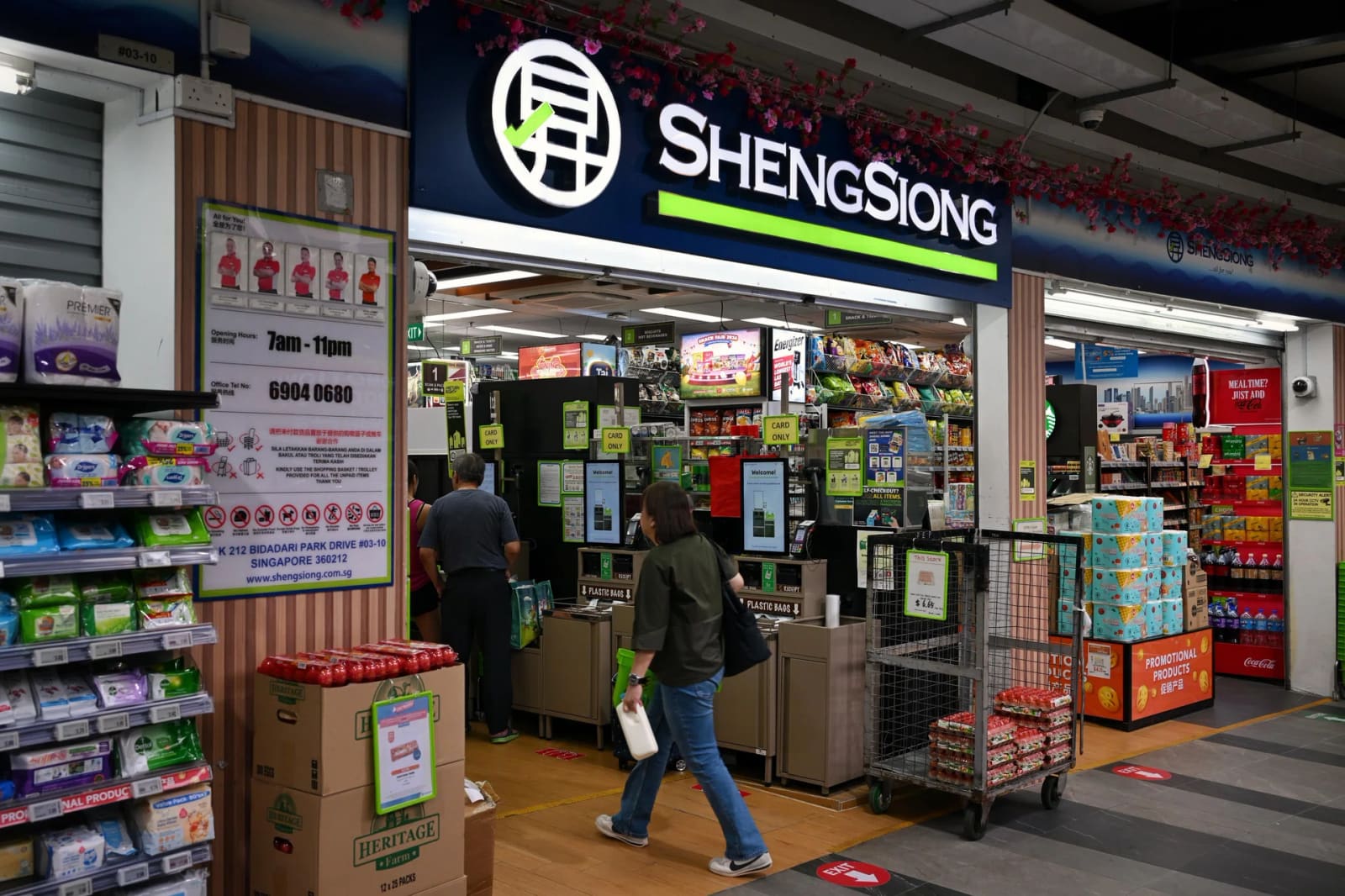
DBS Lifts Sheng Siong Price Target to S$3 Amid Voucher Boost Questions
Singapore's largest supermarket chain faces growth moderation as government support scheme winds down in December
KEY TAKEAWAYS
- ·DBS raised its price target on Sheng Siong to S$3 from S$2.80, applying a 28 times forward price-to-earnings multiple driven by scarcity and defensive appeal.
- ·Earnings growth decelerated to 11 per cent in Q2 2026 from 12 per cent in Q1, with DBS expecting a sharper slowdown into mid-single digits in H2 as the S$350 million SG60 voucher programme expires in December.
- ·The operator is investing S$520 million in a distribution centre for completion by end-2029, with capital expenditure peaking in 2027 and 2028 before margin benefits materialise.
Valuation Upgrade Meets Growth Reality
DBS Group Research lifted its price target on Sheng Siong to S$3 from S$2.80, applying a forward price-to-earnings multiple of 28 times. Analyst Chee Zheng Feng attributed the revision to investor appetite for defensive consumer plays with scarcity value, pointing to the supermarket operator's resilience and disciplined management. The upgrade came with a caveat: earnings momentum is fading as the S$350 million SG60 voucher programme nears expiration at the end of December.
Sheng Siong's second-quarter profit rose 11 per cent year-on-year, supported by new store openings and a favourable sales mix. Yet the pace has already decelerated from 12 per cent growth in the first quarter, signalling the beginning of a sharper slowdown. DBS expects growth to dip into the mid-single-digit range during the second half of 2026, pressured by tough year-ago comparisons when the voucher scheme accounted for an estimated 4 per cent of total industry sales.
The analyst maintained a hold recommendation and kept his full-year 2026 earnings forecast unchanged, while nudging 2027 projections up by half a percentage point to reflect stronger-than-anticipated contributions from recently opened stores. Chee noted that newly launched outlets have delivered better performance than modelled, prompting the modest upward revision despite headwinds from the voucher roll-off.
Store Network Under Pressure
Sheng Siong's expansion plans face friction from potential closures tied to Housing & Development Board redevelopment projects. DBS's 2027 forecast assumes five net new stores, factoring in the possibility of one to two HDB-located outlets shutting down if government urban renewal plans proceed. The supermarket chain operates predominantly in public housing estates, making it vulnerable to relocation risk when older precincts are earmarked for rejuvenation.
Still, the operator has demonstrated an ability to execute openings efficiently. The chain's track record of ramping up revenue at new sites has exceeded internal expectations, giving management room to offset store closures with higher productivity elsewhere in the network. The balance between expansion and contraction will determine whether Sheng Siong can sustain mid-single-digit topline growth once the voucher tailwind disappears.
Distribution Bet
Sheng Siong has committed S$520 million to a new distribution centre scheduled for completion by the end of 2029. The facility is designed to support at least 120 stores, well above the current footprint, and will incorporate automation and logistics technology intended to improve gross margins and operational efficiency over time.
Capital expenditure will peak in 2027 and 2028, when construction and equipment installation costs hit their maximum. The investment will temporarily weigh on cash flow and lift depreciation charges, creating a near-term drag on earnings. DBS expects the negative impact to be partially offset by margin gains as the centre reaches full utilisation, though the timing of those benefits remains uncertain.
The distribution project underscores Sheng Siong's long-term ambition to scale beyond its existing network. Whether the infrastructure investment delivers the promised efficiency gains will hinge on store count growth and the ability to leverage advanced systems without incurring excessive operating complexity. For now, the market is pricing in the execution risk alongside the defensive qualities that have made the stock a preferred consumer proxy in Singapore.
What Comes After the Vouchers
The SG60 voucher scheme was introduced as part of the nation's diamond jubilee celebrations, distributing digital credits that could be spent at participating retailers, including supermarkets. The programme injected a temporary lift into consumer spending, benefiting operators with broad store networks and digital payment infrastructure. Sheng Siong captured a meaningful share of voucher redemptions, but that tailwind will evaporate once the credits expire at year-end.
Investors are now recalibrating expectations for a post-voucher environment. The question is whether underlying demand remains resilient enough to sustain mid-single-digit growth, or whether the supermarket sector faces a more pronounced slowdown as discretionary spending normalises. DBS's revised target price suggests confidence in Sheng Siong's defensive positioning, even as near-term earnings momentum cools. The premium valuation reflects scarcity value in a market where pure-play consumer names with stable dividends are increasingly rare.
RELATED STORIES
Singapore Brokerages Raise STI Targets on Earnings Strength
Jun-ho Seo · 3 min
Shein Drops 4% in Hong Kong Debut as Tariff Pressure Weighs on Valuation
Priyanka V. Rao · 4 min

Addvalue Technologies Lands $5 Million in Space and Radio Contracts
Tran Quoc Bao · 3 min
Singapore Tightens Stablecoin Rules to Separate Regulated Tokens From Crypto Claims
Priyanka V. Rao · 2 min
Spot something wrong? Email editor@briefasia.com. We log every correction publicly.