ExclusiveLifestyle · Culture
Đăng Khôi Takes Trống Cơm to Silk Way Star
Round two asked twelve countries to perform their own culture. The Vietnamese entry raises a larger question: what is a folk archive actually worth once it leaves home, and what does an artist have to do to make it travel.
KEY TAKEAWAYS
- ·On Silk Way Star, a cumulative twelve-country show where nobody is eliminated, Đăng Khôi took the folk song Trống Cơm and, with producer Hino, built an arrangement (quan họ's nảy hạt running into rap, folk instruments against contemporary production) that puts heritage to work inside the song rather than as decoration.
- ·The format rewards range over the crowd-pleasing spike, so a local accent becomes the thing that makes a performer memorable, and the real payoff sits off the scoreboard: rival singers asking to learn the opening line of Trống Cơm in Vietnamese.
- ·He assembled all ten performances in the seven days before departure and sang his own new song, not a known hit, in round one; whether a bench built that fast holds through the deep later rounds is the honest thing to watch.
In Yiwu, twelve singers from twelve countries walked into a night themed on culture. It is a rare situation in a performer's life: the point at which heritage stops being a soft advantage and becomes the only thing being weighed.
One, folk music is a resource, not a finish
Vietnam holds one of the deepest traditional music archives in Southeast Asia, and one of the most casually used. Quan họ Bắc Ninh, ca trù, hát xoan, the court music of Huế, the gong culture of the Central Highlands, all carry UNESCO inscription. Very few music cultures in the region hold a list like that. A list, though, does not convert itself into a piece of work.
The wrong use is familiar everywhere. A pop song keeps its Western structure, adds a bamboo flute to the intro, adds traditional dress to the visuals, and calls the result identity. The folk material is sitting outside the song. It is a finish, and international audiences read a finish very quickly, particularly on a night when all twelve delegations have brought their own traditions into the room.
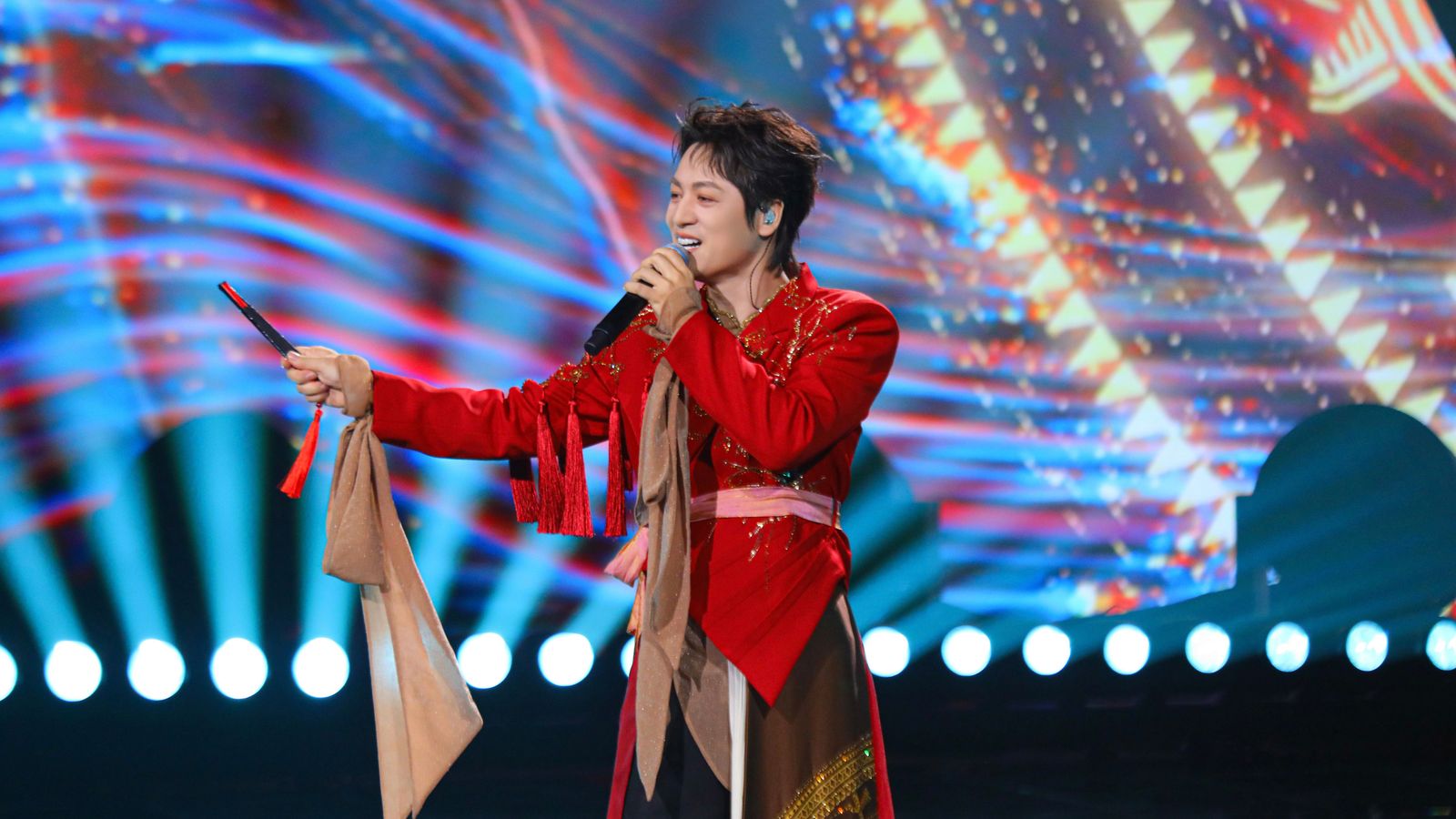
Đăng Khôi's second round demonstrates the other use. He chose Trống Cơm, a song from the northern delta that borrows the image of a rice drum to describe a village festival. The arrangement he built with the producer Hino was made during the competition itself, over a few days, and it does not keep the song in a museum case: folk instruments set against contemporary production, a passage of quan họ sung with the nảy hạt technique running directly into a rap section, and a new melodic and lyrical passage the two of them wrote for the occasion.
The nảy hạt detail is worth slowing down for. It is the particular granulated ornament of quan họ singing, something a pop vocalist does not have available and cannot acquire in a few sessions. Placing it beside rap means putting two entirely different systems of vocal articulation inside one musical line and then solving the join. When it works, a listener who has never heard of quan họ still registers that an unfamiliar vocal technique has just passed through. That is heritage doing structural work inside a piece rather than standing outside it as a caption.
The visual design follows the same rule. The costume assembles three motifs with real historical weight: bamboo, the Lạc bird of the bronze drums, and drum surface patterning itself. Not three decorative marks arranged to signal Vietnamese-ness, but three layers of one argument about endurance, aspiration and origin. A viewer in Astana or Tbilisi cannot decode the individual layers. They can read the coherence, and coherence is what survives the language barrier.
A heritage list does not convert itself into a piece of work. The material only earns its place when it is doing something inside the song.

Two, a format built so that nobody has to lose their accent
Season two of Silk Way Star is a television co production between China Media Group's CCTV and the Presidential Broadcasting Corporation of Kazakhstan, with twelve singers from China, Kazakhstan, Kyrgyzstan, Russia, Malaysia, Türkiye, Serbia, South Africa, New Zealand, Brazil, Georgia and Vietnam. Ten themed nights, each episode more than a hundred minutes, broadcast in three languages. This is the first time Vietnam has sent a representative.
The season's rule change is the part worth reading closely. Nobody is eliminated. All twelve appear in all ten episodes, the title goes to the highest cumulative score, and each episode names a Star of the Episode.
That alters what the competition rewards. Elimination formats pay for the spike, and therefore pay for flattering the room: perform what the crowd already likes, perform what cuts cleanly into a shareable clip. A cumulative season across ten genres pays for range instead. Nobody reaches night ten on a single formula. And when a performer is forced to widen, they go back to wherever they hold the most material, which is their own tradition.
The other delegations are doing exactly this. Rukhiya Baidukenova, representing Kazakhstan, has said she will use the sybyzgy, the dombyra and throat singing in more than half her performances. Hong Bing, the show's chief music director, has framed the arrival of South Africa, Brazil and New Zealand as what makes the season genuinely global. Taken together, this is a stage where a local accent is not something to suppress in order to be accepted. It is the only thing that makes a performer memorable.
This is also where the Asian music formats emerging over the past few years differ from the Western reality television model the region once imported whole. The older model looks for a good voice measured against a standard already fixed, and music cultures outside that standard spend their energy bending toward it. The newer model places several standards side by side and lets the audience hear where they diverge. For a music culture with real depth and no global distribution, that shift is worth more than any trophy.
The liveliest part tends to happen off the scoreboard. After the performance, competitors from the other countries took an interest in the rice drum he had brought with him, then asked him to teach them to sing the opening line of Trống Cơm in Vietnamese. A Serbian or Kyrgyz singer working their mouth around a northern Vietnamese folk line is the real output of a program like this, and it earns nobody a single point.

Three, a performer still doing the work
Among the twelve, Đăng Khôi does not carry the heaviest competition record. The room includes Curley G, who came out of Sing! China and topped Produce Camp 2020, and Bogdan Shuvalov, winner of the twelfth season of The Voice Russia. What he brings is a different kind of capital.
He left performing for close to a decade and returned in 2024, at a stage when most of his contemporaries have moved definitively into production or business. That return did not stop at a commemorative appearance. Two years later it led to a national seat.
Three details describe how he works. All ten performances for the season were assembled in the seven days before departure, including song selection and production, rehearsal, tailoring, logistics and language study. In the opening round, where nearly everyone performed the hit that made their name, he sang Khi con gọi là ba, a recent composition of his own. And the Trống Cơm arrangement was not carried over from Vietnam ready made; it was built inside the competition schedule.
The second of those is the expensive one. In an introduction round a known hit does much of the labor for a singer: the audience recognizes the shape, the arrangement has been tested many times, and the performer only has to supply presence. Giving that up for a song nobody has heard trades safety for the right to define yourself. Performers long enough in the profession usually stop being willing to make that trade.
The unresolved part should be said plainly. Seven days is evidence of compression, and it is also a real risk inside precisely this format. A cumulative season pays for depth in rounds seven through ten, when the first ideas have been spent and arrangements that were never quite finished begin to show. Whether a bench built in a week holds for ten episodes is a question nobody can answer yet, including him. That is the right thing to watch across the rest of the season, and it is fairer to the artist than counting points.
What Vietnam is actually carrying
Over the past two years, as regional audiences began paying attention to Vietnamese performers on pan Asian stages, most domestic commentary has measured success by placement. Phương Mỹ Chi finished third at Sing! Asia 2025, and the detail still repeated most often is the 0.8 point margin rather than how her team set ca trù against orchestral writing.
That measurement misses the asset Vietnam actually holds in quantity. A placement expires within a season. An arrangement that proves quan họ can live beside rap does not, and it tells younger writers something more useful than any appeal to preserve tradition: the folk archive is not reserved territory for academy musicians and festival programming.
Vietnam is not short of raw material. What it is short of is the number of people patient enough to work that material honestly and in contemporary terms, and the routes out through which such work can be heard. Silk Way Star is one such route, open for ten nights.
Eight of those nights remain on air. The results already sit with the people who were in the studio in Yiwu. What sits with nobody yet is how many Vietnamese musicians go back into the archive after this season.
RELATED STORIES
Nguyen Dang Quang and the long, quiet path to mastery
Manh Khang · 7 min
The pianist who goes looking for forgotten music
Manh Khang · 8 min

Vietnam's Offshore Oil Find Tests Hanoi's Will Against Beijing
Priyanka V. Rao · 5 min
Laos Hydropower Faces Solar and Wind Competition as Regional Grid Expands
Tran Quoc Bao · 4 min
Spot something wrong? Email editor@briefasia.com. We log every correction publicly.