ExclusivePerspectives · Essays
Nguyen Dang Quang and the long, quiet path to mastery
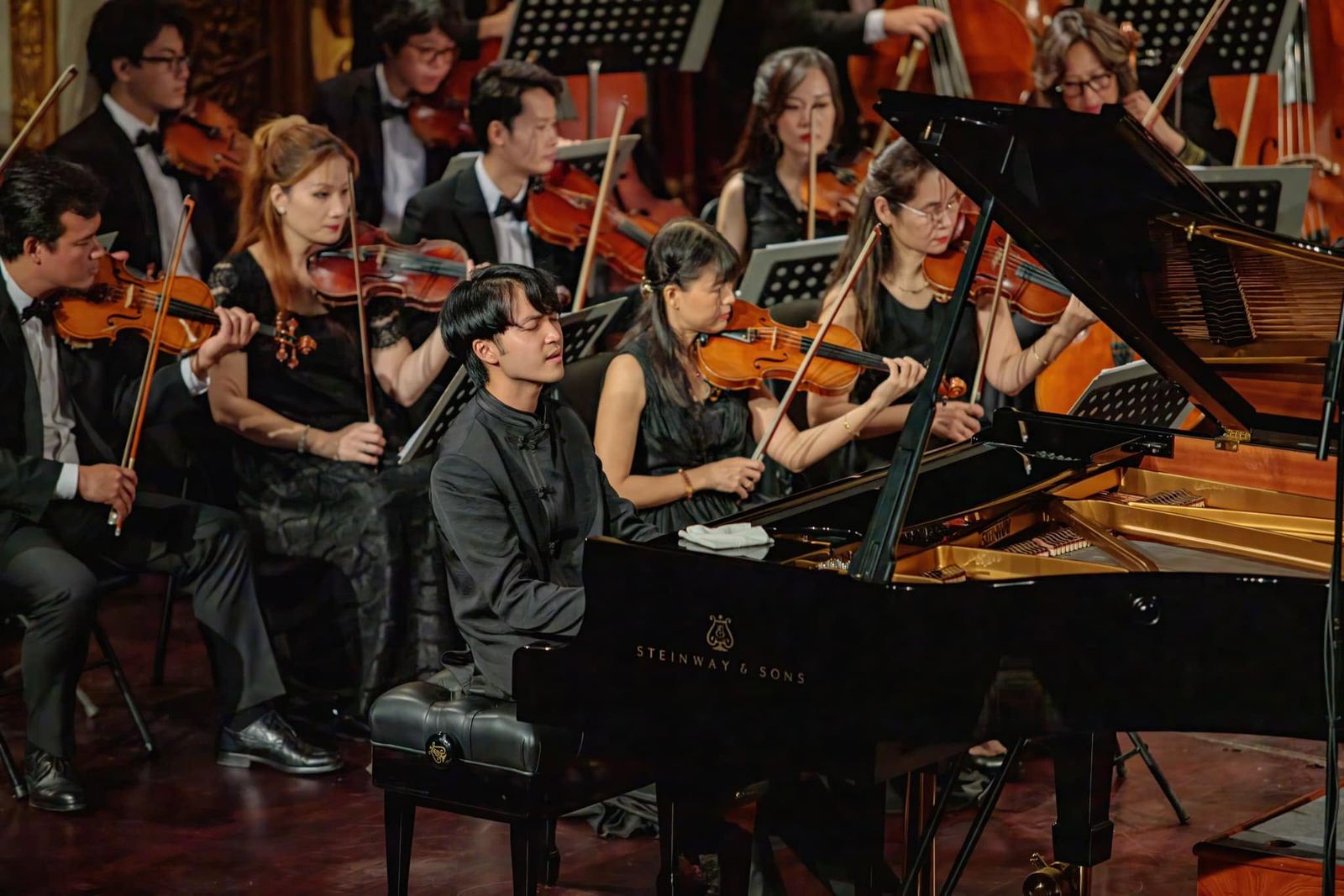
Last night in Hanoi, Nguyen Dang Quang played Ravel's G major concerto with the Vietnam National Symphony Orchestra. He has won nearly every prize a young Vietnamese pianist can win, and a decade later he is still sitting in a studio.
KEY TAKEAWAYS
- ·Nguyen Dang Quang won almost every prize open to a young Vietnamese pianist, then stopped entering competitions when they stopped teaching him anything and kept studying, still a doctoral candidate at 28.
- ·What was handed down to him over twenty years, from his grandmother Tran Thu Ha to her brother, the pianist Dang Thai Son, is a way of listening rather than a reputation, the East Asian idea of talent as a current to be passed on rather than a private flash.
- ·His Ravel G major, whose slow movement holds a thirty-four-bar line that repeats nothing, is the proof: not a piece for showing you are good, but one you can only play after you have given up needing to.
The second movement of Maurice Ravel's Piano Concerto in G major opens with a solo line running thirty-four bars without repeating one, unaccompanied for most of its length. Ravel told the pianist Marguerite Long he wrote it two bars at a time, and that it nearly killed him.
That is the passage that sounded on the evening of September 9 in the Grand Concert Hall of the Vietnam National Academy of Music.
The program was number 186 in the Vietnam National Symphony Orchestra's subscription series, and the third Haydn program of the season, conducted by Nguyen Phu Son. Rossini opened it with the William Tell Overture. Haydn closed it with the Symphony No. 82 in C major, nicknamed The Bear. In between came the Ravel, and Nguyen Dang Quang.
At home his name still travels attached to a family. His grandfather was the tenor Trung Kien, a People's Artist. His grandmother is Professor Tran Thu Ha, a People's Teacher and former director of the Vietnam National Academy of Music. His mother is the singer Thanh Lam, also a People's Artist; his father the composer and producer Quoc Trung.
But what is interesting about this musician lies elsewhere, and it becomes visible the moment you read his record in chronological order.
He has won nearly every prize a young Vietnamese pianist can win. Then he stopped entering competitions and went on studying. Today, at 28, he is still a doctoral candidate.
Beginning at nine
Born in 1998 into a family with musical traditions, he began piano at the age of nine at the Vietnam National Academy of Music, under the tutelage of his own grandmother. In 2016 he graduated with distinction from the academy's nine-year pre-college program.
There is a detail in that biography few people pause on long enough. The teacher who took him into his studio at the Université de Montréal, where he earned a bachelor's degree in classical piano performance in 2020 on a full Vietnamese government scholarship, was the pianist Dang Thai Son. And Dang Thai Son is his grandmother's brother.
Which is to say that what was handed down to him across more than twenty years was not a reputation. It was a way of listening. How weight settles into a key. What to do with the silence between two phrases. The things no syllabus contains, which pass from one person to another in a room with two people in it.
East Asian cultures understand this instinctively, and the Western telling usually gets it differently. In the familiar Western story, talent is a private flash of lightning. In the Asian understanding it is a current: someone gives, someone receives, someone keeps, and the obligation of the one receiving is not to let the water stop in his own lifetime.
After Dang Thai Son came Professor Jean Saulnier, who supervised the master's degree he completed at the same institution in 2022 and who supervises his doctoral work now.
What to do once you have won enough
He stopped entering competitions when they stopped teaching him anything, not when he stopped winning them.
His prize record spans exactly eight years. First Prize at the Val Tidone International Music Competition in Piacenza, Italy, in 2012, when he was fourteen. Gold Medal and Special Prize at the ASIA International Piano Festival and Competition in Seoul in 2014. In 2015, at the third Hanoi International Piano Competition, he took First Prize, Best Vietnamese Contestant and Best Performance of a Concerto at once. Second Prize at the Lansum International Music Competition in Los Angeles in 2016. In 2020, First Prize at the Malaysia Virtual International Music Competition. He has also been named one of the ten Outstanding Young Representatives of Vietnam.
In most music cultures a record like that is a destination. You take it as a passport, sign with management, and start selling tickets on the strength of those lines.
He did the opposite. After 2020 the list of prizes stops, and the list of teachers grows.
He has taken masterclasses with Charles Richard-Hamelin, André Laplante, Armen Babakhanian, Henry Kramer, Jérôme Granjon, Jimmy Brière, Marina Mdivani and Hae-Won Chang. Eight names, eight schools, eight different understandings of the same instrument. A musician who had already won enough not to need another teacher sat down as a pupil eight more times.
And the dissertation is not finished. As of today he is continuing his doctoral studies at the Université de Montréal.
A concerto that allows nothing approximate
Which explains the Ravel.
Look at what he has brought to stages over the past decade and a clear path appears. Schumann's Concerto in A minor with the conductor Honna Tetsuji and the Vietnam National Symphony Orchestra. Rachmaninoff's Rhapsody on a Theme of Paganini on the 2023 Toyota Concert Tour, again with Honna Tetsuji, in both Hanoi and Ho Chi Minh City. These are works that reward volume, stamina and a young player willing to throw himself at them.
The Ravel stands on the other side. He wrote it between roughly 1929 and 1931, after the 1928 American tour on which he met Gershwin and came home fascinated by jazz. The outer movements are quick and hard-edged, full of nightclub brass. The middle movement is classical to the bone, modeled on the Larghetto of Mozart's Clarinet Quintet, K. 581. Mozart's melody spans twenty bars. Ravel builds a longer line, thirty-four, and repeats nothing.
Playing it means walking a wire with nothing underneath. No harmony to cover, no tempo to hide in, no climax to make an audience forget a note that fell short. Only a long line, and one person who has to keep it taut from beginning to end.
It is not a work for proving you are good. It is a work you can only play after you have given up needing to prove it.

The map
Over the past decade he has played at Zipper Hall in Los Angeles, Salle Claude-Champagne in Montreal, the concert hall of the University of Guangxi in Nanning, the Diocesan Museum of Brescia in Italy, the Hanoi Opera House and the Saigon Opera House. He appeared at the fourth Japan and Vietnam Piano Festival, performing at Kawai Concert Hall in Tokyo and the Sugita Theater in Yokohama. He has played in concerts for the Embassy of Japan, the Embassy of Canada and the Danish Royal Family.
At home he has worked with the Vietnam National Opera and Ballet Orchestra, the Saigon Symphony Orchestra and the Ho Chi Minh City Ballet Symphony Orchestra, under the conductors Tran Vuong Thach, Nguyen Thieu Hoa and Le Ha My.
Read that map and it does not look like the map of a star being pushed. It looks like the map of someone learning the trade in several places at once: a museum in Brescia, a university hall in Nanning, a theater in Yokohama. Mostly rooms with few spectators and a lot of colleagues.
What a young Asian musician carries
2025 marked 150 years since Ravel's birth, and a generation of Asian pianists is rereading him. From Tokyo, Seoul and Shanghai to Hanoi there is a cohort trained under exacting discipline, accustomed to repeating a phrase hundreds of times without experiencing it as hardship, bringing to the European repertoire a quality Europe itself is short of: patience.
Dang Quang belongs to that cohort in the most literal way available. He does not describe his patience in interviews. He simply has not stopped studying.
The orchestra's subscription series began in 2005. One hundred and eighty-six programs means that for twenty years, without a gap, an audience has booked ahead and sat down. In the hall on the evening of September 9 there were piano students who study inside that same building, fifteen meters from the instrument, hearing thirty-four bars in a room where they could go wrong.
No recording teaches that. It may well be the real contribution of an evening like this one, larger than the question of how well anybody played.
All images and videos courtesy of Nguyen Dang Quang.
RELATED STORIES
The pianist who goes looking for forgotten music
Manh Khang · 8 min
Vietnam's Offshore Oil Find Tests Hanoi's Will Against Beijing
Priyanka V. Rao · 5 min
-800x471.jpg?prefix=brief-asia)
Cover the logo. They'll still know who you are.
Simon Ng · 9 min
Ho Tu Bao Taught Machines to Learn. Now He Teaches Doubt.
Manh Khang · 9 min
Spot something wrong? Email editor@briefasia.com. We log every correction publicly.