Perspectives · Analysis
Ho Tu Bao Taught Machines to Learn. Now He Teaches Doubt.
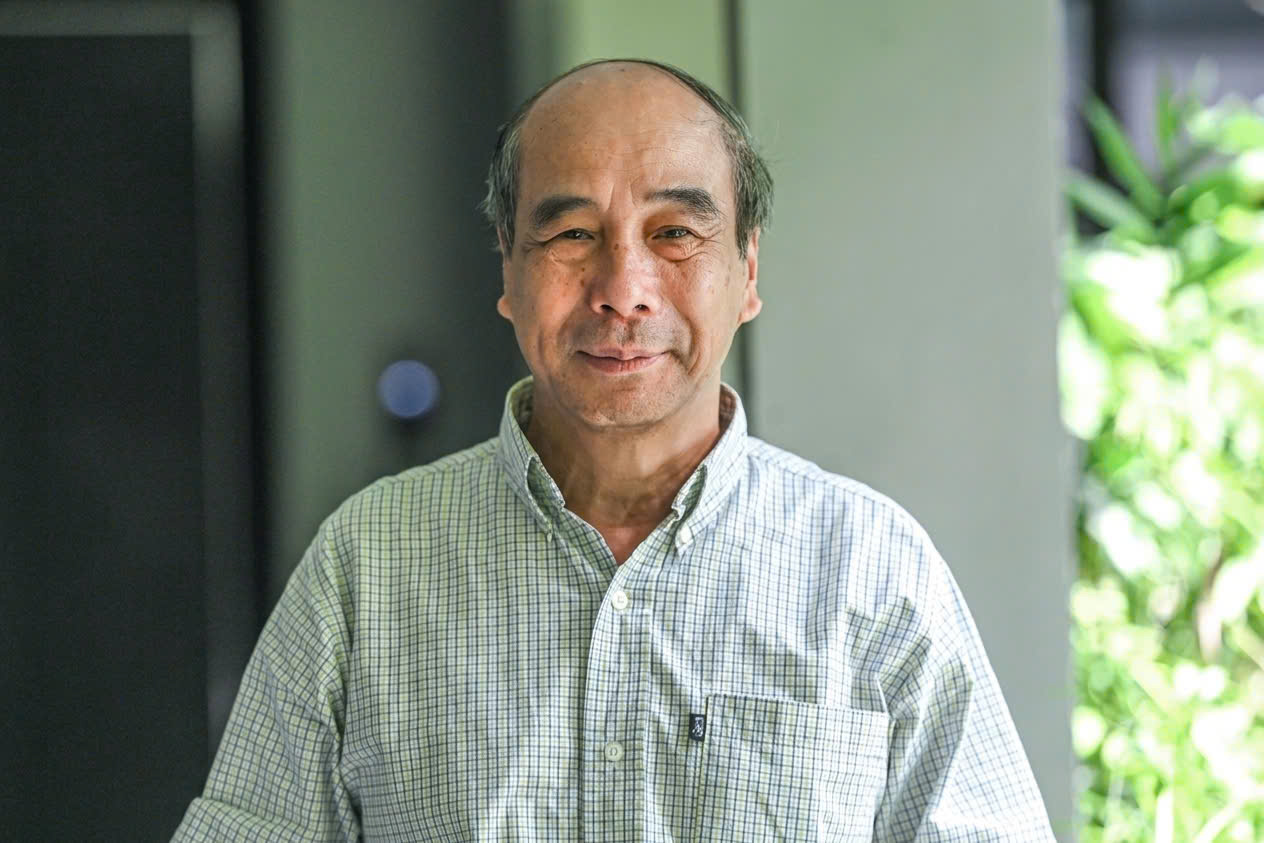
He was among the first people to bring machine learning to Vietnam, starting in 1984. More than forty years on, most of his time goes to something else entirely: showing people outside the field how to notice when a machine is wrong.
KEY TAKEAWAYS
- ·As generative AI turns as ordinary as a phone across Asia, one of Vietnam's longest-serving AI researchers spends his days on the opposite of the hype: teaching people to notice when a fluent machine answer is simply wrong.
- ·Ho Tu Bao brought machine learning to Vietnam in 1984 and helped train around 200 Vietnamese PhDs through Japan's JAIST, but his message now is a slow one: old AI failed in front of experts who caught it, generative AI fails in front of anyone, and few can check it.
- ·What he keeps returning to is who pays for a wrong answer, the student who loses marks, the shopkeeper who over-orders, the patient who reads it as advice, and his quiet proof is a book on keeping humans in charge that he let a machine illustrate.
Across much of Asia, 2026 is the year a generative assistant became as ordinary as a phone. It sits in classrooms, in offices, behind shop counters and in the pockets of people doing the weekly shopping. Generative AI is software that produces new text, images or code on request.
When answers become that easy to get, the scarce thing is the ability to notice an answer that reads well and is wrong.
In Vietnam, the person who has said this earliest and most patiently is also one of the country's longest serving AI researchers.
A book the machine illustrated
There is a small detail in the book he published last summer that most readers will pass right over. Most of the illustrations in it were not drawn by an artist. A machine drew them, at the author's request.
The book is called "AI and Humans". It runs to 268 pages and came out in early July 2025 from the Information and Communications Publishing House in Hanoi. Its author, Professor Ho Tu Bao, was seventy three at the time, with more than forty years of work behind him on machine learning, the field that builds systems able to find patterns in data without being given the rules. He spent the whole book arguing that people must keep their place in front of the technology. Then he handed the technology the pen and let it illustrate the argument.
It sounds like a contradiction. It is probably the point. Machines now do a great many things, including things we assumed belonged to people alone. So the question is not how to keep the machine out. It is how far the machine can be trusted, where it breaks, and who carries the loss when it does. In a July 2025 report on the book, the Vietnamese outlet ZNews wrote that he had produced it from a simple thought: whether we like it or not, AI is going to travel alongside us, so we may as well understand it properly.
This profile draws on what he has said and written in public over the past few years. Read in order, one thing comes through clearly. At a moment when almost everyone is telling everyone else to move faster, the person who understands the machine best keeps advising people to slow down.
A question in the summer of 1984
He was born in 1952. He began university studying mathematics, then spent a long stretch away from the lecture hall. When he came back he switched to control mathematics at Hanoi University of Technology, and collected his degree at the end of 1978, at twenty six. He joined a computing research institute in Hanoi, and a few years later won a scholarship to do doctoral work in Paris.
In the summer of 1984 he had just finished a master's degree in a different and more fashionable area when a letter arrived from Professor Phan Dinh Dieu, a senior figure in Vietnamese computing. In a January 2024 interview with the newspaper Thanh Nien, he recalled the advice as very short. Move into artificial intelligence if you can, because that is where computing is going. At that point few people anywhere worked on AI, and in Vietnam almost nobody did. He changed direction and started again from close to zero.
His supervisor in Paris, Professor Edwin Diday at Paris Dauphine University, did not hand him a topic. He handed him a question. Could the rules used by an expert system, a program that reasons from encoded knowledge, be pulled out of tables of data instead of written by hand? In today's vocabulary that is machine learning. In 1984 it had no familiar name and no guarantee of going anywhere. Almost three years later he finished an algorithm he called CABRO and defended his thesis in 1987, which made him one of the first Vietnamese researchers in the field.
Back home, he joined one of the groups building software for export with a European partner. In today's language it was a technology startup, except that the whole institute shared a handful of personal computers, and the power supply was weak and unreliable, so most of the work happened at night. They built handwriting recognition, map databases, chip design tools and an expert system toolkit that he led. By 1990 the products were shown at the CeBIT trade fair in Hannover and a number of copies sold. He described all of this in an August 2025 interview with the newspaper Dan Tri.
Then it stopped, for a reason that had nothing to do with any line of code. The only way to reach customers abroad was by post. A bug report took a month to arrive, and the reply took about as long again. In a software market a month is not slowness. A month is an exit. The export software effort of those first groups ended there.
The lesson was not that the talent was missing. The talent was there. It was that good technical work sits still if the infrastructure around it will not carry the work to a user. Thirty six years later the same thinking returns when he talks about AI. Building core technology is one thing. Turning it into something an ordinary person can actually use is another.
Twenty five years in Ishikawa
In 1993, when Japan had just finished setting up the Japan Advanced Institute of Science and Technology (JAIST) in Ishikawa prefecture, it asked Professor Setsuo Ohsuga of the University of Tokyo to recommend two foreign staff. He recommended Ho Tu Bao. With the invitation came a letter that he has kept ever since, in which the Japanese professor wrote that he hoped his Vietnamese colleague would serve as a bridge between the two countries. He told Thanh Nien that story.
The bridge turned out to be measurable. From 2000 JAIST signed cooperation agreements with a series of Vietnamese universities and research centers. At the peak, Vietnamese graduate students numbered around one hundred, roughly one tenth of the institute's enrollment. On the number of Vietnamese doctorates JAIST helped train, he gave a figure of more than 180 in early 2024, and 201 PhD holders as of April 2026, a figure confirmed by JAIST. Universities in Hanoi, Danang, Hue and elsewhere all have faculty who passed through Ishikawa.
He left in 2018 and returned to Vietnam, and JAIST named him professor emeritus. According to a biographical file provided to this publication, in April 2026, at a workshop on AI in business held at his Vietnam Institute for Advanced Study in Mathematics (VIASM) in Hanoi, he received a commendation recognizing his role as a scientific bridge between the two countries. For a man who has supervised more than thirty doctoral students, the commendation is probably just a short way of describing thirty years of work.

Where he draws the line
In August 2024, at a conference on data science and AI in education, he set out a four part position, according to published accounts of the session republished on a resource site for teachers. Three of the four are encouragements. Administrators and teachers at every level should use AI to lighten their work. Universities should use it to train professional skills better. Ethics and law should be taught so that people use AI responsibly. The fourth is where he moves against the general tempo: schools do not need to rush into generative AI, and should instead introduce AI step by step, following guidance from UNESCO.
Machines can be wrong. The question worth asking is who pays for the error.
His reasoning is technical rather than moral, and it is easy enough to follow. Both older and newer forms of AI are inductive. The system produces many possible answers and returns the one with the highest probability, and that answer can still be wrong. The difference is who is sitting in front of the screen. Older AI systems were usually built by people who understood the data and the problem, so errors showed up. Generative AI can be used by anyone, and very few of those people are in a position to check what it just produced.
He saw this early. At the end of 2022 he asked friends in the United States to help him try ChatGPT, and on January 12, 2023 VIASM held a seminar on it. Speaking to the broadcaster VOV2 in February 2023, he said the main weakness was not ignorance but uneven quality. There are areas the system has not updated and it still returns an answer. A student who does not know that will copy the error with all the confidence of someone copying the truth.
This is where the subject leaves the laboratory. The cost of a wrong answer does not land on the model. It lands on the child who loses marks for repeating a fact that never existed. On the shopkeeper who over orders because an estimate looked confident. On the person who has just read something that sounds a great deal like medical advice. Keeping people at the center, in the end, only means remembering that at the end of every machine answer there is a real person who has to decide something.
He is still teaching
In mid July 2026, in an office building in Hanoi, more than three hundred teams had 48 hours to build early working versions of AI products for problems submitted by companies, in areas from finance and health care to agriculture and regional language processing. VnExpress reported close to two thousand registrations as of July 13, and on the judging panel, beside specialists from Singapore and Sweden, sat Ho Tu Bao. The event was run jointly by technology companies, a university and a nonprofit AI foundation.
The core of it is using the digital side to improve the physical side.
A month later, according to the biographical file provided to this publication, he appeared at Hanoi University of Science and Technology as a speaker at a summer school on edge AI, the approach that runs models directly on a device instead of sending data to a server. At seventy four, he is still in the classroom. If you wanted to measure dedication without reaching for a single adjective, that is probably the shortest way to do it.

At the July event the organizers also announced that Vietnam will host an international AI olympiad for students for the first time in 2027. That is a milestone readers can check within months, and it is the clearest test of what he has been arguing. The question is not whether Vietnamese students can build a model. They can. The question is what the scoring will reward: a product that runs smoothly, or a contestant willing to point at the place where their own model will fail.
Return to those illustrations. The author let the machine draw them, did not hide it and did not apologize for it. Perhaps because for him, keeping people at the center never meant keeping the machine outside the door. It meant that someone has to read it again, doubt it at the right moment, and answer for the last step. Forty years teaching machines to learn, then teaching people to question machines, turn out to be the same job.
RELATED STORIES
Vietnam's Banking Sector Adopts AI Safety Measures Amid Digital Expansion
Priyanka V. Rao · 3 min

Japanese Chipmaker Plans Southeast Asia Production Expansion
Cheng Wei-Lun · 3 min
Vietnam Positions State as First Customer for Domestic Tech Products
Tran Quoc Bao · 3 min
Vietnam Faces Productivity Challenge as Capital-Led Growth Model Stalls
Priyanka V. Rao · 3 min
Spot something wrong? Email editor@briefasia.com. We log every correction publicly.