Technology · Products
Chinese Robot Vacuum Makers Accelerate Product Cycles Beyond Smartphone Pace
While humanoid robots struggle with scale, service robotics firms in China have entered a competitive sprint marked by rapid iteration and compressed development timelines.
KEY TAKEAWAYS
- ·Chinese robot vacuum manufacturers are now iterating product designs faster than smartphone makers, driven by lower component costs and intense domestic competition in a market expected to exceed 15 million units annually by 2027.
- ·Advances in sensor miniaturization have enabled lidar units costing under fifty dollars in volume, allowing mid-tier models to feature mapping precision once limited to flagship products.
- ·The accelerated innovation pace in robot vacuums signals a broader pattern for service robotics, as categories reaching commercial scale inherit the competitive dynamics and rapid development cycles of consumer electronics.
A New Cadence in Consumer Robotics
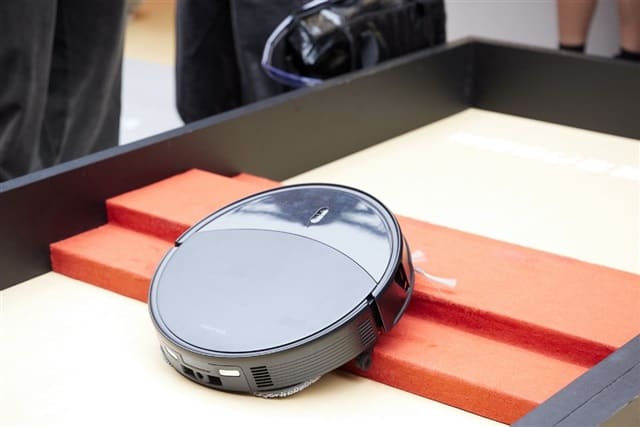
The robot vacuum sector in China has entered a phase of hyper-competition characterized by innovation cycles that now outstrip those of smartphones, traditionally the benchmark for rapid consumer electronics iteration. This shift marks a turning point for service robotics, which have transitioned from novelty products to mainstream appliances subject to the same relentless pressure for differentiation that once defined mobile devices.
Unlike humanoid robots, which remain constrained by high costs and limited commercial viability, robot vacuums and other service machines have achieved sufficient economies of scale to support aggressive R&D investment. Chinese manufacturers are leveraging this maturity to compress development timelines, introducing new models with enhanced navigation algorithms, improved battery efficiency, and expanded cleaning capabilities at intervals that rival or exceed the annual refresh cycles seen in premium smartphone lines.
The Drivers Behind Accelerated Iteration
Several factors underpin the accelerated pace. Advances in sensor miniaturization and machine learning have made it economically feasible to embed sophisticated perception systems into sub-$500 devices. Lidar units that once cost hundreds of dollars now retail for under $50 in volume, enabling manufacturers to equip mid-tier models with mapping precision previously reserved for flagship products.
Competitive pressure within China's domestic market has also intensified. With established players like Roborock, Ecovacs, and newer entrants vying for share in a market projected to exceed 15 million units annually by 2027, differentiation has become existential. Companies are racing to patent novel mopping mechanisms, obstacle avoidance techniques, and self-maintenance features that reduce user intervention.
Supply chain proximity plays a critical role. Shenzhen's electronics ecosystem allows firms to prototype and test new components within weeks rather than months. This agility contrasts sharply with smartphone development, where global supply chains and carrier certification requirements impose longer lead times despite mature processes.
Implications for the Broader Robotics Landscape
The velocity of innovation in robot vacuums offers insights into the broader trajectory of service robotics. As production volumes rise and component costs decline, other categories - lawn mowers, window cleaners, delivery bots - are likely to follow similar patterns. The transition from novelty to commodity accelerates once a product category crosses critical thresholds in reliability and affordability.
For Asia's robotics supply chain, the trend reinforces the region's dominance in high-volume, iterative manufacturing. Taiwan's sensor and motor suppliers, South Korea's battery makers, and Japan's precision component firms are all beneficiaries of the accelerated cycles, as each new model generation demands updated subsystems.
What Comes Next
Industry observers expect the pace to remain elevated through 2027 as manufacturers explore integration with smart home ecosystems and experiment with multi-function platforms that combine vacuuming, mopping, and air purification. The challenge will be sustaining differentiation as core technologies mature and performance converges across price tiers.
The robot vacuum's evolution from niche gadget to fiercely contested category underscores a broader pattern: once a consumer robotics segment achieves scale, it inherits the competitive dynamics of consumer electronics - and the innovation tempo that comes with it. For Chinese manufacturers, the race is just beginning.
RELATED STORIES
China Targets 84% Share of AR-HUD Production by 2031
Cheng Wei-Lun · 3 min
China's Battery Dominance Faces Quality Test as CALB Defect Spreads
Anand Sundaram · 3 min
AliExpress Shifts Focus to Brand Building as AI Hardware Sales Surge Overseas
Cheng Wei-Lun · 2 min

Li Auto Expands Battery Roster with CALB as Third Supplier
Siti Nuraini · 2 min
Spot something wrong? Email editor@briefasia.com. We log every correction publicly.