Asia · Business
China's ZXMoto Doubles Production After World Championship Win
Two-year-old manufacturer targets European expansion as domestic market contracts and competitive pressure intensifies across Asia's motorcycle industry.
KEY TAKEAWAYS
- ·ZXMoto's March world championship victory drove sales from 25,000 units in 2025 to a projected 100,000 this year, with the company doubling its workforce to meet demand.
- ·The startup's 820RR model retails at 43,000 yuan ($6,370), at least 30 percent cheaper than comparable Ducati, Yamaha, and Honda bikes, while matching performance specifications.
- ·China exported half of its 22 million motorcycles produced last year as domestic sales fell 3.4 percent in 2025, pushing manufacturers toward Europe, Southeast Asia, and Africa.
Racing Success Fuels Demand
ZXMoto recorded a four-second victory at the Supersport World Championship in March, only its third world championship race. The win sent orders soaring for the Chongqing manufacturer, founded just two years ago by former mechanic Zhang Xue.
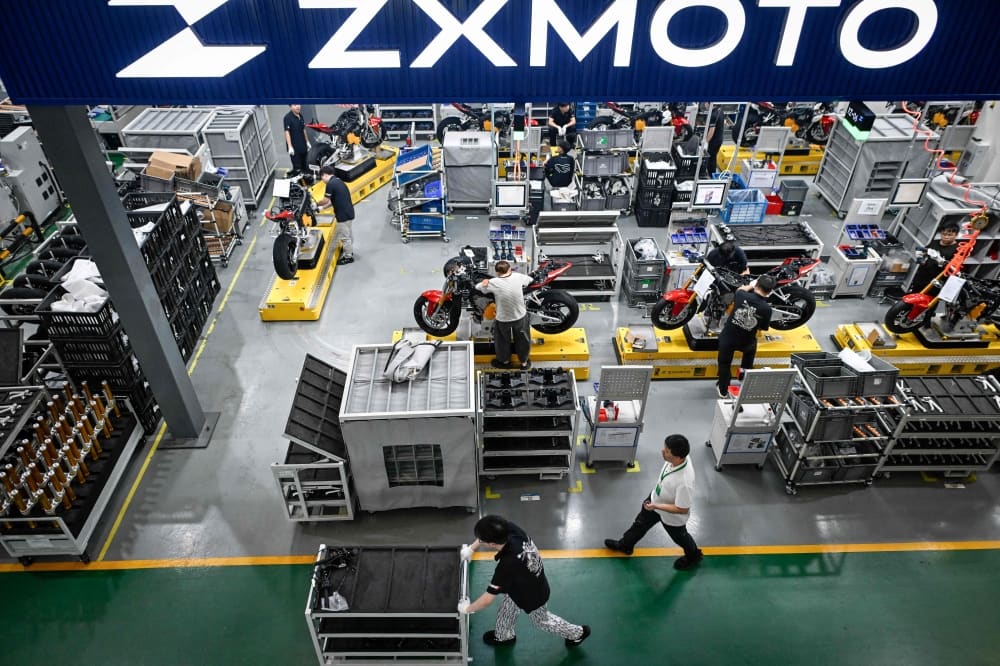
The company has doubled its workforce since the race and now operates its factory 24 hours daily to meet demand. Customers still face wait times of several months for orders.
Sales climbed from 25,000 motorcycles in 2025 to a projected 100,000 units this year, according to Zhang. The firm plans to reach 200,000 units by 2027, matching BMW's production scope in the category.
Price Advantage Against Established Brands
ZXMoto's flagship 820RR model delivers 133 horsepower and accelerates from zero to 100 kilometers per hour in 2.8 seconds. The bike retails for approximately 43,000 yuan ($6,370) in China, at least 30 percent below comparable models from Ducati, Yamaha, Honda, and Kawasaki.
Zhang, 39, previously worked as a mechanic and claims he can assemble an engine blindfolded. He positioned the brand to compete directly with European and Japanese manufacturers on both performance and value.
The 820RR has attracted domestic buyers seeking alternatives to imported machines. One owner, a 28-year-old rider identified as Yang, cited both national pride and product quality as purchase factors.
Domestic Market Contraction Drives Export Push
China's motorcycle sales declined 3.4 percent in 2025 and continued falling this year as consumers shift toward automobiles or less-regulated electric bikes. The contraction is forcing manufacturers to pursue international markets with higher margins.
Chinese producers exported half of the 22 million motorcycles manufactured domestically last year, according to industry figures. Nearly all brands are now pursuing overseas expansion.
ZXMoto aims to export 40,000 units to Europe in 2027. Rival manufacturer Shineray already sells 90 percent of its lower-tier models to South America, Southeast Asia, and Africa.
Nie Jianwei, Shineray's overseas marketing head, described the domestic market as intensely competitive, using the Chinese term "juan" to characterize the pressure. He noted that manufacturers continuously reduce prices to maintain competitiveness.
Chongqing's Industrial Ecosystem
More than 50 motorcycle manufacturers and hundreds of component suppliers operate in Chongqing, known as China's motorcycle capital. The concentration enables rapid production cycles and integrated supply chains.
Bill Russo, an automotive industry analyst specializing in China, noted that ZXMoto emerged from one of the world's most competitive industrial ecosystems. He drew parallels to China's passenger car sector roughly a decade ago, when domestic brands like BYD and Geely began challenging established foreign automakers on price before advancing technologically.
Zhang attributed part of ZXMoto's advantage to Chongqing's lower production costs compared to manufacturing bases in Japan or Europe. He argued that foreign competitors face technological ceilings limiting their rate of progress.
Barriers to Global Market Penetration
Russo cautioned that motorcycles remain more emotionally driven purchases than automobiles. Heritage, racing history, and brand prestige carry greater weight in two-wheeler buying decisions, providing established Japanese and European manufacturers with stronger defensive positions.
The analyst expects Chinese brands to build global presence through local investments and partnerships rather than exports alone, though momentum is building.
ZXMoto projects that overseas sales will account for most of its volume within five years. The company is constructing an 800 million yuan factory scheduled to open in late 2027, with plans to rank among the world's top 10 motorcycle brands by 2034.
Zhang drew comparisons to the initial European reception of Japanese motorcycles decades ago, noting that quality products eventually gain acceptance. In his Chongqing headquarters, the roar of engines undergoing testing punctuated the conversation as workers maintained the round-the-clock production schedule.
RELATED STORIES
Shein Retreats From Vietnam Warehouse Bet as China Manufacturing Proves Irreplaceable
Cheng Wei-Lun · 4 min
Shein Scales Back Vietnam Expansion, Reinforces China Manufacturing Base
Cheng Wei-Lun · 3 min

BYD, Geely and Chery Crack Global Auto Top Ten
Cheng Wei-Lun · 3 min

Manila Eyes Nickel Processing to Escape China's Price Control
Priyanka V. Rao · 4 min
Spot something wrong? Email editor@briefasia.com. We log every correction publicly.