Technology · Products
Automotive Display Market Stands at Inflection Point as Tandem OLED Passes Durability Tests
Liquid crystal panels still dominate nine in ten vehicle screens, but a new generation of dual-layer organic emissive technology has cleared reliability benchmarks that could reshape the industry beyond the decade's end.
KEY TAKEAWAYS
- ·Liquid crystal panels account for more than 90 percent of automotive display shipments, but Tandem OLED has now met critical durability and lifetime standards required by carmakers.
- ·Dual-layer emissive architecture reduces current density and thermal stress, extending lifespan and passing accelerated aging tests that single-layer OLED prototypes previously failed.
- ·Industry researchers expect cost compression and growing production scale to make automotive OLED viable for mid-tier luxury and premium mass-market vehicles after 2030.
The Incumbent's Grip
Walk through any automotive supplier conference in Seoul, Shenzhen, or Tokyo and the message is clear: liquid crystal display panels remain the workhorse of the cabin. More than nine in ten vehicle screens shipped in recent quarters rely on LCD architecture, a dominance rooted in decades of supply-chain maturity, predictable cost curves, and proven tolerance for temperature swings, vibration, and the ten-to-fifteen-year service life automakers demand. OEMs know the failure modes, tier-one suppliers know the yields, and procurement teams know the price per diagonal inch.
That entrenched position, however, now faces its first credible challenge in years. Tandem OLED technology has cleared a threshold that until recently seemed out of reach for organic emissive displays in automotive contexts: lifetime and reliability benchmarks rigorous enough to satisfy the qualification protocols of global carmakers. The shift is not imminent, but the technical and commercial groundwork for a post-2030 transition is now in place.
Stacking Layers to Buy Time
Tandem OLED architecture places two emissive layers in series within a single panel stack, effectively halving the current density required to achieve a given brightness. Lower current density translates directly into reduced stress on the organic materials, slowing the photochemical degradation that has historically limited OLED lifespan. In consumer electronics, a screen that dims noticeably after three years is a warranty irritant; in a vehicle, it is a safety and resale-value liability.
The dual-layer approach also improves tolerance for the thermal extremes common in automotive environments. Cabin temperatures can swing from sub-zero cold soaks to sustained highs above 85 degrees Celsius when a dashboard bakes in equatorial sun. Early single-layer OLED prototypes often failed accelerated aging tests that simulate such cycles, exhibiting color shift, uneven luminance, or outright pixel failure. Tandem configurations distribute thermal load and electrical stress across two emissive zones, yielding measurably longer mean time to failure in third-party lab testing and in-vehicle validation runs.
Several Asian display makers have invested heavily in tandem stack architectures over the past three years, building pilot lines and working closely with tier-one suppliers in Japan and South Korea to refine encapsulation, driver IC integration, and optical bonding processes. That collaboration has produced validation data sets large enough to give procurement and reliability engineers confidence that the technology can meet automotive-grade durability standards.
Cost Trajectories and Regional Dynamics
Automotive OLED adoption has always been a question of economics as much as engineering. Even as tandem stacks solve the lifetime problem, they add material cost and process complexity. Each additional organic deposition step, each precision alignment tolerance, and each yield loss in lamination or encapsulation flows straight to the bill of materials. Today, an automotive-qualified OLED panel costs several multiples of an equivalent LCD, a premium that only ultra-luxury nameplates and halo models can absorb.
Industry researchers tracking panel pricing expect that gap to narrow through the remainder of the decade. Fab utilization rates are climbing as consumer IT and premium smartphone demand pulls through tandem OLED capacity, spreading fixed costs over larger volumes. Material suppliers in Japan and South Korea are scaling synthesis and purification of the organic compounds used in tandem stacks, driving down per-gram pricing. And equipment vendors are introducing deposition and patterning tools designed specifically for automotive throughput and uptime requirements, reducing capital intensity per square meter.
By the early 2030s, the cost differential between automotive OLED and high-end LCD with local dimming and quantum-dot enhancement is projected to compress to a range that makes OLED viable for mid-tier luxury and premium mass-market nameplates. That is the inflection point at which volume adoption becomes plausible. China's display sector, already the world's largest LCD producer, is also ramping OLED investment with an eye on the automotive segment, adding competitive pressure that could accelerate the timeline.
Implications for Cabin Architecture
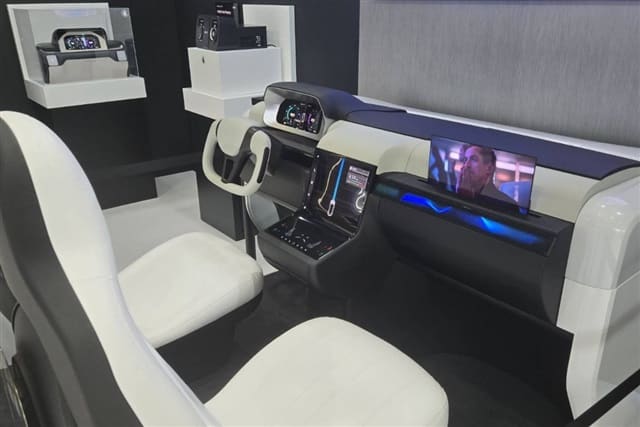
The technical validation of tandem OLED arrives at a moment when automakers are rethinking cabin interfaces. Instrument clusters, center stacks, and passenger-side entertainment screens are converging into unified digital surfaces that span the dashboard. OLED's ability to deliver perfect blacks, infinite contrast, and off-axis viewing angles makes it well-suited to such layouts, particularly in conjunction with curved or flexible substrates that conform to interior design language.
Beyond image quality, OLED panels are thinner and lighter than LCD assemblies, which require a backlight unit and often a local-dimming array. That weight and depth advantage matters in battery-electric platforms, where every gram and millimeter contributes to range and interior volume. The technology also enables more granular zoning of brightness and color temperature, supporting driver-assistance systems that dynamically adjust display output based on ambient light, time of day, or attention monitoring.
Several European and Japanese OEMs have already committed to OLED cockpit displays in model-year 2028 and 2029 launches, using tandem-stack panels sourced from South Korean and Chinese suppliers. Those deployments will serve as real-world proving grounds, generating field data on longevity, repair costs, and customer satisfaction that will inform broader rollout decisions in the following product cycles.
The Road Ahead
The automotive display market moves in generational cycles tied to platform development timelines, which stretch five to seven years from concept to production. Tandem OLED's recent qualification success means the technology is now eligible for design-in on platforms that will enter production in the early 2030s. By that point, cumulative learning from pilot programs, continued cost reduction in materials and processing, and growing competition among panel suppliers should converge to make OLED a mainstream option rather than a niche luxury.
Liquid crystal will not disappear overnight. Its installed base, supply-chain depth, and cost position ensure it will remain the default choice for entry and volume segments well into the next decade. But the technical and commercial barriers that have kept OLED on the margins of automotive displays are eroding, and the industry is now planning for a cabin in which emissive screens are the rule, not the exception.
RELATED STORIES
Samsung Display Unveils Technology to Fix Brightness Drop in Foldable Screens
Cheng Wei-Lun · 2 min
Samsung and SK Hynix Turn Down KEPCO's Multibillion-Dollar Prepayment Demand
Cheng Wei-Lun · 4 min

Hon Hai Posts Record August Revenue on AI Server Demand
Jun-ho Seo · 3 min

Fujitsu to Exit Commodity Hardware as AI Shifts Production Strategy
Aiko Nakamura · 4 min
Spot something wrong? Email editor@briefasia.com. We log every correction publicly.