Asia · Trending
Vietnam Fuel Prices Surge to Two-Month Peak Amid Regional Supply Strain
E10 gasoline climbed 6.6% as Middle East tensions ripple through Southeast Asian petroleum markets, exposing inventory fragility in Hanoi and Ho Chi Minh City
KEY TAKEAWAYS
- ·E10 gasoline in Vietnam rose 6.6 percent to VND22,850 per liter Thursday, the highest level since late May, with diesel climbing 7.2 percent to VND27,620.
- ·Middle East tensions between the U.S. and Iran disrupted procurement for wholesalers, while localized demand surges in Hanoi and Ho Chi Minh City exposed distribution bottlenecks and diesel shortages.
- ·Officials cite adequate national stockpiles but acknowledge regional supply gaps, with some suspicion that distributors are withholding inventory to capture further price gains.
Pump Prices Climb Across the Board
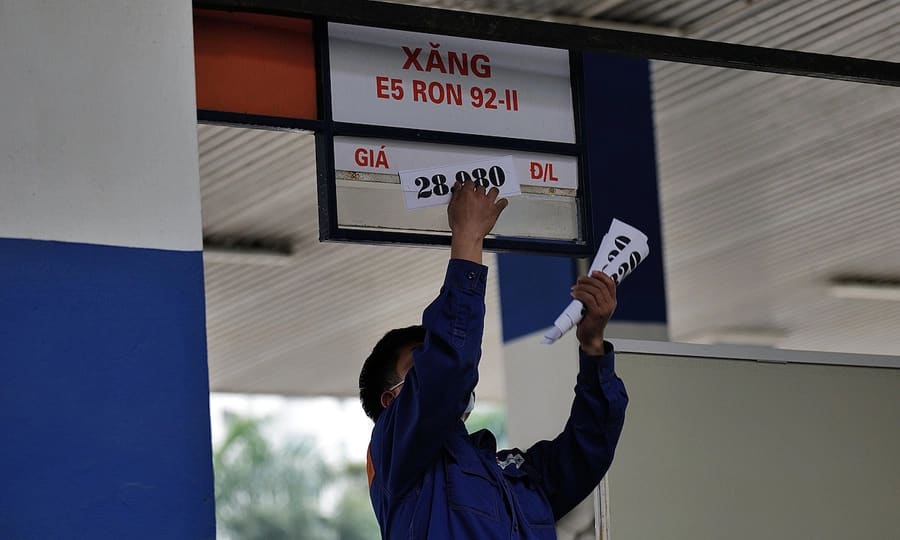
Fuel retailers across Vietnam implemented sharp increases Thursday afternoon, pushing pump prices to levels unseen since late May. E10 RON95 gasoline, the most widely used grade in the country, rose 6.6% to VND22,850 per liter. The biofuel blend E5 RON92 climbed 7.2% to VND22,380, while diesel saw a parallel 7.2% jump to VND27,620.
The adjustments mirror a broader upward trend in global petroleum markets. RON95 benchmark prices added 5% over the past week to reach $121.3 per barrel, while diesel futures rose 5.4% to $159, according to data from the Ministry of Industry and Trade and the Ministry of Finance. The increases come as escalating friction between the United States and Iran disrupts supply chains and rattles commodity traders.
Distribution Bottlenecks Surface in Major Cities
The price surge has coincided with visible supply constraints in Hanoi, Ho Chi Minh City, and several provincial markets. Diesel shortages have been particularly acute, with tanker trucks reporting wait times of three to four days at distribution terminals. Some retail stations have imposed volume limits on individual purchases, while others have shuttered temporarily due to insufficient inventory.
Tran Huu Linh, director general of the Agency for Domestic Market Management and Development, pointed to procurement disruptions caused by Middle East instability. Wholesalers have struggled to secure consistent shipments, compressing the buffer that typically cushions regional markets against sudden demand spikes.
Localized demand surges in certain provinces have further tightened the market, forcing wholesalers to ration allocations to downstream retailers. Linh noted that while national stockpiles remain adequate, the distribution network lacks the flexibility to respond quickly to geographic pockets of elevated consumption.
Speculation and Inventory Management
Officials have not ruled out the possibility that some market participants are withholding inventory in anticipation of further price gains. The practice, while difficult to prove, is a recurring concern during periods of rapid price appreciation. Diesel, which commands higher margins and is critical for logistics and agriculture, becomes especially vulnerable to speculative behavior.
Vietnam's petroleum sector operates under a hybrid model in which the government sets retail price ceilings but allows market forces to shape wholesale dynamics. This structure can create misaligned incentives during volatile periods, as distributors balance regulatory compliance with profit optimization.
Regional Context and Forward Pressure
Southeast Asia's fuel markets remain tightly linked to Middle Eastern supply routes and global refining capacity. Vietnam imports the majority of its refined petroleum products, leaving domestic prices sensitive to both crude oil fluctuations and refining margins. The recent uptick in benchmark prices reflects not only geopolitical risk premiums but also seasonal demand patterns as summer travel and industrial activity peak.
The diesel shortage carries particular weight for Vietnam's logistics sector, which relies on the fuel for freight transport across the country's expanding highway network. Prolonged shortages could ripple into supply chain costs for manufacturers and agricultural exporters, sectors that have been central to Vietnam's export-driven growth model.
For consumers, the increases represent the sharpest single adjustment in two months and add to broader inflationary pressures. Fuel costs feed directly into transportation expenses and indirectly into food prices, given the country's reliance on road freight for domestic distribution.
What Comes Next
Industry observers will be watching whether the current supply tightness eases as wholesalers adjust procurement schedules and regional refining capacity responds to higher prices. The government has historically intervened with price stabilization funds during periods of extreme volatility, though officials have not signaled imminent action.
The interplay between geopolitical developments in the Middle East and domestic distribution mechanics will shape the trajectory of Vietnam's fuel market in the coming weeks. For now, drivers and logistics operators are navigating a market marked by higher costs and uneven availability.
RELATED STORIES

Vietnam Ships 1.7 Million Tonnes of Coffee as Brazil Delays and EU Rules Reshape Trade
Tran Quoc Bao · 3 min
Chinese Brands Capture Vietnam's $92 Million Robot Vacuum Market
Siti Nuraini · 3 min
Southeast Asian Factories Adopt Proximity Planning to Retain Workers and Investors
Lim Hui Ying · 3 min

Five ASEAN Members Back Regional Oil Stockpile as Study Nears Completion
Tran Quoc Bao · 3 min
Spot something wrong? Email editor@briefasia.com. We log every correction publicly.