Asia · Trending
Vietnam Cuts Fuel Prices as Global Oil Markets Shift on Supply Expectations
Hanoi reduced retail gasoline and diesel costs Thursday, tracking a weeklong slide in international crude benchmarks driven by Middle East diplomacy and U.S. inventory builds
KEY TAKEAWAYS
- ·Vietnam cut E10 RON95 gasoline by 2.32 percent to VND22,320 per liter and E5 RON92 by 2.95 percent as global crude prices declined over seven trading days.
- ·International oil benchmarks retreated on expectations of easing U.S.-Iran tensions and rising U.S. crude inventories, lowering procurement costs for Southeast Asian importers.
- ·Vietnam's Deputy Prime Minister instructed the Ministry of Industry and Trade to monitor supply and prevent shortages after wholesalers rationed sales amid Middle East disruptions.
Price Adjustment Tracks Global Crude Decline
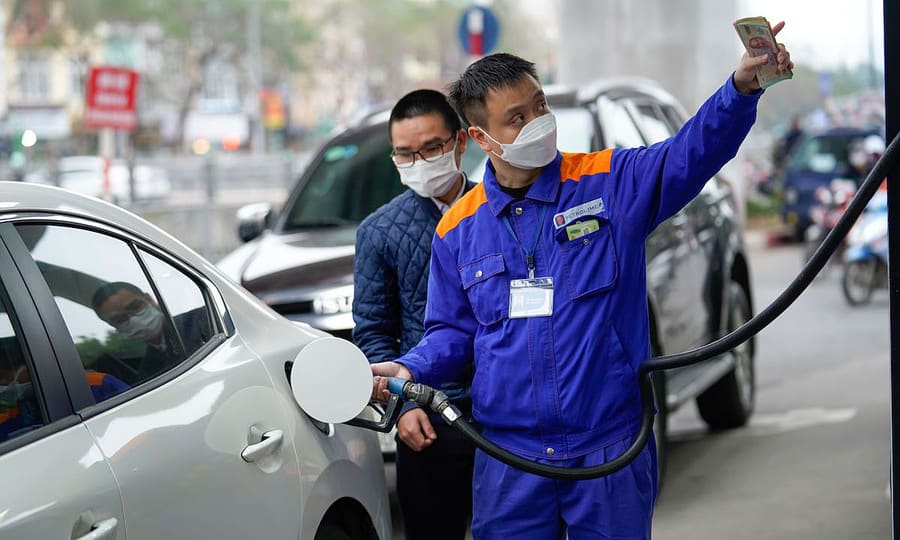
Vietnam's Ministry of Industry and Trade cut retail fuel prices Thursday afternoon, marking the first downward adjustment in three weeks. The widely used E10 RON95 gasoline blend fell 2.32 percent to VND22,320 per liter, equivalent to 85 U.S. cents. E5 RON92, a lower-ethanol variant preferred by older vehicles, dropped 2.95 percent to VND21,720. Diesel, critical for freight and industrial users, declined a more modest 0.29 percent to VND27,540.
The reductions mirror a broader pullback in international crude benchmarks over the past seven trading days. Brent crude, the reference price for much of Asia's oil imports, has retreated from recent peaks as traders recalibrate expectations around Middle East supply disruptions and rising stockpiles in the United States. The shift represents a rare moment of relief for consumers across Vietnam, where fuel costs directly influence inflation and household budgets.
Middle East Diplomacy and U.S. Stockpiles Drive Market Sentiment
Two developments have reshaped trader sentiment in recent sessions. First, diplomatic signals suggesting a potential de-escalation in tensions between Washington and Tehran have eased fears of supply disruptions in the Strait of Hormuz, through which roughly one-fifth of global petroleum passes. While no formal agreement has been announced, market participants have begun pricing in a lower probability of conflict-driven supply shocks.
Second, the U.S. Energy Information Administration reported a larger-than-expected build in domestic crude inventories, signaling weaker demand or improved production. The data has reinforced a narrative of adequate near-term supply, pushing futures prices lower. For Southeast Asian importers like Vietnam, which rely heavily on refined products from Singapore's trading hub and Middle Eastern suppliers, the combination of easing geopolitical risk and inventory accumulation translates directly into lower procurement costs.
Vietnam's petroleum sector operates under a regulated pricing mechanism, with the Ministry of Industry and Trade adjusting retail rates roughly every two weeks based on a formula tied to international benchmarks. The system aims to shield domestic distributors from abrupt swings while gradually passing global price movements to consumers. Thursday's cuts reflect the ministry's assessment that the recent decline in import costs warrants relief at the pump.
Regional Supply Pressures Complicate Distribution
Despite the price reductions, Vietnam's fuel distribution network has faced strain in recent weeks. Conflict in the Middle East disrupted procurement schedules for several domestic petroleum wholesalers, forcing them to tap alternative suppliers at higher spot prices. At the same time, stronger-than-anticipated demand in key industrial zones and coastal provinces has stretched inventory buffers, particularly for diesel used in manufacturing and logistics.
Wholesalers have responded by temporarily rationing sales volumes to certain retail stations, prioritizing contracts with large commercial customers and essential services. The measures, while short-lived, have raised concerns about supply continuity heading into the peak agricultural season, when diesel demand typically surges for irrigation pumps and transport of rice and seafood harvests.
Last week, Standing Deputy Prime Minister Pham Gia Tuc directed the Ministry of Industry and Trade to intensify monitoring of the petroleum market. The instructions called for a detailed assessment of supply, demand, and inventory levels across the country's six petroleum wholesalers, with a mandate to prevent shortages. The ministry was further tasked with ensuring that wholesalers secure adequate import commitments and maintain uninterrupted retail sales. A follow-up report to the Prime Minister's office is expected within the next fortnight.
Broader Implications for Southeast Asia's Energy Security
Vietnam's experience underscores a broader vulnerability shared by net energy importers across Southeast Asia. Thailand, the Philippines, and Indonesia all face similar exposure to global crude volatility, with limited domestic refining capacity relative to consumption. Recent disruptions in the Middle East have prompted renewed discussion among ASEAN energy ministers about diversifying supply sources and expanding strategic petroleum reserves.
Vietnam currently maintains a national reserve sufficient for roughly 30 days of consumption, below the International Energy Agency's recommended 90-day threshold for net importers. Expanding storage capacity requires significant capital investment and coordination between state-owned enterprises and private distributors. Some industry observers argue that Vietnam should accelerate negotiations with Russia and Kazakhstan to secure long-term supply contracts at fixed or capped prices, reducing exposure to spot market swings.
The broader energy transition also looms. Vietnam has committed to net-zero emissions by 2050 and is scaling up liquefied natural gas imports to replace coal in power generation. However, petroleum demand for transport and petrochemicals is projected to grow through the early 2030s, making short-term supply security a priority even as the government pursues renewable energy targets. Balancing these objectives will require careful management of import dependencies, pricing policies, and infrastructure investment.
Price Outlook Remains Uncertain
While Thursday's reductions offer immediate relief, the outlook for fuel prices in the coming months remains clouded by geopolitical and macroeconomic uncertainty. Any resumption of tensions in the Middle East could quickly reverse recent declines, particularly if supply routes are threatened or production facilities targeted. Conversely, a sharper-than-expected slowdown in Chinese industrial activity, a key driver of regional oil demand, could deepen the current downtrend.
Currency movements also play a role. The Vietnamese dong has traded in a relatively stable range against the U.S. dollar in recent months, but any depreciation would raise the local-currency cost of dollar-denominated fuel imports, offsetting gains from lower crude prices. The State Bank of Vietnam has intervened periodically to smooth exchange rate volatility, but its capacity to do so depends on foreign reserve levels and broader capital flow dynamics.
For now, consumers and businesses will welcome the respite. Transport operators, whose margins have been squeezed by elevated fuel costs over the past year, gain a modest buffer. Households, particularly in rural areas where motorbikes remain the primary mode of transport, will see a small reduction in daily expenses. Whether this relief proves durable will depend on forces largely beyond Hanoi's control, a reality that continues to shape Vietnam's energy policy calculus.
RELATED STORIES

Vietnam Pours Capital Into Laos as Vientiane Seeks Relief From Beijing Debt
Priyanka V. Rao · 4 min

Thailand Faces Two Decades in Middle-Income Trap Without Workforce Upgrade
Priyanka V. Rao · 3 min
AEON Vietnam Breaks Ground on New Shopping Centre in Phủ Lý
Tran Quoc Bao · 3 min
Shein Retreats From Vietnam Warehouse Bet as China Manufacturing Proves Irreplaceable
Cheng Wei-Lun · 4 min
Spot something wrong? Email editor@briefasia.com. We log every correction publicly.